Norway is looking to capitalise on the high demand for coldwater prawns. Jason Holland looks at one of the most important commercial species in the world.
While the overall supply of coldwater prawns is considerably less than that of its tropical cousins, the market isn’t any less dynamic. In fact, at a time when many of the leading warmwater shrimp producing nations are struggling to meet global demand because of disease problems, the coldwater prawn sector is positively thriving.
Commercially fished coldwater prawns comprise more than 10 species, including the northern prawn (Pandalus borealis), the brown shrimp (Crangon crangon) and the pink shrimp (Pandulus jordani), although the principle species is the borealis, which accounts for 70% of the total catch.
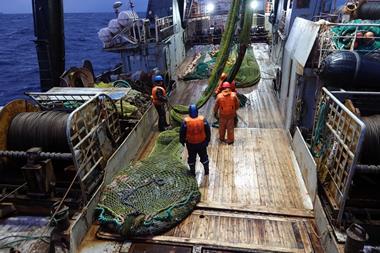
Making up around 10% or around 400,000t of the world’s total shrimp production, coldwater prawns are mainly caught using bottom trawls around the North Atlantic belt from Canada through Greenland, Iceland, Russia and Norway at depths of 100-700m.
These fisheries are extremely well managed and the gear used creates very little bycatch. Canada, the world’s biggest supplier of coldwater prawns, reduced its total allowable catch (TAC) in 2009, 2010 and 2011. Its quota last year was 134,534t. Meanwhile, Greenland, which is the number two supplier, has reduced its TAC to 117,400t this year. WF&A readers should note it will cut the total catch further in 2013 – to 90,000t – in line with its pursuit of Marine Stewardship Council (MSC) certification.
Norway received MSC certification for its Barents Sea borealis in April this year and Camiel Derichs, MSC deputy director Europe remarked that during the assessment of the fishery, the certifier found that the stock was in excellent shape, that exploitation levels were moderate to low and the impacts of the fishery on other species and the ecosystem in the Barents Sea were limited.
The certification applies to around 20,000t of prawns, which is approximately 80% of the fleet’s total catch. Norway was the second country, after Canada, to secure the eco-label for its coldwater prawns.
While the Barents Sea fishery is already certified by Friend of the Sea and KRAV, exporters have suggested the MSC status could also contribute to market price increases. Meanwhile, the cuts in the size of both the Canadian and Greenland catches should see the Norwegians gain market share this year.
Catch fluctuations
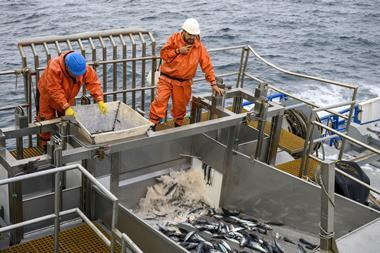
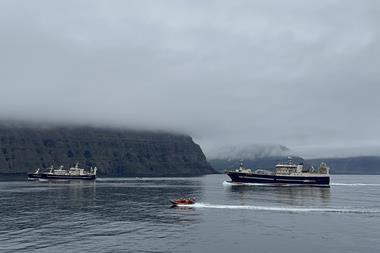
Norwegian coldwater prawn fishing is a year round industry, taking place along the Norwegian coastline and in the Barents Sea, with most landings between May and September. The prawns grow slowly in temperatures ranging from 0˚C-8˚C, which Norwegians claim give the shellfish their firm flesh and sweet taste. The stock is shared with other nations but the Norwegian fleet, which comprises 89 vessels, catches around 90% of the total catch.
Historically, Norway began offshore fishing for shrimp around 1970. Vessels from several nations entered the fishery thereafter and the catch in 1984 reached a high of 128,000t. The highest catch in recent years was in the year 2000 (83,000t) but catches since then have fallen.
Today, the Norwegian prawn fishery is regulated by effort control. Licenses are required for Russian and Norwegian vessels, and third-country fleets operating in the Svalbard zone are regulated by the number of effective fishing days and the number of vessels by country. The minimum stretched mesh size is 35mm and separating panels prevent a bycatch of undersized prawns, fish fry and small fish.
All catches from the Norwegian fishery are sold through electronic auctions. There are five auctions which handle sales of Norwegian shrimp, but Norges Rafisklag is the main auction house and has a central role in the sales process.
Both Norwegian and foreign fishermen sell their fish through this marketplace which is open for bids from Norwegian and foreign buyers.
Once landed, the shrimp is weighed and sales notes providing information on the type of species, size and weight are issued. Catch data is instantly reported to governmental bodies.
Landings in Iceland are made through the Surofi auction.
Increasing values
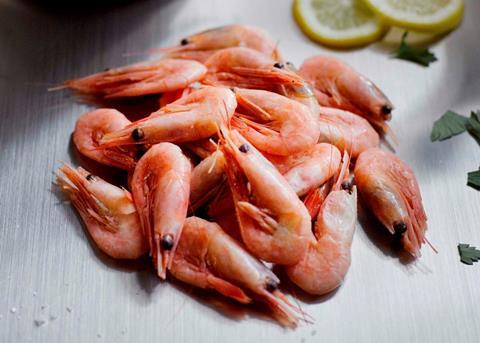
Coldwater prawns are usually traded in three formats: shell-on, cooked and peeled, and ready to eat. Cooked and peeled is the most common form found in North America and Europe. In fact, Europe consumes approximately 75% of the world’s production of cooked and peeled coldwater prawns, half of which is accounted for by the UK market, where the product’s sweet flavour and moist texture has made it the star ingredient of salads, sandwiches and prawn cocktails for several decades.
Overall, the coldwater prawn prices have been increasing by around 25% annually over the past two and a half years, largely as a result of the high demand for shell-on, cooked shrimp.
Sweden is Norway’s biggest market for coldwater prawns, explained Ove Johansen, market analyst prawns and shellfish with the Norwegian Seafood Council (NSC). He said Sweden imported 1,352t last year with a value of €9.4m ($12.2m).
The UK is Norway’s second largest market for coldwater prawn products. Last year it directly imported 704mt, valued close to €4m ($5.2m). Finland follows closely behind in third, importing 601t valued at €3.5m ($4.5m) last year.
All of these countries are expected to ramp up their imports this year and in so doing, further strengthen Norway’s position in the sector.
|
The Pandalus borealis
[Source: Seafish] |