



Icelandic innovation company Arcticeconomy is using artificial intelligence and extensive fisheries data to reshape fish stock forecasting and quota decision-making in Iceland’s commercial fishing sector.
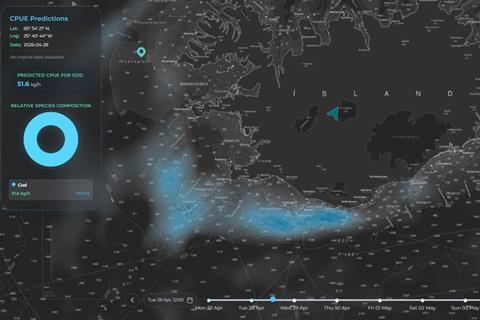
The company’s CATCH platform combines skipper knowledge, historical fisheries data and AI-driven forecasting to support fish stock forecasting and improve the evidence base for quota decision-making.
Developed by CEO Svanur Guðmundsson and data scientist and AI engineer, Altair Agmata, the system is designed to bridge the long-standing gap between fisheries science and operational experience at sea.
“We believe these methods can help fisheries science move into a more predictive and data-driven era,” says Mr Guðmundsson.
“This method can change how we calculate fish stocks, how we plan fishing activity, and how we forecast the future of the industry.”
Data-led modelling
The AI-powered fisheries technology platform uses neural network modelling trained on decades of fisheries data gathered from Icelandic fishing vessels.
According to Mr Guðmundsson, the system has analysed approximately 1.5 million hours of towing data dating back to 2000, alongside environmental and operational information including ocean temperature, currents and catch distribution.
Mr Agmata describes the platform as “the ChatGPT for fisheries forecasting”, explaining that while language models predict words, CATCH predicts fish distribution and catch hotspots.
The tool forecasts where fish stocks are likely to move and how species interact over time, allowing skippers and fisheries managers to make more informed decisions.
The technology has been developed to address limitations within traditional fisheries management systems, which Mr Guðmundsson said still rely heavily on methodologies established decades ago.
Current quota-setting approaches typically assess individual species annually, while CATCH is designed to support multi-species modelling and more dynamic forecasting.
The platform’s predictive capabilities could enable fisheries managers to assess stock movements years in advance, rather than relying solely on one-year outlooks.
Mr Guðmundsson says the long-term ambition is to support more responsive and science-based quota decisions by continuously updating fisheries forecasts using real-time data inputs.
Data integration
A key component of the system is its integration of operational fisheries data supplied directly from vessels.
Mr Guðmundsson says the fishing industry has historically struggled to have skipper observations recognised within formal scientific assessments, despite crews identifying changes in fish behaviour, migration and stock distribution long before official quota reviews.
By combining fisheries data with AI modelling, Arcticeconomy believes the industry can strengthen both sustainability and economic performance.It says that improved forecasting could help operators identify the best periods to target specific species, reduce unnecessary fuel consumption and improve catch quality through better timing and planning.
The platform also incorporates ocean temperature as a major predictive factor in fish stock movements.Mr Guðmundsson notes that temperature is currently underutilised within many global stock assessment systems despite its significant influence on species distribution.
Scientific grounding
The company has already published scientific work outlining its methodology, with research featured in an Oxford Academic special edition focused on biology methods and protocols.
Mr Guðmundsson says it is prioritising publication over patent protection in order to gain recognition and validation from the wider scientific community.
While the technology has generated growing interest, both Mr Guðmundsson and Mr Agmata acknowledge that industry adoption will depend on trust and collaboration between fisheries scientists, regulators and vessel operators.
“It’s all about trust,” Mr Guðmundsson says. “The knowledge of skippers can now be supported by scientific calculations and data that can be tested, compared and used in decision-making.”
Looking ahead, Arcticeconomy plans to expand the system into additional fisheries, including pelagic species, while continuing to increase modelling capability and data integration.
The company also sees significant international potential for the technology as fisheries worldwide face mounting pressure to improve sustainability, stock management and operational efficiency through advanced fishing technology and artificial intelligence.
CATCH will be presented at the IceFish 2026 exhibition, where digitalisation, sustainability and artificial intelligence are expected to play a growing role in discussions about the future of the seafood sector.
Visit Arcticeconomy on stand F51