



Countries across the Mediterranean and Black Sea have taken new steps to strengthen sustainable fisheries and aquaculture, with delegates at the 48th session of the General Fisheries Commission for the Mediterranean (GFCM) adopted 12 new decisions aimed at advancing science-based management, environmental stewardship, and compliance in regional fisheries.
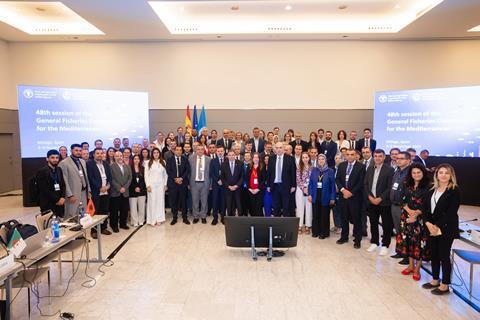
The meeting, hosted by Spain’s Ministry of Agriculture, Fisheries and Food and attended by 22 member countries and the European Union, also marked a milestone with Ukraine’s accession as the GFCM’s 24th contracting party.
Spanish Agriculture and Fisheries Minister Luis Planas opened the session by calling for deeper regional cooperation to “secure the future of fisheries and fishing communities, in which profitability and sustainability must go hand in hand.”
Bolstering compliance and traceability
Among the key outcomes was the reinforcement of GFCM’s compliance mechanisms, including improved monitoring, control, and surveillance (MCS) systems to tackle illegal, unreported, and unregulated (IUU) fishing.
The new framework will assess members’ data reporting and MCS performance, identify gaps, and guide remedial actions ranging from technical assistance to enhanced vessel monitoring system requirements.
A new requirement was also introduced for all vessels over 20 meters operating in waters beyond national jurisdiction to carry an International Maritime Organization (IMO) number, improving traceability and transparency.
The session also saw progress on several management fronts. A new harvest control rule for blackspot seabream in the Alboran Sea was adopted after eight years of scientific work, setting a long-term path to rebuild the stock.
In the Adriatic Sea, measures were agreed to reduce trawling effort on Norway lobster while increasing effort for beam trawls targeting sustainably fished common sole.
Meanwhile, multiannual management plans for giant red shrimp and blue and red shrimp were extended in the central and eastern Mediterranean, covering the Strait of Sicily, Ionian Sea and Levant.
In the Black Sea, scientific advice is now available for six of eight priority species, and the successful implementation of the turbot management plan was highlighted as a key milestone. Awareness campaigns have also expanded to address bycatch reduction of vulnerable species such as sturgeons and harbour porpoises.
The Commission also launched a new GFCM Network of Experts on Fisheries and Climate Change, which will integrate climate considerations into regional fisheries advice.
Progress in sustainable aquaculture
GFCM members endorsed measures to further strengthen aquaculture governance and environmental performance, building on the outcomes of the 2024 Regional Aquaculture Conference.
Two new resolutions were adopted — one introducing a harmonised environmental monitoring programme, and another promoting aquaculture zones for ecosystem restoration. Both are designed to boost environmental resilience and data-driven management.
The Commission also praised progress in coordination through the Scientific Committee on Aquaculture and regional demonstration centres, noting that aquaculture continues to gain importance as a sustainable food source in the Mediterranean and Black Sea.
Ukraine joins the GFCM
Ukraine’s official membership was widely celebrated as a “historic moment” for regional cooperation.
“Full participation in the work of the GFCM opens new opportunities for developing fisheries, aquaculture, and marine ecosystem conservation in the Black Sea,” said Taras Vysotsky, Ukraine’s Deputy Minister of Economy, Environment and Agriculture.
Ukraine had previously participated as a cooperating non-contracting party since 2015, contributing to stock assessments and management initiatives across the Black Sea.
The GFCM also elected a new Bureau for a four-year term, with Eyüp Mümtaz Tiraşin (Türkiye) as Chairperson, Francesco Saverio Abate (Italy) as First Vice-Chair, and Saber Alazabi (Libya) as Second Vice-Chair.
Outgoing Chairperson Roland Kristo reflected on the Commission’s progress since 2018, saying: “We’ve laid the foundations for long-term sustainability in our region. The GFCM is strong, focused, and ready for what’s next.”
The FAO body will next release its flagship report, The State of Mediterranean and Black Sea Fisheries 2025, on 28 November, providing the most comprehensive analysis yet of the region’s fishery and aquaculture trends, with contributions from over 700 experts.