Despite all the terrors of ongoing conflict, most Ukrainian fish producers have maintained their operations – not least because the population needs them to, learns World Fishing & Aquaculture
Russia’s shock invasion of Ukraine in late February has had an immense knock-on effect on the Ukrainian economy, with it set for an unprecedented 45% contraction in 2022. Furthermore, the brave Ukrainian resistance has come at great cost, and in addition to countless casualties, more than 8 million people have been displaced by the conflict, according to United Nations estimates.
Since many refugees are farmers who have fled the hostilities, leaving their businesses behind, the war in Ukraine has brought considerable concern relating to the war-torn country’s food security.
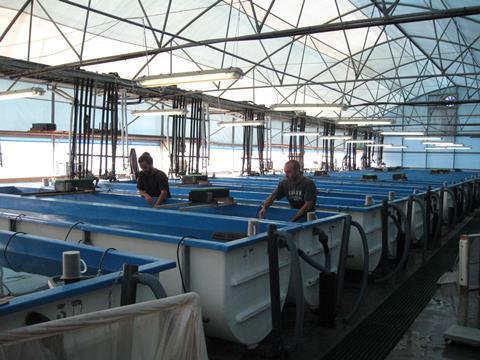
In the past few years, Ukrainian farmed fish production had stood at a level of around 20,000 tonnes per year, according to the most recent figures from the General Fisheries Commission for the Mediterranean. It’s also estimated that there were more than 4,000 registered fish farms in the country, the majority of which are small-scale systems with less than 30 tonnes of annual production.
Meanwhile, Ukraine’s per capita fish consumption is estimated at 15 kg per capita, with the domestic demand historically met by imports and wild fish catches, and to a lesser extent by fish farming. However, with imports remaining largely disrupted and fishing in the Azov-Black Sea Basin being pretty much impossible, aquaculture has begun to play an increasingly important role in the Ukrainian food system.
The majority of aquaculture facilities in Ukraine are freshwater pond-based farms for common carp (Cyprinus carpio), silver carp (Hypophthalmichthys molitrix), bighead carp (Hypophthalmichthys nobilis), grass carp (Ctenopharyngodon idella) and Prussian carp (Carassius gibelio). These species account for 90% of the total aquaculture production, the General Fisheries Commission reported.
Farming of other species – including European catfish and African catfish (Clarias gariepinus), pike, pike-perch (Sander lucioperca), trout, sturgeon and paddlefish – in pens, flow-through systems and recirculating aquaculture systems (RAS) had also been on the rise in previous years.
Shrimp farm mothballed
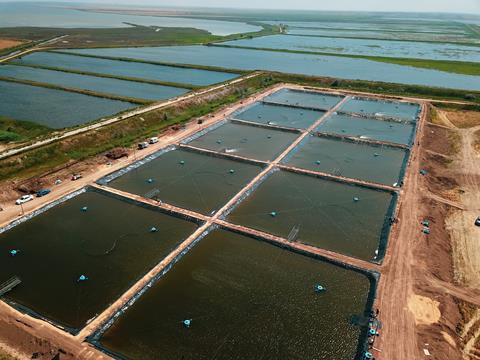
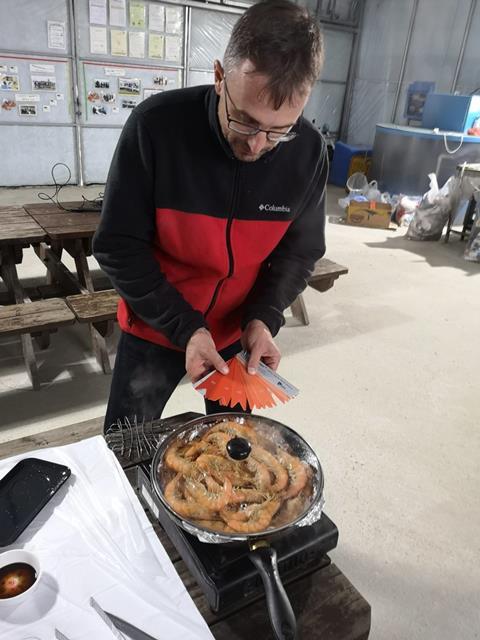
Despite the considerable need for Ukrainian aquaculture, the war is taking its toll on the sector. Merman’s, which is Europe’s largest land-based vannamei shrimp farmer, and probably the most high profile project in the Ukrainian seafood sector, was forced to shutter its production in March, owing primarily to a logistics crunch, said Lubomir Haidamaka, company owner of Vismar Aqua, which implemented the project.
Based in the Mykolaiv region and comprising a recirculating aquaculture system (RAS) farm with a designed production capacity of 500 tonnes, along with a hatchery, grow-out facility, processing area and feed mill, the farm was launched in late 2021. Unfortunately, operations lasted just four months before the Russian invasion forced its suspension.
Its final shrimp harvest was in fact passed to a charity supporting the Ukrainian people.
But while the farm is located in the nearest vicinity to the front line, unlike many other industrial facilities in the Ukrainian south it remains largely intact.
“No physical damage to the farm [has been made]. The Russian army was the closest – like 60 km away from the farm,” Haidamaka said, adding that he believes the war will not reach the production facility.
“The farm is located at a real dead end, so it would be really difficult for them to get there,” he said.
Providing that no damage is sustained, it will be rather easy for the farm to resume operations, Haidamaka remarked.
“It’s going to take about six months to get back to normal once the war is over,” he said, explaining that what the farm will need is broodstock and other imported materials.
Small-scale importance
To date, the traditional small fish farms in Ukraine have proven to be more flexible and capable of adapting to the new conditions and circumstances brought by the war.
In 2021, Ukrainian farmed fish production stood at 16,900 tonnes, according to official statistical data. And, as the Ukraine Institute of Fish Farming pointed out, some 30-50% of the production before the war was in the small-scale segment.
These farmers in particular have seen their role in Ukraine’s food security increasing, confirmed Mykola Pugachov, Deputy Director of the Ukrainian Institute of Agrarian Economics. As large industrial producers were driven out of business, it is these small farmers that have been left to fill the gap, he said.
Pugachov is therefore calling on authorities to issue urgent support to the small-scale farming segment.
“Nobody really discusses who has stayed to farm. But who are the ones who are farming right now in Ukraine, and what are they farming, who is managing the food security of the country? It’s the small farmers that are producing a lot of the foodstuffs that stay in the country and who are actually feeding the country,” he said.
Collateral damage
Nevertheless, it has been reported that some fish farms have been destroyed. For example, two large water reservoirs in the Kharkiv region – Oskol and Pechenezhsky – suffered heavy damage due to the fighting.
About 50 tonnes of fish per year was officially produced in the Oskol reservoir alone, although unofficially this figure was believed to be closer to 200 tonnes, while the regional administration estimated that the collapse of the dam most likely resulted in the loss of at least two-thirds of its fish stock.
One of the key problems Ukrainian aquaculture now has to deal with is a lack of personnel, as thousands of men and women have joined the armed forces and territorial defenses. Ukraine publication Zerkalo Nedely is among those to have reported that all fish farms in the Kyiv region have been experiencing staff shortages due to the war. And if the martial law drags on, it may affect fish production in the country, the newspaper said.
The Russian invasion has also largely disrupted fish farming in the Azov-Black Sea Basin. Most farmed fish production in Ukraine is concentrated in the Kherson, Mykolaiv and Odesa regions. Russian forces occupied Kherson in early March – one week after the invasion began. Prior to this, it had a population of 290,000, but according to its former mayor, some 40% of residents have since fled the city.
Dozens of fish farms in the territories occupied by Russian troops found themselves stripped from their partners and customers in the west. There is also a considerable lack of information regarding their current situation.
“As far as I know, some state fish farms in the Kherson region, which is occupied at the moment, continue their operations and recently managed to release some pike fingerlings into Dnipro River as part of the governmental programme,” Haidamaka said.
Independence is key
Meanwhile, in the territories free from Russian troops, fish farmers have managed to recover from the initial shock of the invasion. That said, they do face the considerable issue of sourcing feed, as import supplies have been largely disrupted by the sea blockade and the destruction of land-based transport infrastructure.
“Fortunately, there are no reports of the physical destruction of large feed factories yet. However, all feed factories, regardless of their size, have been affected by disrupted logistic chains,” commented Svitlana Litvin, an analyst of the Ukraine agribusiness club UCAB.
The Russian invasion of Ukraine temporarily paralysed feed imports to the country, but the industry has managed to bounce back in the past month, according to Igor Silchenko, director of the Ukraine feed additive distributor Agrofeed Ukraine.
Haidamaka explained that all freshwater traditional farms operating in the region of Azov-Black Sea have managed to maintain their operations as they are not as dependent on imports.
“They have to continue to do their job. Aquaculture is such a thing that you cannot stop doing it. Like any livestock operations,” Haidamaka said. Instead, they face the potential challenge of a slump in demand on the domestic market.
The picture is different for those farms dependant on imported materials such as feed and broodstock through to packing materials.
“They have experienced problems. And as far as I know, many stopped their growing cycles and have temporary shutdown their operations.”
On a more positive note, Ukraine fish farmers have a low dependence on processing infrastructure. The vast majority of domestically farmed fish like carp and catfish are bought by Ukrainian consumers unprocessed and whole. Indeed, according to industry estimates, between 80 and 90% of domestically farmed fish is sold live – in both urban and rural areas. This means that the problems currently experienced by fish processors are not hampering fish farmers.
Eyes on the horizon
Despite the extreme current conditions, Ukraine fish farmers continue to plan ahead – mulling new development strategies – while maintaining cautious optimism that the war will end soon.
“Yesterday, we met with a group of people who are interested in the development of aquaculture in the southern region of Ukraine and we’re thinking to start growing mullet in the [Dnipro] estuary. Still, [there are] many things to take care of, but I hope we can get some traction. All of us understand that we will have a huge deficit in the seafood market in Ukraine – now even in imported products, so we have to take care somehow and try to tackle that problem,” Haidamaka said.
There is no doubt that the future of the Ukrainian fish farming industry will be tightly linked to the outcome of the war, which currently has no end in sight. Discussing new development plans in the current situation doesn’t seem irrational, as almost everybody in Ukraine is confident that their country will eventually prevail on the battlefield.
“Everything is going to be alright. Ukraine will certainly win,” Silchenko offered.