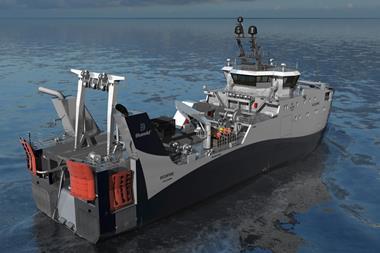



To better understand how alternative fuels, power systems and drivetrains could offer a fresh blueprint for fishing vessels and greener fishing operations, six new vessel designs have been created to identify critical barriers to achieving net-zero emissions. This work follows on from a Fisheries Innovation & Sustainability (FIS) -organised “Vessels of the Future” workshop, held in Glasgow in April 2022, in which UK fishing industry leaders and key stakeholders converged to discuss the opportunities and challenges associated with creating net-zero fishing fleets.
Following this meeting, FIS commissioned Macduff Ship Design, in collaboration with the University of Exeter’s Centre for Future Clean Mobility (CFCM), to ascertain the main obstacles to this goal, with a focus on three distinct vessel types. A second stage, supported by Marine Fund Scotland, focused on the development of the six concept vessel designs, based on the most viable clean fuel options identified in the earlier stage. These designs have undergone rigorous proof-of-concept validation to ensure feasibility and are set out in the FIS “Net Zero Vessels Concept Design Project” report, published in August this year.
According to Duncan Boag, Naval Architect at Macduff Ship Design, the concept designs provided for the report represent a feasible way for fishing vessels to transition away from diesel to a net-zero alternative. He also explained that while Macduff ensured all the designs are viable from a development perspective, the report highlights the significant challenges facing this transition.
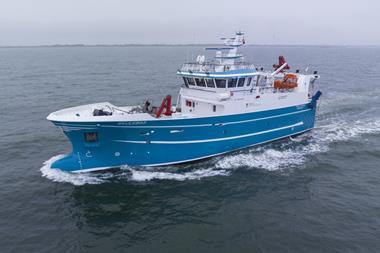
Two concept designs are presented for each of the following vessel types: under 10-metre creel boats, 15-metre nephrops trawlers, and under-24-metre whitefish trawlers. These designs are tailored to use some of the most promising alternative fuel options – battery electric, methanol, and liquified natural gas (LNG).
The FIS report also finds there’s a need to address technical, regulatory, and financial barriers before widespread industry investment and adoption becomes viable, which technical challenges include equipment availability and the development of the critical underpinning infrastructure for alternative fuels. It adds that regulatory compliance remains a concern but anticipates smoother interactions with regulators as understanding relating to zero-emission vessels accumulates, while on the financial side, increased capital costs and uncertainties surrounding fuel prices require careful consideration and remain a significant challenge for the sector.
Making business sense
Explaining the reasons for the work, FIS Executive Director Kara Brydson told WF that as a coalition of experts driving innovation for a prosperous and sustainable UK seafood industry, FIS felt it was important to look at the vessels of the future.
“We must prepare and plan together because the UK fishing industry is being asked by governments, customers and consumers to show in practical terms how it is reducing [its] reliance on diesel. It’s also true that we’ll need to respond to the availability and affordability of diesel as other industries transition to alternative fuels. And of course, fishing businesses are providers of low carbon food as part of a modern, carbon-conscious seafood industry.”
Brydson said the new designs help further the understanding of how using alternative fuels, power systems and drivetrains could replicate the capabilities of three different existing diesel-powered fishing vessels.
“As well as these technical insights, the designs also help us identify the regulatory and financial barriers that might prevent the uptake of each technology by the UK fishing industry. Of course, there are other fuel possibilities to consider, and FIS is now building our portfolio of designs with a focus on hydrogen.”
Brudson said the report’s findings indicate that vessel owners trying to do the right thing in switching to alternative fuels will, for the time being, be at a critical disadvantage competing in a market with diesel vessels. She added that the enabling architecture – such as ports and harbour infrastructure, fuel supply chains, vessel finance packages, and skills and safety training – must be established before these designs can become a reality.
“As Duncan Boag, the author of the report, says, the first net zero fishing vessels won’t be as commercially competitive as existing diesel vessels. All fuel alternatives are currently more expensive than diesel in terms of capital costs and, aside from electric options, operational costs,” she said.
“Transition must make business sense for fishers, who must be supported to make informed financial decisions to remain competitive while making progress towards net-zero. Early adopters of the new technology need advice and funding, and in return UK regulators and others can learn from these pioneers.”
The report also identifies potential next exploratory steps to further progress on the road to net zero fishing vessels, including a review of harbour infrastructure, the investigation of retrofitting options for existing vessels, and the use of the concept designs to build a demonstration vessel.
“It does feel like a big step to have these first detailed designs, and I’m grateful to Macduff Ship Design, and all our partners who have made it happen. But of course, it comes with trepidation about what is required to take the next leap forward,” Brydson said.
“The designs show in black and white, quite literally, that in most cases, net-zero vessels would have to be larger to match the operation of an existing diesel vessel, which would significantly increase capital costs and crew requirements. Not only that, but ports and harbour infrastructure, fuel supply chains, vessel finance packages, and skills and safety training all need to be in place before these designs can become a reality.”
Tough transition
FIS and Macduff Ship Design displayed the new designs at the Scottish Skipper Expo in May this year, and Brydson said that had the accompanying message been “this is easy”, she doesn’t think she would be able to show her face again.
“But because we’ve been clear that it’s certainly not easy, but that we can work together to support a practical, safe and truly just transition, and of course skippers are always ready to discuss ways to reduce fuel costs and increase efficiencies. It’s also important to recognise that fishers are the ultimate innovators, and some skippers are already have positive experiences with their own conversion projects.”
Brydson also said she’s excited that meeting the net-zero challenge head-on could attract a new generation of technology- and climate-savvy fishers – through innovative short courses, and new courses focussed on the future of fuels, while a framework of certifications around alternative fuels and transferable between maritime sectors could attract and retain crew that are highly skilled and ready for the changes ahead.
With regards to the level of interest in the UK’s commercial fishing industry to transitioning to net-zero operations, she said that some of the most useful conversations have been about why we need to think about this shift now, rather than sitting back and watching other sectors do it.
“This would risk other industries pushing technology and infrastructure in a direction that doesn’t suit fishing vessels, which then become utterly compromised on design and operation,” she said. “FIS has a mantra – nothing about us without us – meaning that any innovation in seafood has to have fishing businesses at the heart of decision-making right from the start. We must ensure that port infrastructure, access to fuels, training provision, finance packages are all fit for purpose for the UK fishing industry.
“It can feel overwhelming to try to fit all the pieces of the alternative fuel jigsaw - high costs and low availability, safety, space and storage, MCA approvals… The fishing industry needs cross sector finance, planning and support to navigate this new world. What is wonderful is that hubs like the Seafish Vessels of the Future Forum mean that no one has to grapple with the puzzle alone.”
Next steps
With FIS members including the likes of Sainsbury’s, M&S and Young’s Seafood, there’s strong support from the supply chain, confirmed Brydson.
“I always say that FIS has hit the jackpot when it comes to the knowledge and expertise in our membership. Of course, members support the industry in playing its part in achieving net-zero targets, while understanding that rapid or ill-considered changes in vessel design or infrastructure could create skills deficits both offshore and onshore,” she said. “FIS members champion innovation to make the greatest positive change for the UK seafood industry and the people driving it, and that feels especially true for our vision of vessels of the future.”
Alongside the report, FIS last year asked pelagic skipper and marine engineer James Duthie Jnr to travel to Norway to meet key players in the country’s vessel sector, and to consider how their net-zero know-how could be applied to the UK fishing fleet. Meanwhile, FIS and the Fishmongers’ Company recently joined forces to launch an international Fisheries Exchange Programme.
Exchanges can be to and from anywhere in the world, and fishing vessel decarbonisation is one topic that will be prioritised, Brydson said. “We welcome applications from individuals and organisations that work in, or support, the fishing and seafood industry. Funds will be awarded up to GBP 8,000 per project.”
As for the next stage of the net-zero vessels project, she said that “until someone bites the bullet” and builds or retrofits a net-zero fishing vessel, it’s all just talk.
“We need proof-of-concept fishing vessels reflecting types suitable for our fisheries, as this is the only way to understand the costs, skills, capacities, consents and infrastructure required to retrofit and rebuild a modern UK fishing fleet. Until we, collectively, are in position to do that, FIS and Macduff Ship Design are looking at vessels working on hydrogen, ad also embarking on an ambitious data collection project to help vessel owners make informed choices about a safe and prosperous transition away from diesel.”