
Corvus fuels world’s first zero-emission fishing vessel
Bergen, Norway-headquartered Corvus Energy has been selected by Hvide Sande Shipyard in Denmark to supply a complete hydrogen fuel cell system for the new fishing training vessel MS Skulebas.
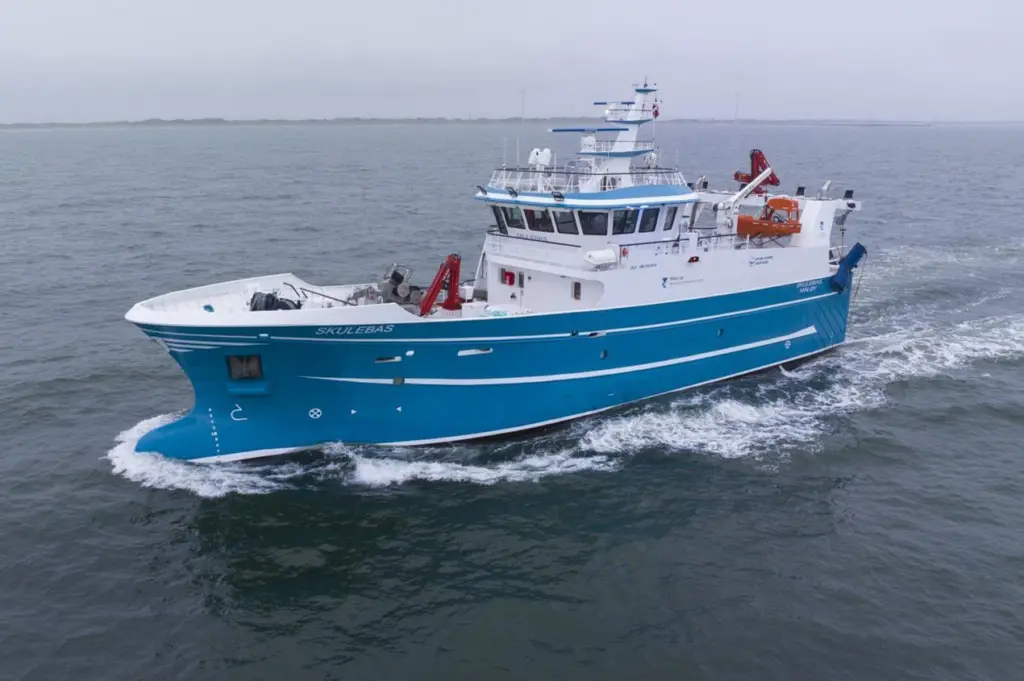
The 35-metre Skulebas has had the latest technology and commercial fishing systems installed and is intended to set an example of innovation and cooperation within the maritime and education sectors. The vessel, which is owned by Vestland County in Norway and operated by Måløy Upper Secondary School, is the first of its kind – combining both fuel cells and batteries in a fishing vessel.
Skulebas was delivered by Hvide Sande Shipyard at the end of June 2023 as a battery hybrid vessel and is now in full operation with students onboard. When the 2023/2024 school year is complete, the vessel will return to the shipyard for the installation of the new fuel cell system.
Corvus’s Pelican Fuel Cell System was developed through the three-year H2NOR project. It builds upon technology from global fuel cell leader Toyota. It is the only marine fuel cell that’s designed to fully comply with the “gas-safe principle”, meaning it can be placed anywhere onboard a ship without additional safety systems.
A company spokesman told WF the system was developed with the recognition that not all vessels cannot be made zero-emission on batteries alone.
“To travel longer distances we need to carry clean fuel and fuel cells to transform the fuel into electricity. We were starting up a study to look at fuel cells when Toyota came to Corvus and wanted us to be their route to market. This was the start of the project and the background for our Inherently gas safe fuel cell. We found the PEM Fuel Cell to be the most mature technology, and with Toyota we have a well proven product that we have integrated into a maritime solution.”
Important milestones
Corvus will deliver a 340-kW PEM fuel cell system for Skulebas and Hexagon Purus will deliver the Hydrogen storage solutions. The hydrogen fuel cell system is scheduled for delivery in the second-quarter 2024 and will be in full operation in the following quarter.
Corvus Energy CEO Geir Bjørkeli said this installation will be another big milestone for Corvus. “Adding the Pelican fuel cell to the energy system onboard will make this the first zero-emission fishing vessel in the world. Skulebas will play a pivotal role in showcasing the feasibility, efficiency, and environmental benefits of fuel cells within the maritime industry, furthering the transition to decarbonize all vessels.”
Bjørkeli also praised Vestland County for its forward-thinking. “Vestland County was the first to invest in all-electric ferries back in 2014, and since then it has become a pioneer and global example with 19 out of 25 ferry routes being all-electric. This demonstrates that policy works, and we believe that today´s milestone will be the start of the same journey for hydrogen fuel cells as it was for batteries.”
Skulebas is already equipped with Orca batteries from Corvus Energy which will work together with the Pelican Fuel Cell System. Corvus explained that combining these two technologies gives “the best of both worlds” and significantly extends the range of zero-emission operations.
“Adding our inherently gas-safe Pelican Fuel Cell System will enable the vessel to conduct the majority of its operations fully-electric, producing zero emissions, supplemented by clean hydrogen-powered energy when needed,” Corvus EVP and Project Director of Fuel Cells Kristian Holmefjord said.
Vestland County’s mayor Jon Askeland is excited that the first hydrogen/electric hybrid fishing and training vessel will be operated by the Måløy school.
“A unanimous county council decision supported the need for this vessel. It will play a vital role in attracting and educating the future workforce. Investing in this project is one of the most forward-thinking uses of our funds, and it equips us to advance the fishing industry into a new era with evolving demands for more sustainable fishing methods, environmentally friendly propulsion, high flexibility, and above all, a high level of safety for all on board. Therefore, it is very gratifying to also introduce a cutting-edge hydrogen installation on the vessel,” he said.
‘Powering a clean future’
Corvus told WF the company is seeing increased interest in zero-emission solutions, but this largely depends upon type of fishing and size of vessel.
“The largest vessels are focusing on solutions to reduce the emissions and to have part of operations as maneuvering to harbour and harbor stay as zero-emissions, while smaller fishing and aquaculture vessels are more interested in complete operations as net-zero,” the spokesperson explained.
With regards to what the net-zero solution could mean for commercial fishing companies in the longer-term, Corvus said the Skulebasproject will prove the possibilities offered by combining fuel cell and battery systems.
“The range of sizes and requirements for fishing vessels make it difficult to have one solution for all, but if this can open for some owner to take the step to zero-emission and for other to reduce the emissions, we find both very important on the way to powering a clean future,” the spokesperson said.
Corvus also confirmed it has many projects in the pipeline for battery systems, and some interesting projects for fishing and aquaculture vessels with fuel cell and battery systems.
“It will be important to increase the availability for hydrogen around the coast before more companies the step to invest in this technology,” the spokesperson added.