



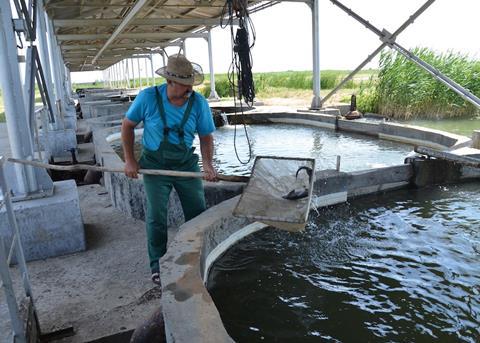
The Kazakh government has adopted a bold aquaculture development programme, aiming to boost domestic fish production from the current annual figure of 7000 tonnes to some 270,000 tonnes by 2030.
The new programme is set to change dramatically the face of the Kazakh fisheries sector. Annual domestic fish consumption is expected to jump from 67,000 tonnes to 134,000 tonnes, and the anticipation is that exports could quadruple from 30,000 tonnes to 134,000 tonnes, according to government sources. New large-scale hatcheries will be required and fish processing capacities will have to be significantly expanded to serve the needs of such a growing industry.
Implementing these plans would require an unprecedented 541 billion tenge in investment ($1.3 billion), which makes this programme the most costly aquaculture development campaign to be proposed in the former Soviet regions.
Private investors could contribute 345 billion tenge ($800 million), and the government has expressed its readiness to provide the rest. This is proposed for a variety of subsidies for both new and existing projects, as well as establishing relevant infrastructure, according to the country’s Minister of Ecology, Geology and Natural Resources Magzum Mirzagaliyev, presenting the new programme in the Kazakh Parliament.
For instance, the government rolled out plans to build four large-scale feed mills in different parts of the country, with an overall design production capacity of 400,000 tonnes of fish feed per year.
“The most important factor in the fish farming industry’s successful development is subsidies provided right from the start. Today, state support measures are envisaged for purchasing feed, machinery, and equipment for fish farms, but in our opinion, shared with business, these [state support measures] need to be expanded,” Mazgum Mirzagaliyev said.
The government makes no secret that it is gambling largely on foreign investors. By 2030, Kazakhstan aims to become a major fish exporter, selling farmed fish worth around $330 million per year to foreign customers. In government officials’ opinion, this fact makes the expanding Kazakh aquaculture very attractive to foreigners. China is seen as the largest potential market, importing fish worth $14 billion per year, the Kazakh government stated in its introduction to the programme. Consquently, this means that China could where investors are most likely to be found.
The new subsidies are required for one additional key task, namely push all farms to register their businesses correctly, as the authorities suspect that not all farmed fish in the country actually makes it to the official statistical data.
“Subsidies would prompt lakeside farms to come out of the shadows, and so to realistically assess the production capabilities of the fish farming industry,” said Kazakh Agriculture Minister Saparkhan Omarov.
There are varying estimates on how much fish is actually produced in this shadow segment, but the authorities remain confident that making the fish farming industry in the country fully transparent would help ramp up the official production figures.
Kazakh fish farmers are confident the programme is entirely realistic. The chairman of the board of the Scientific and Production Center of Fisheries LLP, Kuanish Isbekov, for instance, said he anticipated that the production could grow even beyond the declared goals.
“In theory, the country’s fish farming production potential is around 600,000 tonnes, with the main share of more than 80% on the water area of the central Caspian Sea in the Mangistau region, where Caspian salmon and sturgeon species can be grown using cage farming technology. In this way, we would not only raise export potential but would also achieve import substitution,” Kuanish Isbekov said.
Skepticism
However, there are still weak points in the upcoming programme. The cost of feed remains a factor of considerable concern, as this determines production costs and therefore the profitability of the Kazakh fish farming industry.
According to Rausahn Khamitova, director of fish farming company Caspian Riviera LLP, the price of imported feed in Kazakhstan today is comparable to the price of fish. This means that without state subsidies on feed, growing fish in the country would be unprofitable.
“There are several companies producing fish feed in Kazakhstan, and we tried to switch to domestic feed, but its quality is poor. Fish frequently become ill and, in the end, it turns out that expensive feed is cheaper,” she said, adding that feed has to be a cornerstone of industry development.
“Even taking into account very high subsidies, feed is expensive, and it is necessary to encourage production of high-quality domestic feed.”
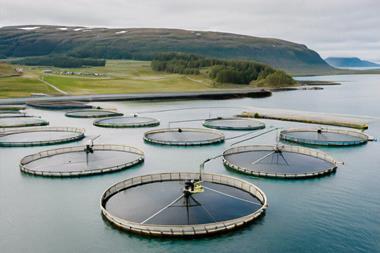
Caspian Riviera LLP has been raising sturgeon for five years in closed water supply installations and tried flow systems and cage farms. Despite the problems with feed supply, the company plans to participate in the upcoming industry development programme.
“Currently, we are planning to build a plant that would involve a complete cultivation cycle, as well as a full cycle of practically waste-free food production,” Rausahn Khamitova added.
There are still legal obstacles for Kazakh farmers for establishing farms in the Caspian Sea, near the coast. According to Rausahn Khamitova, it is virtually impossible to establish a fish farm in the sea without breaking the law. The authorities have been promising to withdraw existing administrative barriers, some of which are outdated Soviet regulations that make little sense, hampering the industry’s development. Still, so far, almost nothing has been done.
Kazakhstan imports not only feed but also all kinds of equipment and broodstock. This makes production costs in the industry rather high and raises questions about whether the declared export goals could actually be beaten.
The government estimated that on sturgeon, Kazakhstan has 66% self-sufficiency on broodstock. On carp, this figure is 12%, while for all other fish species, this figure is as good as zero. To improve supply, the government has pledged to establish a network of hatcheries and breeding centres. However, no concrete details have been yet announced.
High import dependence on almost everything means that practically all farmed fish in Kazakhstan is more expensive than in neighbouring countries. For example, the average price of tilapia is 1500 tenge ($3.5) per kg, which is 20% higher than in China. Taking logistics costs into account, local analysts warn that almost all farmed fish would be uncompetitive on the Chinese market.
In addition, the Kazakh government is notorious for embarking on major development programmes, which have little hope of reaching fruition. The most recent example is the beef export development programme. In 2011, the government rolled out a programme similar to the one recently approved for the fish farming sector.
Pumping nearly $200 million into cattle breeding, the Kazakh government hoped to become the biggest beef exporter in CIS, selling 180,000 tonnes per year to overseas buyers by 2020. However, in reality, export last year was limited to 5500 tonnes, plus the country continues to import beef. Inadequate quality feed rations and complete dependence on imported genetic and breeding material have been blamed.
There’s a good chance that this story could repeat itself in the coming decade.