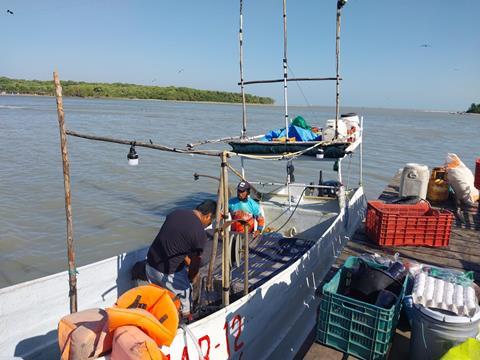



A new, groundbreaking certification scheme designed specifically for small-scale fisheries (SSFs) is looking to help unlock market access, drive sustainability and deliver greater value to coastal communities. Dubbed “Community Catch”, the initiative aims to overcome the high costs and complexity associated with other fishery certifications by offering an affordable, flexible and digitally-supported pathway that’s tailored to the unique realities of SSFs – which account for around half of the world’s fish catch and over 90% of its fishers.

Officially unveiled at Seafood Expo Global in Barcelona in May 2025, the scheme also offers a lifeline to fisheries that are at the risk of slipping through the net when it comes to buyers and end-markets, explained Chair of the Board of Trustees at Community Catch, Dr Andrew Hough.
Founded by a small group of industry experts and being led by CEO Linda Wood, formerly head of seafood sourcing at Marks and Spencer (M&S), Community Catch is open to all small-scale fisheries, regardless of target species or fishing gear.
“We have a standard that is designed to be directly relatable to small scale fisheries…From the outset, we wanted to create something that made economic sense for them. Something where they could pay an amount of money, get an evaluation, hopefully a certification, and they would benefit from it – with value brought back to those organisations and communities,” Hough said.
Ensuring the scheme is affordable and accessible was crucial, he added. “Having these fisheries slip through the net because of cost is the last thing we want. Instead, we want these fisheries to thrive and to keep these communities going. That’s our position within the marketplace.”
Self-assessment solution
Work on the scheme began in 2020, Hough explained. With some funding secured, the process of creating a standard aimed specifically at SSFs that’s both environmentally sustainable and socially responsible, involved extensive consultations, 14 pilot tests, and five deep dive tests, he told WF. Today, the standard includes requirements on target stock sustainability, fisher health and safety, biodiversity, fishery management, labour rights, fish welfare, climate change and community development. At the same time, a digital platform has been created to support the fishery self-assessment, verification, improvement and certification processes.
It’s the self-assessment element that especially sets Community Catch apart from other standards from a practicality perspective and which makes it much more accessible to SSFs, commented Hough, who has spent a large part of his career developing standards and processes in the fisheries space. Alongside answering specific questions, these self-assessments require the uploading of verifiable supporting evidence for the questions provided. Amongst other things, this can include interviews with skippers, vessel photographs and videos, and also relevant published reports.
“Thanks to the technology that’s now at our disposal, self-assessments and remote CAB evaluations make certification a lot more affordable because they take out the expense of flying several people – assessors – around the world to ask the same questions we’re asking. Instead, we have auditors working remotely, looking through the information submitted in the self-assessment, and then going back to the client if they need to know more.”
With regards to the environmental criteria that fisheries must meet to achieve Community Catch certification, it was decided at the very beginning that the standard should aim to be aligned with the Global Sustainable Seafood Initiative (GSSI) public-private partnership, which aims to create a more sustainable seafood supply chain through a common, consistent benchmark tool for all seafood certification schemes.
With GSSI regarded as essential by many of the world’s leading seafood buyers, Community Catch is in the process of applying for GSSI recognition, Hough confirmed.
Meanwhile, on the social side – to protect fishers’ rights and to promote decent working conditions in the sector – it has incorporated relevant elements and stipulations of the Sustainable Supply Chain Initiative (SSCI) and International Labour Organization (ILO).
Pathway to progress
Support is also provided to fisheries that may not initially meet all certification requirements, with the scheme built to recognise fisheries that are improving. For these, it will typically specify a time frame to deal with any highlighted issues.
Flexibility is key to this process, highlighted Hough. “Depending on the number of issues that need to be dealt with, we give flexibility as to what they deal with first, knowing that in small-scale fisheries, resources are probably going to be stretched – they may only have so much time or so much money available. Ultimately, we’ll still need them to get those things dealt with within a period of time and to the level of the Community Catch standard, and we will support as much as we are able.”
Part of this will see a database of assistance providers made available through the Community Catch website. This platform will also provide fishers, fisheries, supply chain members, supporters and funders with access to free materials and resources to support their efforts.
“We don’t want people to get stuck. So, while we can’t tell these fisheries what to do – because we’re the standard setter – we are able to provide names and details of groups or individuals that could be in a position to help them with whatever problems they’re having. We are trying to make the website, and the Community Catch programme, as helpful as we possibly can, because this is where improvements come from. This is where things change.”
Community Catch has also signed a memorandum of understanding (MOU) with FisheryProgress, a one-stop shop for information on the progress of global fishery improvement projects (FIPs), whereby participants in the Community Catch programme that have been through a Conformity Assessment Body (CAB) fishery assessment and are deemed to be improving will be recognised as such on both parties’ websites. The hope is this corroboration can in turn be acted upon by seafood buyers.
For supply chain enterprises that are buying and selling or processing seafood derived from a Community Catch certified fishery or one engaged in its improvement plan, the initiative has developed a membership scheme, the purpose of which is to ensure chain of custody from the fishery client to the final point of sale and to also safeguard SSFs.
Membership costs are tiered according to value of all seafood sales of those companies, with early supply chain supporters including M&S, Migros, Woolworths, Worldwise Foods, Fish4Ever and Abalobi.
“We’ve spoken with many retailers and buyers across the world to gain support and recognition of what we’re trying to do. Most recognise what we want to do and fully appreciate the need and the way we’ve gone about delivering it,” Hough said.
“I think the certification landscape is very different today. The demand is there, people want certification, many want to source product from SSFs, and they are recognising what we’re doing. We hope that one of our big challenges in the coming years is going to be coping with that demand and what could be a rapid growth phase.”
The immediate focus, meanwhile, will be on spreading the word of Community Catch throughout the SSF space and building its network of global fisheries and members, he said.