



While around 2.7 million tonnes of Atlantic salmon will be produced through aquaculture this year, less than 1% of that volume will come from land-based farming systems. Nevertheless, there’s still a lot to get excited about, according to Jacob Begnballe, Sales Director Land Based, Global & Grow-out, AKVA Group.
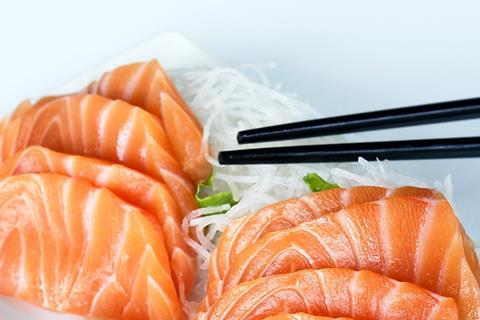
The €300-million turnover aquaculture technology company specialises in delivering solutions for many of the world’s leading salmon producers – both sea-based and land-based. While sea-based farming accounts for the lion’s share of AKVA’s business, there’s justified growing global interest in land-based systems, Begnballe confirmed at this year’s Seafood Expo Global (SEG) Conference in Barcelona.
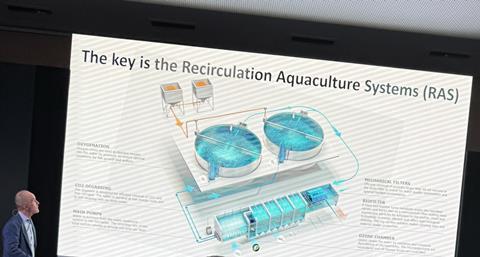
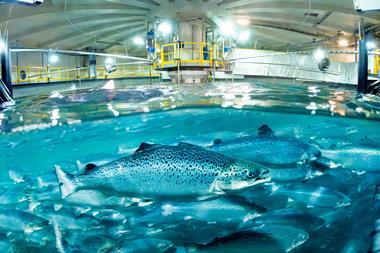
Pointing to Nordic Aqua Partners, which is now producing salmon on land at its new Phase 1, 4,000-tonne capacity recirculating aquaculture system (RAS) facility that AKVA helped build in Ningbo, China, Begnballe said the sector has proved it can be a success.
This fish is being sold under the Nordic PureAtlantic brand to the growing Chinese market.
“A lot of other people have got the same idea as Nordic Aqua Partners: They want fish farms, and they want to grow big fish – big salmon – on land. There are actually 150 different companies involved in the financing and construction on land of 75 facilities, and together, they’re aiming for total production of almost 3.5 million tonnes of salmon, which is more than this year’s production of 2.7 million.
“The first critical comment from me is it’s never going to happen. It’s not going to be 3.5 million tonnes on land. We still have enormous resources at sea, and that will still be superior when it comes to it. It may be 100,000 tonnes. Maybe in the future, one million tonnes, but we will certainly not see it superseding the sea farms.”
Supplementing at-sea production
What land-based salmon farming is, is a supplement to the at-sea production, Begnballe said, highlighting that most of the aforementioned projects are situated in areas of high-density populations. These investments fall into three different system categories: flow-through systems (FTS), hybrid flow-through (HFS) and RAS, with the Boston Consulting Group (BCG) estimating there are 275 FTS projects planned, 325 HFS and 1,800 RAS.
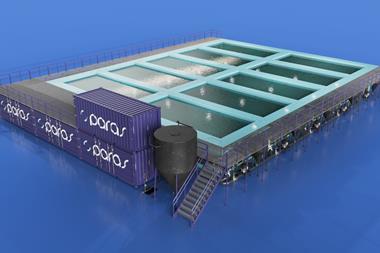
While expensive, RAS’s main attribute and what’s especially attracted investor backing is that these systems – essentially, fully-controllable production environments – can be put anywhere, he said.
“The project in China shows you can do it. There’s limited water consumption, optimal water temperatures, optimal oxygen saturation, fully controlled conditions, easier production planning because you know how fast your fish will grow. You also have high biosecurity because it’s close containment, and it is environmentally-friendly, especially if you reuse the sludge for fertiliser or biogas. We believe RAS is the way to go, and a lot of our clients believe it’s the way to go too.”
Begnballe continued: “Also what we do today is we grow salmon in net pens at sea, and then we fly it to China and other consumers. This results in a lot of CO2 emissions. So why not build the farms next to the big cities? Why don’t we just have it all on land, in fish tanks, until the salmon are five, six or seven kilos – that’s what’s being done by Nordic now – and then they just truck it to market.
“And when you sell your salmon at seven kilos, the extra price you get is worth growing it from four or five kilos. That’s why you do it. And if you can, why not?”
With Phase 1 expected to supply 3,000 tonnes of 7kg salmon this year, Phase 2, which is currently under construction, is expected to lift this volume of big fish to 6,400 tonnes in 2026.
Phase 3 of the Ningo expansion will eventually take the facility’s capacity up to 12,000 tonnes. This is currently at the design and engineering stage.
An increasingly attractive proposition
The case for RAS is further supported by the high market demand for salmon and an underlying supply gap created by the growth constraints seen with conventional at-sea farming. Indeed, the scarcity of suitable grow-out locations, strict government regulations, environmental concerns and productivity challenges expected to limit supply the supply growth to just 2-3% CAGR by 2030, Begnballe said, adding that at the same time, demand is likely to remain strong, keeping salmon prices high and estimated to grow an average 7% per annum.
But, and again quoting BCG analysis, he remarked that despite the strong interest and significant funding for marquee projects over the last 5-10 years, the predicted ramp-up of land-based salmon farming has been delayed, with “immature technologies” and a lack of competence and experience causing operational challenges, while the funding needed for further scaling has “dried up”. Additionally, the slow granting of permits by governments further slowed progress, particularly in locations without conventional production.
“Yes, there has been a struggle to get [the land-based sector] up. But what we actually see now is that projects are being state-authorised, and that’s very positive. And I would say from our company’s side, we believe that we have the technology to prove it.”
As for how much land-based production systems cost, Begnballe said the BCG report “The Inflection Point: Outlook for Land-based Salmon Farming” estimates the CAPEX per kg produced of FTS to be around €10 per year, HFS at €18.50 and RAS at €20.50. The latter, he said, is “maybe a little bit optimistic” and that while economies of scale might be able to bring it down towards that level, it’s currently at least around €30 per kg per year.
“But it’s interesting that these consultants actually see this coming down to a level where you could see an acceleration in construction of these facilities. Likewise, the cost of production today is €7 or €8 per kilo HOG, they believe it will come down to €5.50, and that’s approximately the same as conventional farming in Norway. That’s also very interesting because you don’t have to transport your fish with RAS, which is a dollar or two extra on your price, so you’re already ahead with the RAS facility by one or two US dollars.
“Of course, you will have higher electricity costs and so on, but once you start looking into this, I think it’s an outlook that’s worth considering – it’s positive.”