
Has the storm passed for Russia’s fish farmers?
It’s expected Russian aquaculture production exceeded 400,000 tonnes in 2023, Ilya Shestakov, head of the Russian federal agency for fisheries, Rosrybolovstvo, outlined during a recent press conference. While stakeholders say this will be an essential milestone reached, they note that far more importantly, the country’s fish farming sector has switched to a more industrial path.
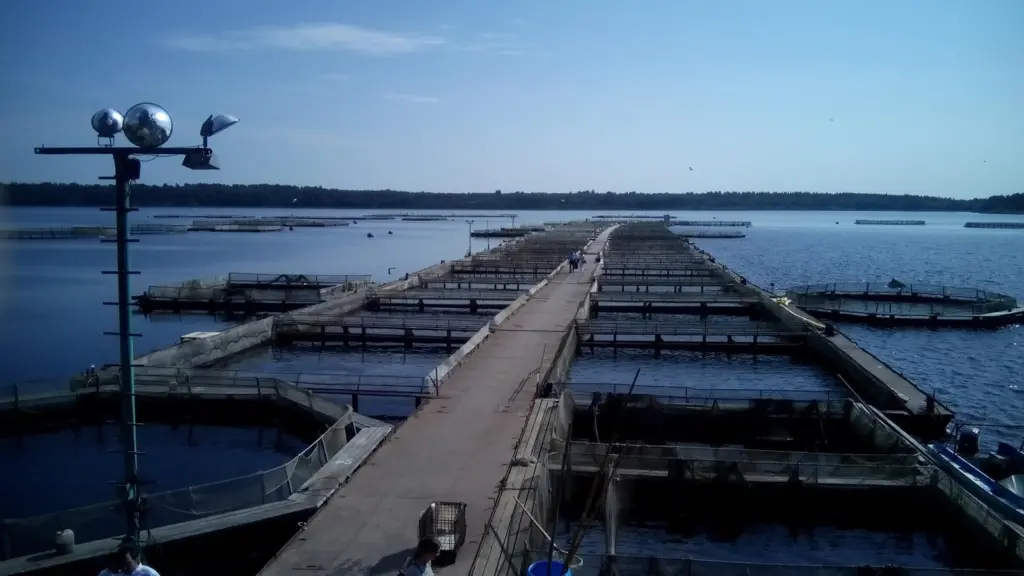
The industry’s transition from extensive and semi-intensive production methods towards modern industrial technologies has brought a significant increase in its production performance in recent years, and it’s anticipated more will follow, Rosrybolovstvo Deputy Head Vasily Sokolov advised.
Russian aquaculture output increased by an annual average of 20% in recent past years, Ilya Solodukhin, head of the customer department of the Russian agricultural bank Rosselhozbank, commented. For 2023, the growth was expected to be around 5%, but this doesn’t mean the industry’s growth trend is slowing down.
Rosselhozbank further estimates the aquaculture industry has an investment potential of RUB 60 to 70 billion (US$650 to 750 million) in the next few years, Solodukhin said.
Rosrybolovstvo has also reported that by 2030, Russian aquaculture production is set to reach 700,000 tonnes, with some observers insisting there are reasons to revise this forecast even further upwards.
This is all positive news for the industry, which in 2022 experienced huge turbulence as Western sanctions imposed in response to the Ukraine conflict barred the passage of a large portion of Western fish feeds and broodstock to the market. These particular issues were eventually solved, with alternative suppliers found in countries like Turkey and China, and some importers helping farmers to continue working with certain European suppliers.
However, Solodukhin also warned that Russia’s heavy dependence on imported fish feed and broodstock remains a critical challenge for future growth.
European feed imports keep farms afloat
Russia currently produces around 110,000 tonnes of fish feed per year, but the demand on the domestic market is believed to be closer to 280,000 tonnes. By 2030, nine new factories are slated to commence operation across the country, some with financial support from Rosselhozbank, expanding production by roughly 220,000 tonnes, Solodukhin advised.
Already, the dependence on imported feed currently stands at 68% against 78% last year, according to Lybov Savkina, General Director of Feedlot, a Moscow-based think tank. Savkina reckons that by the end of 2023/start of 2024, this trade balance could have changed further still, with existing factories expanding production and new capacities set to become operational.
In early 2022, Western sanctions nearly paralysed Russian feed imports from Europe, and several farms warned that unless the issue were solved, they would have to halt operations once they ran out of warehouse stocks.
According to official statistics, exports from the European Union gradually resumed in the second-half of 2023, saving the industry from collapse.
Despite Western sanctions, Norway remained the country’s leading fish feed supplier, accounting for nearly 39% of deliveries, Savkina said. Turkey also now plays a critical role in mitigating the deficit, ramping up supplies to Russia nearly fourfold last year and boosting its market share to 27%. Supplies also kept coming from other EU countries, including Germany which held on to an 8% share.
However, fish feed production requires high-quality fishmeal, the production of which is insufficient in the country, Savkina acknowledged. Russia also lacks a domestic supply of amino acids and produces very few feed vitamins and other additives that are critically important for fish feed production, she said.
Western sanctions also drastically changed the list of countries that Russia could source feed additives from. In previous years, the EU accounted for the lion’s share of supplies, but in 2023, more than 80% of additives come from China, estimated Feedlot.
Booming salmon sector needs broodstock
Nearly 80% of imported fish feed is destined for Russia’s Atlantic salmon (Salmo salar) farming, which market players consider to be the most promising sector for the future.
In the first-half of 2023, Russian salmon production stood at 95,000 tonnes. During the past five years, the country’s salmon industry has tripled in size, and this growth trend is projected to kick into full gear in the foreseeable future.
“The fast growth is primarily attributed to the use of foreign technologies,” said Vasily Glushenko, Chairman of Rosrybkhoz, a prominent Russian fish industry organisation.
But unlike carp (Cyprinus carpio) production, which had dominated Russian aquaculture for decades, salmon farming requires substantial capital investments and large funds to keep operations running – not least in purchasing feed and broodstock. For this reason, only large companies in Russia are engaged in salmon production, Glushenko said.
“With today’s salmon production of 154,000 tonnes [per year] – 80 to 90 million fish eggs and juveniles are imported [by Russia] annually,” Glushenko said, estimating that the share of carp and herbivorous fish in the Russian broodstock production now stands at 30%, while trout (Oncorhynchus mykiss) at only 10%. Some segments have a stronger dependence on imports than others. For instance, smolt for growing Atlantic salmon and sea trout in Russia is fully imported from abroad.
“In the current situation, it is necessary to expand and improve our own breeding base by building selection and genetic centres and to increase the number of breeding plants and hatcheries,” Glushenko said, adding that achieving this would ensure the sector’s long-term growth.
But despite the Russian government showing its willingness to help potential investors, progress to-date in this field has only been moderate.
In early 2023, Akvaproduct, the company running the first Russian RAS salmon farm in Vologda, launched a salmon smolt-rearing unit. The hatchery was to be the first of its kind in Russia. Construction of the complex involving the RAS farm and hatchery started in 2019 but was reportedly delayed by sanctions.
Inarctica, the Russian largest fish farming company, is also building a smolt plant in Karelia Republic, with a capacity of 712 tonnes. In early 2023, the company was forced to sell three smolt plants that it owned in Norway to their management, citing “regular restrictions against the Russian business in Norway”.
With Russia also showing no signs of being able to mitigate its dependence on imported broodstock in the foreseeable future, farmers are now urging authorities to consider allocating additional state aid to the segment.
Gloomy economic context
Weak demand for fish in the domestic market is another factor that Russian fish farmers must contend with. In 2022, the Russian per capita fish consumption amounted to 19.2 kg. This was 10% lower than in the previous year, according to state statistical service Rosstat.
Over the past decade, the consumption level has dropped by 30%, and in the next couple of years, it’s expected to fall by a further 5% to 7%, forecasts National Rating Agency, a government body monitoring the state of play on the domestic consumer market.
The Russian population’s purchasing power remains the key factor determining consumer behaviour. And in a December 2022 opinion poll, some 96% of surveyed consumers admitted they wanted to consume more fish but couldn’t because it was getting less affordable.
During an October 2023 government meeting, Russian President Vladimir Putin urged the government to step in and reverse this downward trend. He ordered authorities to consider putting together a comprehensive roadmap aimed at ramping up fish consumption.
In this context, Russian fish farmers should also be braced for tougher competition from the fisheries sector, particularly with authorities mulling new logistics subsidies for fish deliveries from the Far East, the country’s main catching region.
In the first-half of 2023, Russian fishermen saw a near-threefold slump in net profit – to the lowest level since 2017, as Western sanctions barred the way for Russian goods to important markets. Consequently, several guild unions, including the Pollock and Crab Catchers’ Association, have called for authorities to help them redirect supplies to the domestic market.
Therefore, while Russian aquaculture has outperformed the grim forecasts made in 2022 when the first sanctions wreaked havoc on supply chains, its future production growth isn’t guaranteed, with many unpredictable factors able to potentially derail its progress.