


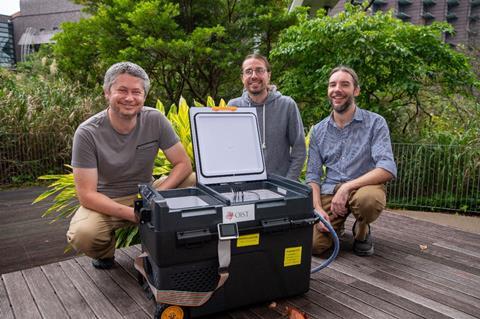
Now, a team from the Okinawa Institute of Science and Technology (OIST) has developed a scalable aquaculture platform designed to address these challenges.
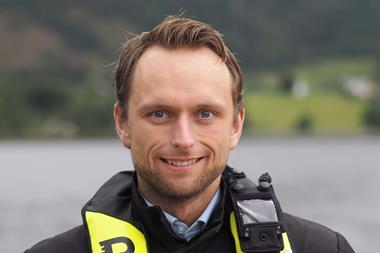
“Our technology provides a simple yet flexible solution to improve efficiency and productivity in one of the most sensitive steps in aquaculture - animal transfer,” says Dr Zdenek Lajbner, who leads the project.
“Traditionally, this has been a very manual process using nets, buckets, or containers. This requires a large amount of manual labour and causes stress to the animals, raising mortality rates.”
“Guiding them using light and water flow allows us to improve survival while reducing stress and labour.”
Automating aquaculture
The system was originally developed to support cephalopod research at OIST, where culturing squid and octopus is particularly challenging.
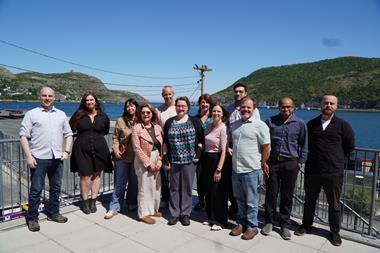
The team - Zdenek Lajbner, Ryuta Nakajima, Mehmet Arif Zoral, Peter Babiak, John Parker, Mouez Lassoued and Jonathan Miller - have designed a modular prototype, successfully testing this on multiple cephalopod species before recognising the broader relevance of their system to the aquaculture sector.
They have also integrated IoT-enabled sensors to continuously monitor key environmental parameters, including temperature, salinity and oxygen levels.
These provide real-time data and alerts to remote users. With automated, detailed, real-time characterisation of each transported individual, immediate automated decisions can be made based on the information obtained.
“What’s different with our system is that transfer is automated using both light and flow. Many aquatic animals display phototaxis and are drawn towards light. By harnessing this natural phenomenon and supporting the movement with a gentle current, we can enable stress free transfer of the animals between containers,” explains Dr Lajbner.
”The pump is typically not in the path of animals. In addition, a range of integrated, remote-operated sensors and controls can allow the users to monitor animal environment, condition and transportation on an individual level in real-time. This can make a variety of important activities like health checks and stock counting much easier and quantitative.”
Reducing stress
Animal stress during hatching and transfer is an important contributor to mortality and long-term aquaculture performance deficits.
Dr Lajbner explains that improving survival, especially in early life stages, can have huge downstream improvements in productivity.
Not only will yield increase, but it can reduce feed wasted on nonviable stock, reduce tank downtime (e.g. by minimising pathogen exposure during transfer, enabling water quality remote monitoring, etc.) and reduce overall human labour, while improving animal welfare.
“We estimate that a 15-25% increase in early-stage survival can significantly improve effective output at farm scale,” says Mr Lajbner.
The OIST team is now seeking industrial partners to validate the system in commercial hatcheries, expand species testing and scale the platform for large-scale aquaculture operations.