



The Federation of European Aquaculture Producers (FEAP) has warned that the European Commission’s evaluation of the Common Fisheries Policy risks further weakening Europe’s aquaculture sector.
In its response to the Commission’s review of Common Fisheries Policy (CFP) Regulation 1380/2013, FEAP said the assessment demonstrates a structural bias against aquaculture and fails to provide a credible framework for future EU policy development.
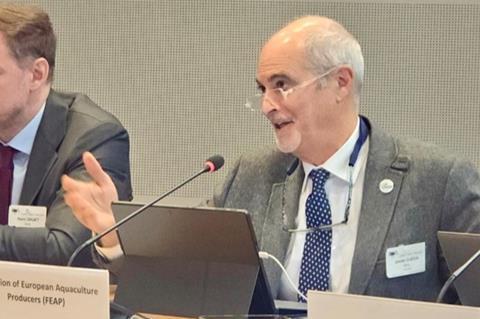
“The Commission’s evaluation identifies many of the problems but refuses to draw the necessary conclusions,” said Javier Ojeda, secretary general, FEAP.
“After more than a decade of voluntary cooperation with Member States, EU aquaculture has not grown. Our self-sufficiency in fishery and aquaculture products has fallen from 46.1% to 38.1%. For the five most consumed species, it is just 12%.”
Missing the point
FEAP argued the evaluation overlooks the direct relationship between stagnant aquaculture production and declining EU food self-sufficiency, while also downplaying the limited effectiveness of existing governance tools such as ’Multi-annual National Strategic Plans for Aquaculture’ and the ‘Open Method of Coordination’.
According to FEAP, the Commission’s review exposes major shortcomings in EU policy implementation, including the absence of common environmental indicators for aquaculture, insufficient climate adaptation requirements and inconsistencies with legislation such as the Nature Restoration Regulation and Birds Directive.
The federation also criticised the lack of measurable performance assessment within the CFP framework, arguing that non-binding governance mechanisms have failed to improve licensing procedures, environmental reporting, and access to marine space for aquaculture operators.
FEAP is now calling on the European Commission, European Parliament and Council to introduce binding governance measures, harmonised standards, aquaculture-specific climate adaptation plans and a dedicated Common Market Organisation to strengthen competitiveness, food security and strategic autonomy across the EU aquaculture market.
Mr Ojeda said the upcoming 2040 Vision for Fisheries and Aquaculture represents a critical opportunity to reposition aquaculture as a strategic food-producing sector within future EU policy.