

Ghana charts safe, sustainable aquaculture production
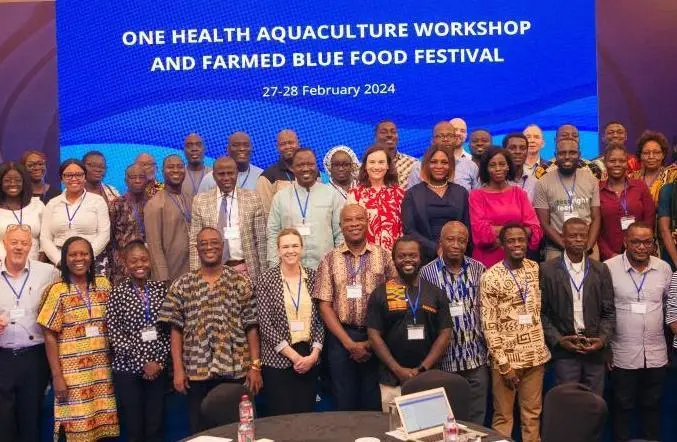
Focusing on how a Seafood Risk Tool can be applied to support aquatic food supply chains in Ghana, scientists and policymakers from the West African country, the UK, Senegal, Sierra Leone and Nigeria recently came together at a One Health Aquaculture Ghana workshop in Accra to discuss how a “One Health” approach can be applied to developing safe and sustainable aquatic food.
Links between national aquatic food production aspirations and the need for providing healthy environmental conditions in which the sector can flourish were also investigated. As were key issues in animal, environmental and human health and the need for collaborative approaches to improve safe and sustainable aquaculture production in Ghana.
New technologies and concepts were shared that could help identify known and emerging chemical and microbial hazards, and the management options that could be applied to supply chains.
The event was organised by the UK government’s Department for Environment, Food and Rural Affairs (Defra) Ocean Country Partnership Programme team and the World Economic Forum’s Blue Food Partnership Ghana Initiative with local partner, the Chamber of Aquaculture Ghana, which has been facilitating engagement with Ghanaian stakeholders as well as by FUTUREFISH, which has provided expertise in aquaculture sector development.
The partnership between the UK and Ghana is part of the UK’s Ocean Country Partnership Programme (OCPP), an Official Development Assistance (ODA) programme under the Blue Planet Fund.
OCPP aims to strengthen marine science expertise, develop science-based policy and management tools and create educational resources for coastal communities. The programme tackles the key marine challenges of pollution, biodiversity and sustainable seafood, and aims to deliver positive impacts on the livelihoods of coastal communities that depend on healthy marine ecosystems.
Speaking on at the event on behalf of Honourable Minister Mavis Hawa Koomson, Chief Director for the Ministry of Fisheries and Aquaculture Development, Marian Kpakpah, said: “We are pleased to be working with our UK partners through the Ocean Country Partnership Programme using a One Health approach to support sustainable aquatic food production. Last week’s One Health Aquaculture workshop and the ongoing collaboration through the OCPP gives us the opportunity to take further actions to support safe and sustainable seafood production and livelihoods.”
In his opening remarks, FCDO Development Director Richard Sandall praised Ghana’s leadership on marine protection and in particular the country’s efforts to introduce important conservation measures such as the annual closed season and the moratorium on new canoes.
“By partnering through the Ocean Country Partnership Programme, the UK and Ghana are sharing world-class science and research with each other. This is supporting evidence-based policy-making that will enable both our governments to address threats to the marine environment, and to coastal livelihoods. But we hope to go further than this: to bolster Ghana’s wider ambitions on sustainable development and climate change, as our support to the development of the aquaculture sector through OCPP and the Blue Food Partnership Ghana Initiative demonstrates,” he said.
Karen Demavivas, Lead, Blue Food Partnership, World Economic Forum added that by “breaking silos to work with a range of expertise and experiences”, OCCP is paving transformative pathways towards greater food and nutritional security, inclusive economic growth, and increased resilience for people and planet.
The Ghana One Health Aquaculture workshop was complemented by a one-day workshop that brought together stakeholders from across Ghana, Nigeria, Senegal and Sierra Leone to open dialogue on the harmonisation and coordination of antimicrobial resistance (AMR) surveillance in aquaculture across the region. It was supported by the UK’s Fleming Fund and was delivered by the UK’s Food and Agriculture Organisation (FAO) of the United Nations reference centre for AMR.
Related Articles
 SEAFOOD
 AQUACULTURE
 SEAFOOD