




A striking tricolour coral assemblage discovered off the tropical archipelago of Lakshadweep is providing new insights into coral resilience, with potential implications for fisheries and the livelihoods of artisanal fishers.
The underwater image, captured during a marine mammal survey by the ICAR-Central Marine Fisheries Research Institute (CMFRI), shows neighbouring coral colonies displaying orange, white and green colours.
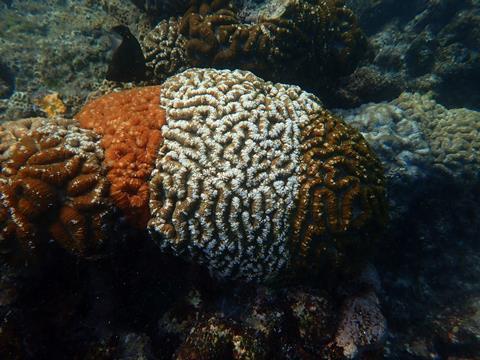
The corals were identified as Lobophyllia corymbosa and Lobophyllia radians, with one L. radians colony showing bleaching while a neighbouring colony remained healthy.
CMFRI director Dr Grinson George said: “Though this assemblage is a symbol of India’s rich marine biodiversity, it also carries an urgent message about ocean health.” He said the contrasting responses to rising sea temperatures could provide ‘crucial insights for the ongoing reef restoration and climate adaptation research’.
CMFRI is pursuing coral reef restoration measures, including the deployment of artificial reefs along coastal waters. The institute says these structures can help revive degraded habitats, enhance biodiversity and support the livelihoods of artisanal fishers.
“With the support from the Government of India, CMFRI is on a mission to rapidly scale up the deployment of artificial reefs along coastal waters to revive degraded habitats, enhance coastal biodiversity and support the livelihoods of artisanal fishers,” Dr George said.
The institute is also working to replenish depleted wild stocks of ecologically and economically important marine species through fish breeding, seed production and sea ranching programmes.
The coral assemblage demonstrates that colonies of the same species can respond differently to environmental stress, potentially offering researchers valuable clues for identifying more resilient corals.
For fishing communities, protecting such habitats could help strengthen marine ecosystems and improve their ability to withstand climate pressures. CMFRI said restoring reefs and rebuilding marine stocks together could contribute to more climate-resilient fisheries and coastal livelihoods.