


Total fish utilisation
With million tonnes of fisheries and aquaculture raw materials going to waste, IceFish 2022’s Fish Waste for Profit Conference heard there’s significant scope to optimise the use and value of seafood
Opening the conference’s fourth edition, held 9-10 June in Reykjavik, and setting the scene, Thor Sigfusson, Founder and Chairman of the Iceland Ocean Cluster, stated there’s now a lot of interest from the industry and beyond in the opportunities that fish by-products and side streams offer, and what’s key is to bringing the start-up community into the picture with its entrepreneurship and tech focus.
“It’s so important to get everybody in the seafood industry to realise that we have the opportunity to create economic, social and environmental value.
“We have huge work to do; we have 10 million tonnes of by-products (globally), and I would say that’s a very cautious estimate. So, there’s huge work ahead of us…we’re only just at the initial stages of these changes,” Sigfusson said.
Better equipped for RRMs
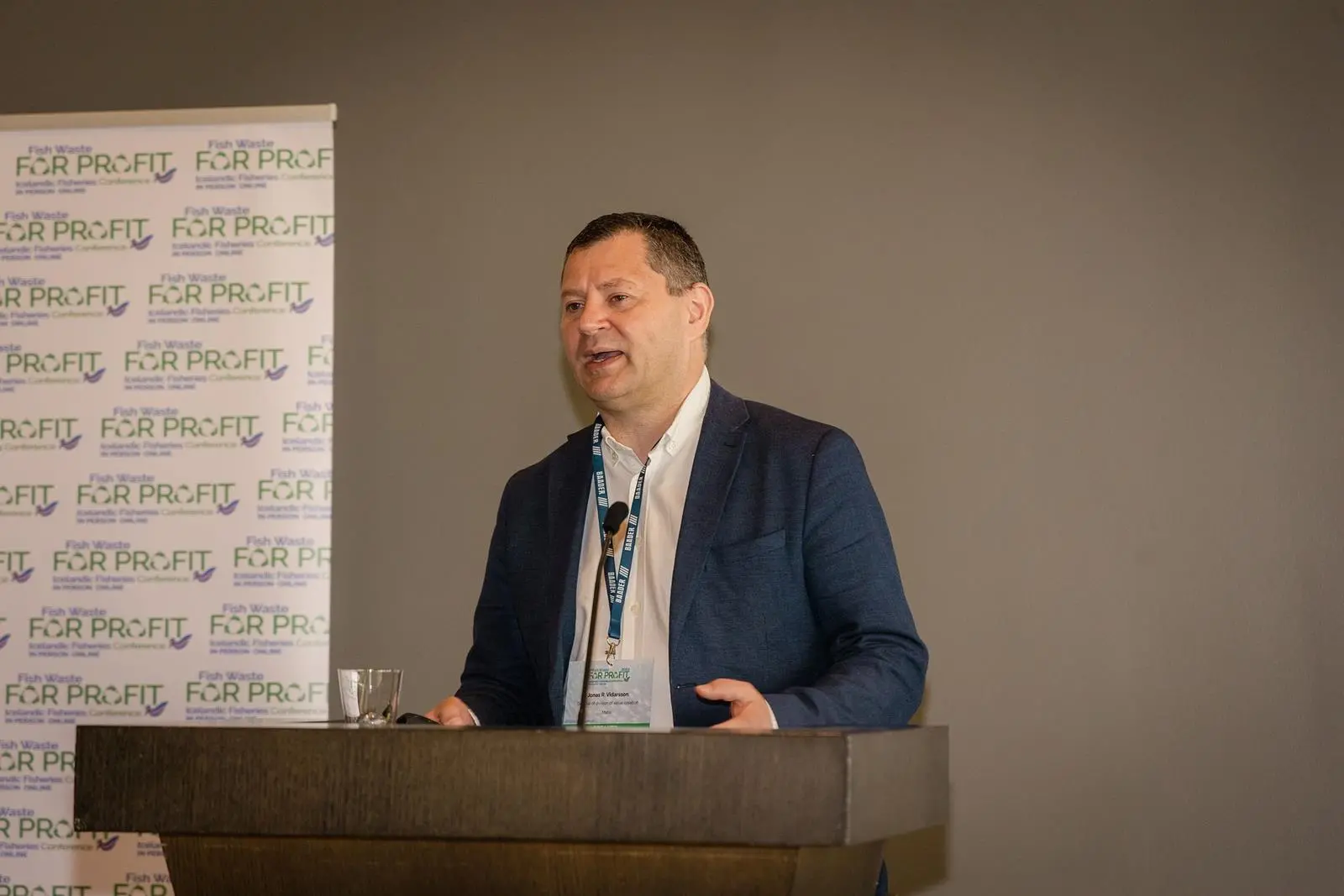
Delivering the keynote address, Jonas Vidarsson, Director of Value Creation at Matis explained that through heavy investment in education and R&D a lot of young people with fresh ideas have joined and revolutionised Iceland’s seafood sector over the past few decades.
Vidarsson also acknowledged that at the same time, a great deal of money has been spent updating the country’s fishing fleet with fewer, more efficient vessels that are better equipped to handle the catch and the rest raw materials (RRMs – or side-stream products), and that the same transition has been seen on the processing side, with much stronger emphasis now placed on the RRMs and servicing.
“There are fewer people in processing, but more are focusing on the rest raw materials,” he said.
“Everybody now realises that you can’t just focus on fillets; that’s just 40%, and you can’t throw away 60% of the fish –that’s not sustainable and it’s not good business.”
There are a vast number of products that can be made from these raw materials, with more opportunities opening up all the time, and there is a lot of money in it, Vidarsson said.
Focus on human food
Iceland is leading the charge, the conference heard. In 2017, it was utilising 72% of its cod in conventional products. According to the latest analysis, by 2021, 90% of the country’s cod catch was being used, including the production of side products.
“This, of course, is fantastic compared with everybody else. But there should still be more effort and attention to value,” Vidarsson said. He gave the example of redfish where only 35% is used for human consumption and the remainder is used for bait or fishmeal.
“It’s 100% utilisation but we can do better. We can make more food and we can make more value from this.”
Head of Research and Innovation at the Iceland Ocean Cluster Alexandra Leeper told the conference there’s also considerable scope for Iceland’s Atlantic salmon, with the country’s production now at 40,000 tonnes and set to double over the next few years.
“The time is now to maximise the value and move towards 100% utilisation.”
However, right now in Iceland, 42% of the Atlantic salmon resource is being “wasted”, she said, adding that the work with whitefish, particularly Atlantic cod, shows much more can be achieved and a number of new initiatives to capture value are underway.
With regards to the “bigger picture” food security challenge, Vidarsson reminded the conference that while 71% of the Earth’s surface is covered by water, fish production only accounts for 158 million tonnes of the total 4 billion tonnes of food produced annually.
“We are not really using the oceans,” he said. “We cannot feed 10 billion people in 2050 without using all of the resources that we have been given…and using all of the resources 100%.”
Related Articles
 FISHERIES
 SEAFOOD
 FISHERIES