




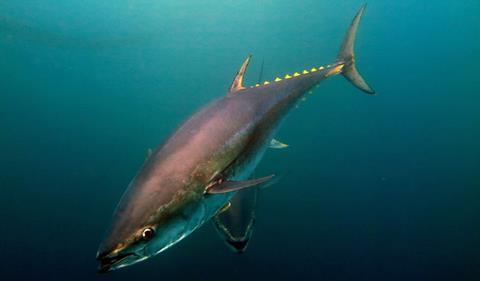
Atlantic bluefin tuna are expected to shift their distribution progressively northwards over the coming decades as ocean warming reshapes feeding and spawning habitats, according to new international study “Navigating Future Waters: The Resilience of the Atlantic Bluefin Tuna Under Climate Change”, led by Spanish marine research centre AZTI.
Published in Fish and Fisheries, the research suggests that while cooler, high-latitude regions could become increasingly suitable for the species, some of its most important spawning areas – including the Mediterranean Sea and the Gulf of Mexico – may become significantly less viable under climate change.
Atlantic bluefin tuna are one of the world’s most economically valuable and closely managed fish species, making early planning and international coordination increasingly critical as ocean conditions continue to change.
Using advanced modelling that combines environmental data, prey distribution and fishing activity, the study projects how Atlantic bluefin tuna habitats could change throughout the 21st century under multiple greenhouse-gas emissions scenarios. The results indicate potential habitat losses in tropical and temperate waters, alongside expanding opportunities in northern Europe, the Northeast Atlantic and waters around Greenland.
“These fish show a strong capacity to adapt, but climate change is clearly altering the balance between feeding areas, spawning grounds and fishing activity,” said Maite Erauskin-Extramiana, lead author of the study. “That makes it essential to integrate climate projections into fisheries management if we want to manage the stock efficiently and sustainably.”
The findings raise particular concerns for reproduction. Under the most pessimistic emissions scenario, habitat suitability for adult tuna in the Mediterranean could fall by 27%, while suitability in the Gulf of Mexico could decline by as much as 70%. Both regions are critical spawning grounds for the eastern and western Atlantic bluefin stocks respectively.
For the fishing industry, the research points to both opportunities and challenges. As tuna and their prey species – including sardines, mackerel and squid – move north, new overlap zones may emerge in boreal regions. These areas could act as future “climate refugia”, offering productive feeding grounds and potentially supporting new or expanded fisheries.
However, the authors caution that such shifts could complicate management frameworks built around fixed geographical boundaries. Highly migratory species such as bluefin tuna may no longer align with existing quota systems, regional management organisations or historical fishing patterns.
“Climate change is affecting not only ecosystems, but how we manage marine resources,” Erauskin-Extramiana said. “Anticipating these changes is key to protecting both biodiversity and the livelihoods that depend on it.”
The study was supported by Spain’s Ministry of Science and Innovation and several European research initiatives, including FutureMares, Mission Atlantic and Biodiversa+. Researchers say the results underline the need for more flexible, climate-adaptive fisheries management approaches that can respond to shifting stock distributions and emerging fishing grounds.