


Portal sheds light on Norwegian salmon farming
The impacts of salmon farming – on land and at sea – are being highlighted thanks to a new sustainability web portal in Norway.
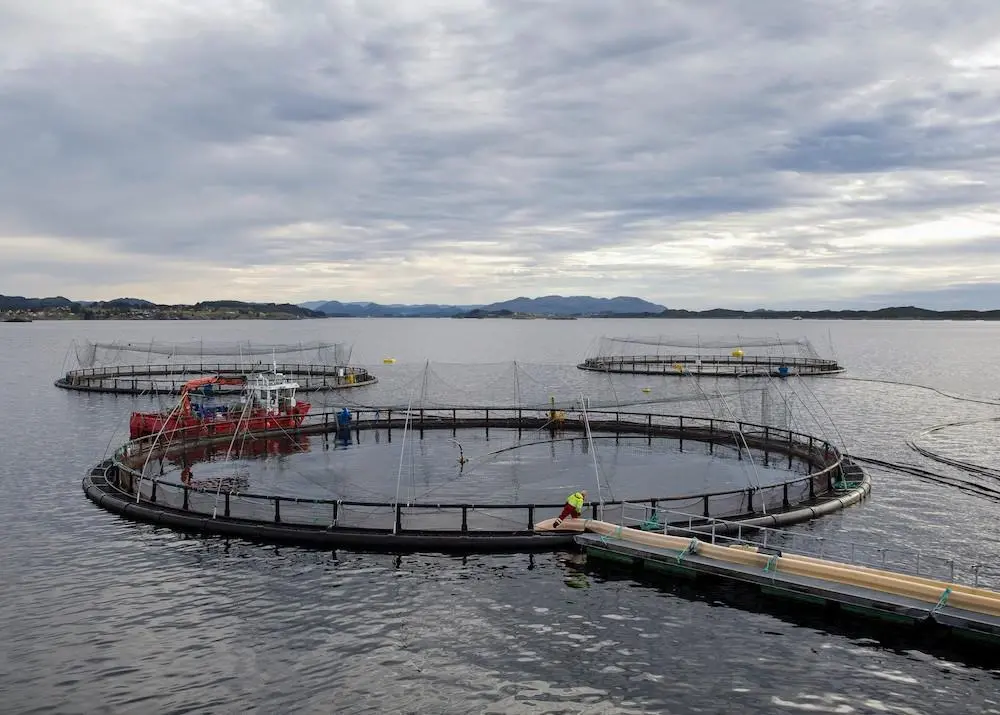
In 2014, FAO statistics showed that aquaculture had surpassed global capture fisheries production. As the world’s fastest growing food sector, aquaculture provides just over 50% of the fish supply for human consumption today. The FAO now predicts that by 2050, the world’s population will reach 9.7 billion, with the need for protein expected to grow by 40%. At the same time, however, the actual demand for protein is expected to double. Fish, in particular farmed salmon, is seen as one way of meeting this demand.
In Norway, the farmed salmon industry has been evolving substantially since the 1970s and is now one of the country’s biggest export industries. But since the industry’s early days, Norwegian authorities have been concerned with its environmental impacts, how profitable it could become and whether it could provide employment and sustain livelihoods, particularly in rural areas.
Some sustainability challenges stemming from the early days of Norwegian salmon farming have been resolved, including specific diseases and the need for antibiotics but others, such as the impact on wild fish and sufficient contributions to local jobs and incomes, still remain.
Impacts on environment, economy and society?
With sustainability a fundamental prerequisite for aquaculture, hopes are high that a new sustainability portal for the Norwegian salmon industry will help increase knowledge of the impacts of salmon farming, and contribute to a fact-based public discussion on the industry’s benefits and risks.
“The portal presents indicators across twenty themes on how Norway’s salmon and trout aquaculture affect three dimensions of sustainability – environment, economy and society,” said project leader Kine Mari Karlsen, Senior Researcher at the Norwegian Institute for Food, Fisheries and Aquaculture Research (NOFIMA).
“The indicators have been chosen to cover substantial aspects of each theme. They are clearly related to aquaculture and not strongly affected by other activities or factors. The data used for the indicators are already publicly available and come from authoritative sources like public authorities and research institutions.”
The aim of the project is to provide users with easy access to a variety of facts on Norwegian salmon farming and increase their understanding of how salmon farming affects the economy, society and the environment. Developed by researchers from Nofima and SINTEF Ocean, with developers from BarentsWatch and Bouvet, the idea of a sustainability portal came about after the aquaculture industry recognised the need to have access to sustainability status reports.
The portal’s environmental themes include data on salmon lice, disease, fish mortality, utilisation of residual raw materials and escape. Economic themes include the contribution to GDP, profitability, feed composition and origin and efficiency, production value and costs while society themes cover certifications, occupational injuries, area use, employment and taxes.
Users can also see trends that are occurring within several fields and how different aspects of salmon farming have evolved. For example, the themes include what may be termed positive and negative effects of salmon faming, such as employment and escapes but the trends for the indicators could turn this positive/negative theme on its head. In other words, if employment is going down it is negative, and if the number of escapes are going down it is positive.
But despite this information, Kine Mari Karlsen says no overall conclusion can be drawn from the portal on how sustainable Norwegian salmon farming actually is.
“The portal presents indicators for many themes but does not give an overall assessment of whether or to what degree Norwegian salmon farming is sustainable,” she said.
“There are several reasons for this. For some themes, we can say when they surely are sustainable, in an isolated manner. For example, if there are no escapees, that would be sustainable in an isolated sense. But if there are some escapees, where is the sustainability limit? We don’t usually have a clear answer to that. Also, for some of the themes, the indicators are only at a national level while for others, regional indicators are included. It’s then not possible to define a sustainability limit at a certain level, for example, because natural and social conditions vary greatly across Norway. Also, the status and development of different indicators may need to be weighed up against each other, as achieving sustainability in one area may reduce sustainability in others.”
For each theme, the portal’s web page includes a short introduction and key figures that typically cover the latest full year, followed by the indicators for each theme, which are represented as graphs. There is also information on data sources and where to go for further information. Some of the indicators are updated automatically every week or month after regular monitoring and reporting. Others come from data from research projects that are only updated at irregular intervals.
Positive feedback
The themes and indicators were selected based on a survey and an iterative process among the project researchers, in addition to input from a quality assurance group with members from academia and an environmental NGO, as well as a group with members from the aquaculture industry. Over 600 respondents were asked which topics would be most important to assess sustainability and what would be important for the portal’s credibility. A mixture of the importance of various themes, how well the available data and indicators substantially covered a theme, and how suitable it could be for presentation in an online portal for a general audience all played a part in deciding what themes to include.
“The portal was launched in December 2018,” Kine Mari Karlsen said. “The second phase of the project will involve updating indicators, automating data collection and presentation as much as possible and coming up with other themes and indicators to add. We will also consider presenting regional and local data for more indicators, to make the portal more useful for local and regional planning and management.”
Since its launch, the portal has garnered an array of positive feedback from Norway, Europe and North America. Public authorities, aquaculture industry suppliers and municipal planners have found it easy to find information and describe the portal as being able to point out the challenges facing Norwegian salmon farming today. Others have found it useful in areas such as coastal planning, and expressed high hopes that it will be an important input in the debate over Norway’s salmon aquaculture.
Financed by the Norwegian Seafood Research Fund, the Sustainability in Aquaculture Portal is hosted on the Barentswatch platform (www.barentswatch.no), which has been established to collect, develop and share information about Norwegian coastal and marine areas.
Related Articles
 PROCESSING & REFRIGERATION
 PROCESSING & REFRIGERATION
 PROCESSING & REFRIGERATION