


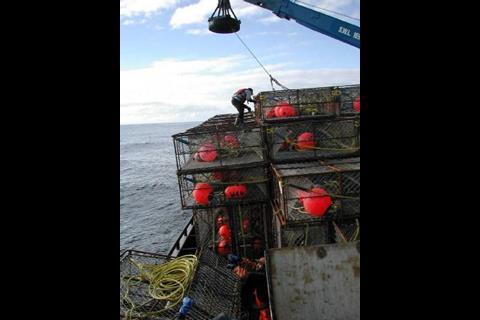
Alaska leads the way through the unparalleled management of its rich fisheries resources.
Alaska is known for many things: its natural beauty, its harsh winters, and its oil and gas exports, but the 49th state is probably best known for its seafood, most notably salmon, crab, pollock, cod and halibut.
In total, Alaska’s commercial fisheries are worth around $1.5 billion (€1.1 billion) to fishermen and have a wholesale value of $3.6 billion (€2.8 billion). It is also estimated the seafood industry contributes $5.8 billion (€4.4 billion) to the Alaskan economy and provides 78,500 jobs.
Sustainability has always been at the heart of Alaska’s seafood industries. In fact, it is so important that it was written into the State Constitution in 1959, mandating that fish “be utilised, developed and maintained on the sustained yield principle”. Thus, Alaska is obliged to manage its natural resources to abundant, sustainable levels.
Because of its huge commitment to ensuring the safe levels of its fisheries resources, many non-Alaskans were surprised to learn earlier this year from the Alaska Fisheries Development Foundation, which represents the salmon fishery, that it won’t be renewing the five-year Marine Stewardship Council (MSC) certification it had held since 2000, and has in its place secured Responsible Fisheries Management Certification via independent, third-party assessment conducted by Global Trust Certification Ltd.
The move means that beyond 29 October, when the current certification expires, no Alaska salmon will bear the familiar eco-label. WF&A readers should, however, note that all Alaska salmon harvested during the 2012 fishing season will be eligible to carry the MSC logo and can be sold as certified as long as the participating entities maintain valid MSC Chain of Custody certification.
Nevertheless, it’s fair to say the move has left many businesses and organisations perplexed. Global Trust’s interpretation of the United Nation’s Fisheries and Agriculture Organization (FAO) Code of Conduct has, for example, been criticised by some in the industry for not being as specific as the interpretation used by the MSC.
The decision to drop MSC was largely a financial one, but the Alaska Seafood Marketing Institute (ASMI) said it doesn’t affect the science-based, robust management of Alaska’s salmon fisheries. “Alaska salmon producers found they would be better off spending their marketing budget promoting the high quality of Alaska salmon products. As far as they are concerned, Global Trust is a viable alternative to MSC and the cost of certification won’t be passed on to the processors,” said ASMI’s Tyson Fick.
Currently, many of the retailers who sell Alaska salmon are saying the decision to sell the products after October will be based on careful consideration and they will only continue to do so if they can be satisfied with the state of the fisheries that their suppliers purchase salmon from.
Putting eco-labels to one side, probably the most relevant things to look at are: how is the fishery doing; and is the management system strong enough and are fishermen following it?
Observers only have to look back through the catch records for proof of excellent management, said Mr Fick.
Valuable catch
Perhaps no seafood embodies the wild, natural Alaska waters more than salmon. There are five Alaska salmon species, and the flavour of each is directly related to the fat content and the environment in which it matured.
King, or Chinook salmon (Oncorhynchus tshawytscha), is the largest and least abundant of the species. The average weight of the fish is around 9kg and it is prized for its red flesh, rich flavour, high oil content and firm texture.
Coho (Oncorhynchus kisutch) is the second largest of the Pacific salmon species, with an average weight of 5.4kg. With an orange-red flesh and delicate flavour, it is popular in both frozen and smoked forms.
Chum, or keta, salmon (Oncorhynchus keta) are also popular with smokers. It has an orange-pink colour and an average weight of around 3.6kg.
With its rosy pink-coloured flesh, pink salmon (Oncorhynchus gorbuscha) is the smallest and most abundant of the species. The average weight of this fish is 910g-1.4kg and it is commonly used in canning.
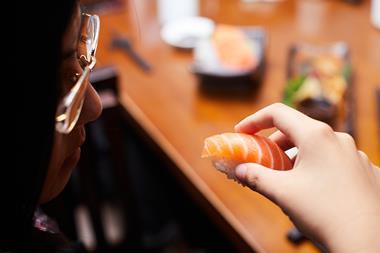
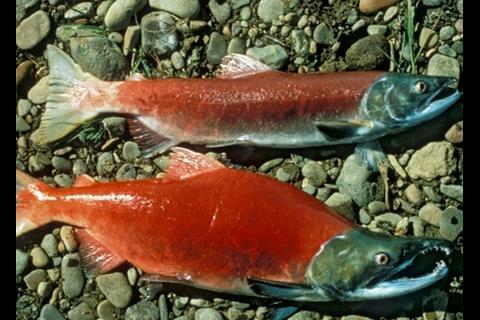
The second most abundant Alaska salmon is sockeye (Oncorhynchus nerka). It has an average weight of around 2.7kg and is widely considered to be the most desirable of the five species. Its intense red meat colour and strong taste make it a favourite with US restaurant chefs. And in Japan, sockeye is the prime salmon used for sushi and sashimi, again because of its colour, taste and texture.
Last year, Alaska’s salmon harvest totalled 177.1 million fish – the ninth largest catch since 1960, with an estimated ex-vessel value of $603 million (€461.2 million), making it the third most valuable since 1975, behind the 1988 and 2010 harvests, respectively.
The pink salmon harvest, valued at more than $170 million (€130 million), set an all-time record; chum reached $93 million (€71.1 million), the third highest value ever recorded; sockeye came in at almost $296 million (€226.4 million), in sixth place among historic sockeye harvests. Chinook and coho harvests, at $20 million (€15.3 million) and $23 million (€17.6 million), respectively, fell more towards the middle of their historic ranges.
This combined harvest included 468,000 Chinook, 40 million sockeye, 3.5 million coho, 116.1 million pink and 17 million chum.
The new run forecasts and harvest projections for 2012 predict a decrease in overall commercial salmon catches this year due to the projected fall in pink harvests. The total commercial salmon catch projection of 132.1 million fish is expected to include 120,000 king salmon in areas outside southeast Alaska, 38.4 million sockeye, 4.3 million coho, 70.2 million pinks and 19.1 million chum.
The projected pink harvest is about 40% lower than the harvest of 116 million last year, while the projected sockeye harvest is about 4% lower than last year’s catch, while the projected chum harvest is 12% higher than in 2011.
Deadliest phenomenon
Alaska salmon achieved its Global Trust responsible fisheries management certification in March this year, joining Alaska black cod (sablefish) and Alaska pollock, which were both certified in the latter stages of 2011.
The last remaining major seafood to undergo the certification process is Alaska’s crab fisheries, which started the peer review stage for certification in March. The review includes Bering Sea/Aleutian Island king and snow crab, Bristol Bay red king crab, St Matthew blue king crab, and Eastern Bering Sea snow crab commercial fisheries.
While salmon is Alaska’s most iconic product, its king crab and snow crab have caught the imagination of consumers the world over. The largest and most impressive of all crab species, king crab has ridden a wave of popularity in the last decade, fuelled in no small part by its starring role in the Discovery Channel’s reality television series, Deadliest Catch, which is broadcast in more than 150 countries.
The show – which aired its 100th episode in the States in April – tracks the highs and lows of fishermen as they risk their lives to bring this delicacy to the plates of diners around the world. As a result, few other shellfish offer such widespread appeal as Alaska king crab. More importantly for the fishermen, it commands high prices at restaurants and supermarkets.
Alaska crab stocks are jointly managed through an agreement between federal and state organisations: the Alaska Department of Fish & Game (ADFG) is responsible for conservation and management, and the North Pacific Management Council (NPFMC) is responsible for policy and allocation.
The Alaska crab season started in mid-October and usually runs through to the end of April or beginning of May.
The 2011-2012 quota for Alaska Bristol Bay red king crab is over 7 million lb (3,175 tonnes), which represents a 47% reduction from 2010. The 2011 Alaska Bering Sea snow (opilio) crab quota was set at nearly 90 million lb (40,823 tonnes), a 64% increase over 2010. And the St Matthew Island blue king crab quota was set at over 2 million lb (907 tonnes), which represents a 47% increase from the previous season.
Double certified
Alaska pollock (Theragra chalcogramma) is Alaska’s most abundant species and the world’s largest sustainable fishery. It added its Global Trust to its MSC certification in December 2011, but WF&A readers should note that unlike the Alaska salmon fisheries, the Bering Sea and Aleutian Islands and Gulf of Alaska pollock fisheries don’t face MSC reassessment until 2015, whereas the salmon industry had to decide in January whether to enter full reassessment.
According to Randy Rice, technical programme director for ASMI, having another certification further demonstrates the strength of Alaska’s responsible fisheries management.
“Furthermore, this FAO-based certification is cost effective for every member of the supply chain because there are no logo licensing fees. It means we are able to provide our customers, and through them the consumer, with an affordable and credible certification alternative.”
This year’s pollock quota for the Bering Sea and Aleutian Islands was reduced by 5.2% or 50,000 tonnes to 1.2 million tonnes, which was 20,000 tonnes less than the acceptable biological catch (ABC) that North Pacific Fishery Management Council (NPFMC) decided upon.
The NPFMC is mandated to not exceed the ABC, but it may decide to go below it when taking the harvest of other species into account. This year, the total catch for groundfish species must not exceed 2 million tonnes for the entire Bering Sea and Aleutian Islands, excluding the Gulf of Alaska.
Meanwhile, Alaska’s cod (Gadus macrocephalu) fisheries caught 89% of the 2011 quota. The total quota was 26,794,000 lb (12,154 tonnes), up from 24,876,707 lb (11,284 tonnes) in 2010. Of the total, 23,880,702 lb (10,832 tonnes) were caught in 2011, up from 21,955,388 lb (9,959 tonnes) in 2010.
Alaska halibut (Hippoglossus stenolepis) fisheries caught 97% of the total quota, which was also up from the previous year, at 2,128,000 lb (965 tonnes). The 2010 quota was 2,062,000 lb (935 tonnes).
Last year’s season ran from 12 March until 18 November 2011.
Looking ahead, Alaska’s groundfish fishery will next year see the arrival of one of the largest and most eco-friendly fishing vessels built in the United States.
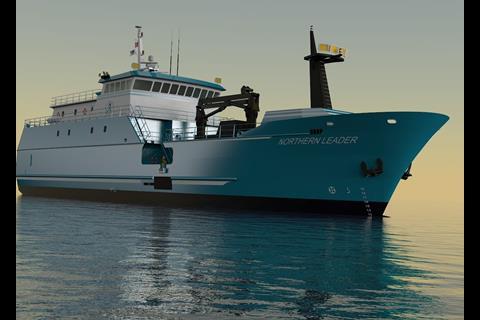
Ordered by Alaskan Leader Fisheries LLC, an Alaskan fishing company, and JM Martinac Shipbuilding Corporation of Tacoma, Washington, the Northern Leader will be a 184-foot x 42-foot x 18.75-foot freezer-longliner designed for service in the Alaskan longline fisheries of the North Pacific, Bering Sea, and Aleutian Islands.
The vessel will target Alaska cod, sablefish, and other groundfish species. It will be one of the largest longliners in the world with over 38,000 cubic feet of refrigerated fish hold with an estimated capacity of 1,867,025 lb (846 tonnes) of frozen seafood.
Robin Samuelsen, chairman of Alaskan Leader Fisheries, said Northern Leader would be one of the most technologically advanced and innovative commercial fishing vessels ever built. “Our ship design will combine an extremely ecosystem friendly fishing system, onboard processing capacities featuring complete utilisation of the vessel’s targeted catches, and propulsion and generator systems that will substantially reduce fuel usage,” he said.
“For centuries, Alaskans have survived a harsh yet giving land by having complete and unabiding respect for our environment. This vessel represents the responsibility of our stewardship of nature’s resources and the necessity to fully utilise what we harvest. The continuing sustainability of Alaska’s resources is only possible by choosing fishing technology that has minimal environmental impact.”
Mr Samuelsen said he was very proud that Alaskans were providing the leadership in rebuilding its aging offshore fleets. Many of the freezer-longliners fishing in Alaska are approximately 70 years old.
“New vessels also provide greater safety for our crews and create many new jobs that start with the building of the vessel and will continue for many years in the harvesting, value-adding, and worldwide marketing of the vessel’s catch.”
Established in 1990 by seven Alaskan fishing families, Alaskan Leader Fisheries is one of the largest Alaskan longline companies with four freezer-longliners, a marketing company, a vessel management firm, and a marine equipment fabricating enterprise.
When Northerm Leader is completed in the spring of 2013, it will be home ported in Kodiak with the primary port of operation being Dutch Harbor.
|
Sound fisheries management
|