


Fifteen governments from Africa, Asia, the Caribbean, Europe and the Pacific have adopted the Mombasa Declaration, committing to improve fisheries transparency and strengthen efforts to tackle illegal, unreported and unregulated (IUU) fishing.
The declaration was endorsed at the 11th Our Ocean Conference in Mombasa, Kenya, by Belgium, Cameroon, Chile, the Dominican Republic, France on behalf of its overseas territories, Gambia, Ghana, Guinea, Liberia, Panama, Papua New Guinea, Peru, the Republic of the Congo, Somalia and South Korea.
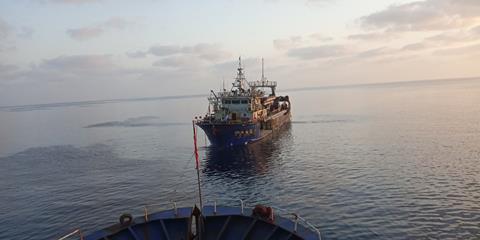
The agreement calls on coastal and flag states to improve the collection and sharing of fisheries data, including information on vessel ownership, licensing and fishing activity. It also supports the Global Charter for Fisheries Transparency, which outlines ten policy principles aimed at improving accountability and governance across the sector.
Supporters say the initiative is designed to address the growing challenge of IUU fishing, which is estimated to cost the global economy up to US$50 billion annually while threatening marine ecosystems, food security and the livelihoods of coastal communities.
Maisie Pigeon, director of the Coalition for Fisheries Transparency, said the declaration reflected growing international momentum behind greater openness in fisheries management.
“There is growing recognition that a productive and sustainable blue economy depends on strong ocean governance, effective monitoring, and accessible data,” she said. “The countries signing the Mombasa Declaration today represent a diverse range of economies and geographies, demonstrating that momentum for transparency at sea is truly global.”
Signatory countries have committed to practical reforms, including modernising vessel registries, publishing fishing authorisations and strengthening information-sharing to improve enforcement.
Beth Lowell, vice president at Oceana, said transparency was essential to protecting marine resources and communities.
“The Mombasa Declaration signals that governments around the world are ready to act against illegal fishing, and to work together for a more transparent, equitable, and sustainable ocean for all,” she said.
Steve Trent, chief executive and founder of the Environmental Justice Foundation, welcomed the agreement, saying: “Transparency is how we expose abuses, support coastal communities, and rebuild trust that fisheries can be managed sustainably and fairly.”
The declaration’s backers hope additional nations will join the initiative before the next Our Ocean Conference in 2027, expanding global cooperation against illegal fishing and strengthening ocean governance worldwide.