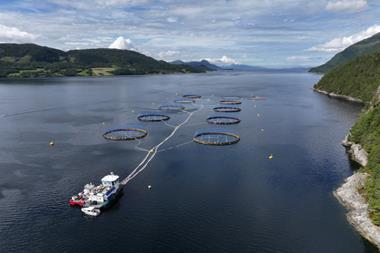



Following the decision taken by the US state of Washington to end commercial finfish net pen aquaculture, a large group of industry leaders have written to the Commissioner of Public Lands Hilary Franz, and Governor Jay Inslee to express their “collective concern” over the move and to demand an independent review of the science upon which the order is based.
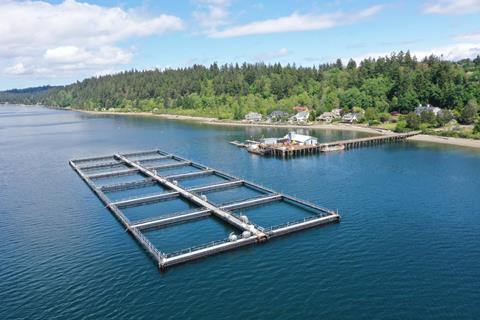
Commissioner Franz’s Order #202211, dated 17 November 2022, directed Department of Natural Resources (DNR) staff to “develop necessary changes to agency rules, policies, and procedures to prohibit commercial net pen aquaculture on state-owned aquatic lands” in the state of Washington.
But the industry letter, addressed to Commissioner Franz, expresses concerns about “the apparent unilateral and unsupported exercise of government power that does not demonstrate thoughtful, constructive thinking and fairness.”
The letter was written by a broad range of US national, state, and species-specific trade associations whose members either produce or harvest seafood that is destined for both domestic and international markets. Signers also include fisheries scientists, resource economists, veterinary medicine professionals and other industry stakeholders.
Additionally, the letter said the signatories found it “troubling” that the order:
- Fails to cite any credible, peer-reviewed analysis or analyses
- Fails to refer to an independent third-party (or even other state agencies) supporting the Order
- Ignores the recommendations in the April 2022 Washington Department of Ecology document fulfilling a requirement of House Bill 2957 (2018) ordered by the Washington state Legislature, “Commercial Marine Finfish Net Pen Aquaculture in Puget Sound and Strait of Juan de Fuca: Guidance and Risk Management” (Publication number 22-06-008)
- Fails to acknowledge the 40-plus years of science that federal and state agencies, including the DNR, have conducted regarding marine aquaculture – science which exists to help inform decision-makers on how to strike a balance between environmental conservation and aquatic food production
It stated: “We do not argue that aquaculture is without impact or risk. Zero impact or zero risk is an impossible standard that no food production system can live up to. At the same time, however, marine aquaculture from domestic production helps reduce the carbon footprint from imports.
“Given the fact that the commercial net pens affected by this Order occupy approximately .0004% of total state-owned aquatic lands, we believe that a third-party review is needed to show that the Order has no basis in scientific fact and is, in essence, an unsupported action by a government agency.”
The letter ended by suggesting there were several possible candidates capable of conducting such a review.
“We sincerely hope you and your staff have sufficient confidence in either the University of Washington School of Aquatic and Fishery Sciences, the National Marine Fisheries Service, and/or the NOAA National Center for Coastal Ocean Sciences as capable of examining an action that most of the US seafood industry believes to be just plain wrong,” it said.