



Hybrid workboat first
A new hybrid-powered workboat is the first of its kind to be used in Scotland’s aquaculture sector.
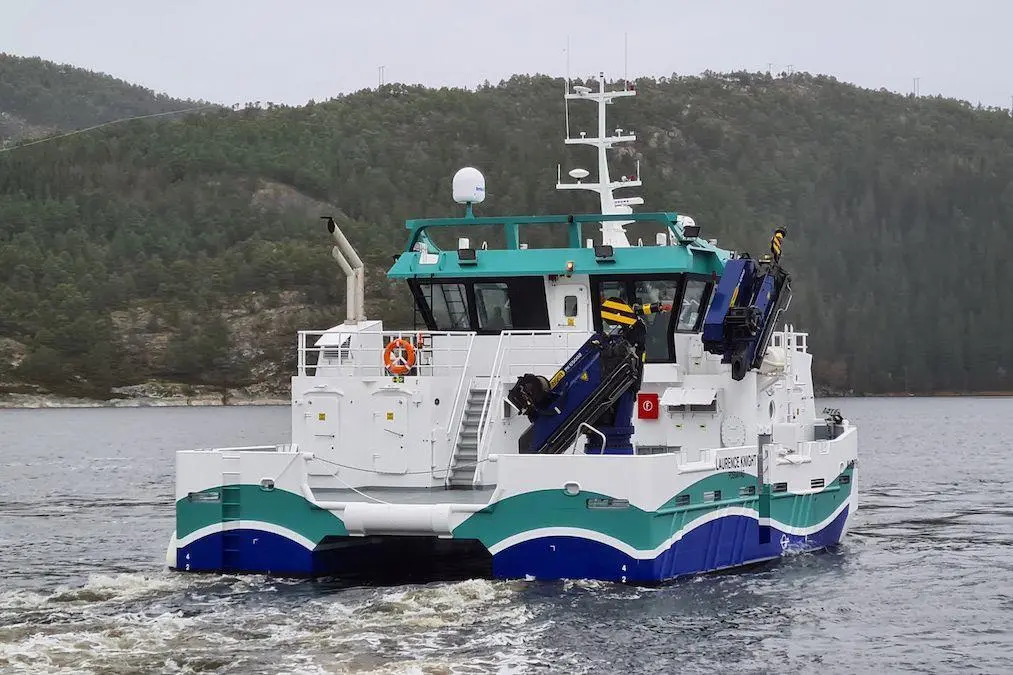
Salmon farmer Scottish Sea Farms has taken delivery of the 15m catamaran, which was commissioned by Mull-based boat operator Inverlussa Marine Services from Norwegian yard Moen Marin and goes into service this month on Scotland’s west coast.
Ben Wilson, managing director of Inverlussa, said: “There are similar hybrid vessels in Norway and we thought it was the right time to introduce this technology to our Scottish customers, who are committed to lowering their environmental impact.”
For Scottish Sea Farms, the new vessel will help achieve CO2 savings of around 234t a year, as well as potentially cut fuel costs by up to 50%.
Durable batteries
Laurence Knight will run primarily on its batteries, marking a ‘massive milestone’ in both carbon reduction and cost savings.
The boat can perform on-farm duties for five to six hours without recharging its batteries from either of the two generators onboard.
This means the generators do not need to be running when the boat is tied up alongside a salmon pen, assisting with a harvest or a net installation, for instance.
And with no demand for an overnight generator, noise will be reduced, as well as diesel fuel consumption and the vessel’s carbon footprint.
244kW battery hours
The batteries, with a total capacity of 244kW hours, can drive cranes and all other energy requirements, including steaming back and forth from the shore. As soon they need recharging, the generators kick in automatically, and they can also be recharged from shore power.
With the new boat, data can be collected from the batteries for analysis back on shore. The technology allows Scottish Sea Farms to manage every individual cell within the battery pack to get the most efficient use out of it.
The batteries have a typical life expectancy of 16 years and are also 100% recyclable.
Related Articles
 AQUACULTURE
 SEAFOOD
 SEAFOOD