



MarinTrust is calling or greater transparency, traceability and collaboration across aquaculture supply chains as demand for responsibly sourced aquafeeds continues to grow globally.
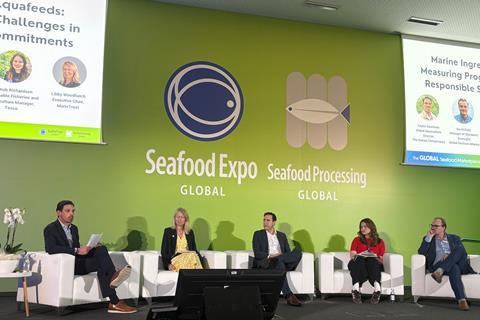
Following her participation in the session entitled “Marine Ingredients in Aquafeeds: Measuring Progress and Challenges in Responsible Sourcing Commitments” at Seafood Expo Global, Libby Woodhatch, executive chair of MarinTrust, explains the aquafeed sector is entering a critical phase where sustainability expectations, certification requirements and supply chain resilience are increasingly shaping commercial decisions across aquaculture.
“Responsibly sourced marine ingredients play a critical role in animal health, feed efficiency and overall sustainability performance,” Ms Woodhatch says, highlighting the growing pressure on the aquafeeds sector to demonstrate credible responsible sourcing practices.
Mounting scrutiny
The global aquafeed market continues to expand as fed aquaculture maintains long-term growth momentum, with seafood outperforming other animal proteins in consumption trends.
However, Ms Woodhatch says the value chain is simultaneously facing mounting scrutiny over sustainability, traceability and human rights due diligence in increasingly complex international supply chains.
She says that one of the central challenges is the constrained availability of marine ingredients, with all available supply already being consumed globally. At the same time, evolving retailer, regulator and investor expectations are driving demand for greater accountability and independently verified certification systems.
Recent research from the University of Stirling shows that changes in aquafeed composition over the past two decades have significantly increased the environmental footprint of European aquaculture.
The study identified reduced reliance on wild fish in feed formulations and their subsequent replacement by plant-based ingredients as a dominant factor behind environmental performance changes across the sector.
Alongside this shift, the increasing production of fishmeal and fish oil from fish by-products is creating new opportunities for the marine ingredients industry. Ms Woodhatch says the upcycling of aquaculture by-products is helping place future supplies of marine ingredients on a more positive trajectory, while also reinforcing circular economy principles within aquaculture.
Certification programme
MarinTrust has always worked directly with companies through its Factory Standard certification programme, which verifies that marine ingredients are responsibly sourced, produced and fully segregated throughout the production process.
Fisheries supplying certified fishmeal and fish oil must either comply with MarinTrust-recognised schemes or undergo independent assessment aligned with the FAO Code of Conduct for Responsible Fisheries.
For fisheries and supply chains facing data limitations or capacity constraints, the organisation operates an ’Improver Programme’ designed to support gradual, time-bound improvements through fishery action plans.
“This approach enables companies to demonstrate progress while maintaining credibility and transparency toward buyers, retailers and regulators,” Ms Woodhatch explains.
Traceability remains a central focus for the organisation as aquafeed supply chains become increasingly globalised and diversified. MarinTrust’s Chain of Custody Standard is designed to provide traceability assurances for traders, storage operators and processors handling certified marine ingredients across the value chain.
Ms Woodhatch highlights the growing use of blended oils within aquafeeds as one area where stronger traceability systems are becoming increasingly important. While blended oils can offer nutritional and commercial advantages, inadequate traceability can expose feed producers and seafood brands to reputational and sourcing risks.
Future demand
A recent joint MarinTrust and Global Seafood Alliance workshop held alongside the IFFO Members Meeting in Madrid examined how aquafeed certification frameworks are evolving in response to market expectations.
The session brought together feed producers, retailers and certification bodies to discuss practical approaches to managing complex global sourcing networks.
Looking ahead, Ms Woodhatch expects aquafeed demand to continue rising, although growth rates are likely to vary significantly by region.
Asia, particularly China, is expected to remain the primary growth driver, while more mature aquaculture markets in Europe and North America are forecast to expand at a slower pace.
Future development within aquaculture, she says, will increasingly focus on efficiency, resilience and science-based decision-making rather than volume growth alone.
Certification and responsible sourcing systems are expected to play an increasingly important role in maintaining the sector’s social licence to operate and attracting long-term investment.
“At Seafood Expo Global, the key message was that certification is about continuous improvement, not perfection,” Ms Woodhatch says.
“Better data, greater realism in reporting requirements, and clearer communication across the value chain are essential to avoid misinformed decision making at all stages.”
MarinTrust is currently prioritising projects aimed at strengthening traceability and integrity across marine ingredient supply chains, particularly as the use of fish by-products continues to expand. To date, the organisation’s standards have assessed more than 120 species connected to by-product sourcing streams.
Ms Woodhatch concludes that collaboration across fisheries, processors, feed producers, retailers and seafood brands will remain essential if the aquaculture sector is to deliver credible sustainability outcomes and secure long-term responsible sourcing commitments across global aquafeeds markets.