



Armon delivers Nesfiskur factory trawler
Designed by Skipasýn and built at the Astilleros Armon shipyard in Vigo, the new factory trawler Baldvin Njálsson is big step up in capacity and technology over the older trawler it replaces.
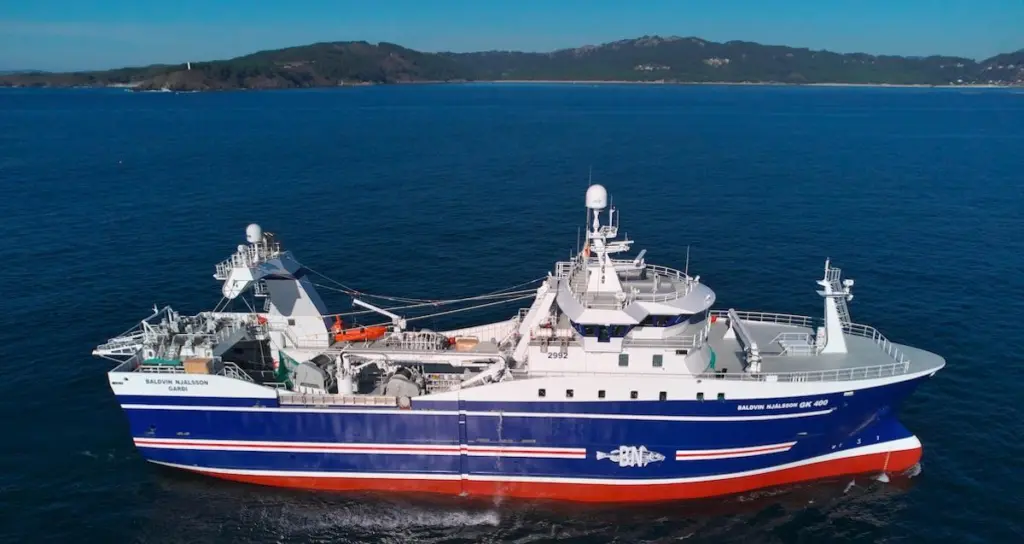
The new trawler has a 65.60 metre overall length and a 16 metre beam, providing greater deck, factory and fishroom space compared to the previous vessel, which was built in Spain for its original owners in Norway before changing hands several times under the Icelandic flag. It has now been sold to Russia and will be operating in the Far East.
Nesfiskur went to naval architect Skipasýn to design a new trawler to meet their requirements for more efficient operation and more economic running, and Armon was selected as the builder. Once the planning and preparation were completed, Armon’s Vigo yard built the new Baldvin Njálsson in only fifteen months. Although a delay in delivery had been predicted due to Covid-19 and its effects on the yard’s working methods, the new trawler was handed over practically according to the original schedule.
“Armon is very proud to have built this vessel for Nesfiskur,” said Ricardo Garcia, commercial director at Astilleros Armon.
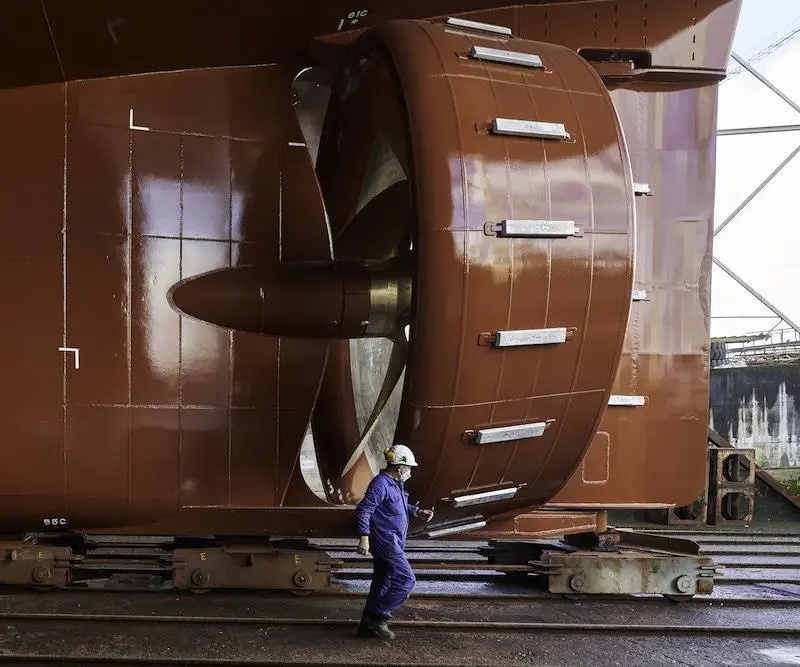
“Taking into account that both Armon and Nesfiskur are family companies, the relationship and collaboration between us throughout the whole project has been the main ingredient in achieving a very successful end product. Thanks to the massive propeller diameter that’s a feature of the Skipasýn design, the results on the recent sea trials surpassed everyone’s expectations. We would like to wish crew of Baldvin Njálsson full codends and safe trips.”
Baldvin Njálsson docked for the first time in Iceland at the end of November, after a delivery trip from Vigo that took it through a bout of heavy winter weather.
Like its predecessor, Baldvin Njálsson has a Wärtsilä main engine and this is in the same power range as that of the older trawler – but driving a significantly larger propeller to deliver a 72-tonne bollard pull, as well as providing a 15 knot top speed.
The Wärtsilä propulsion system includes a 6L32 main engine and SCV100 reduction gearbox with a 9.03:1 ratio. This powers a 5-metre propeller inside a nozzle. The arrangement is designed to minimise fuel consumption and emissions, as well as noise levels and vibration, the result is also one of the quietest propulsion systems for a vessel of this kind.
Electrical power for the ship’s systems is derived from a floating-frequency 1875kW shaft generator, which allows a reduction of main engine revolutions, depending on conditions, as well as from the 596kW Scania D116 gensets.
Steering gear is from Hydramarin and the rudder is a Becker high-lift unit, and a 400kW, 1300mm bow thruster aids manoeuvrability.
Baldvin Njálsson has accommodation for a crew of up to 28 in six single and eleven twin cabins, and operates with two full crews.
Nesfiskur took the option of electric deck equipment from Ibercisa, with three main 250kW, 48-tonne trawl winches placed above and clear of the working deck, and controlled by a Scantrol autotrawl system.
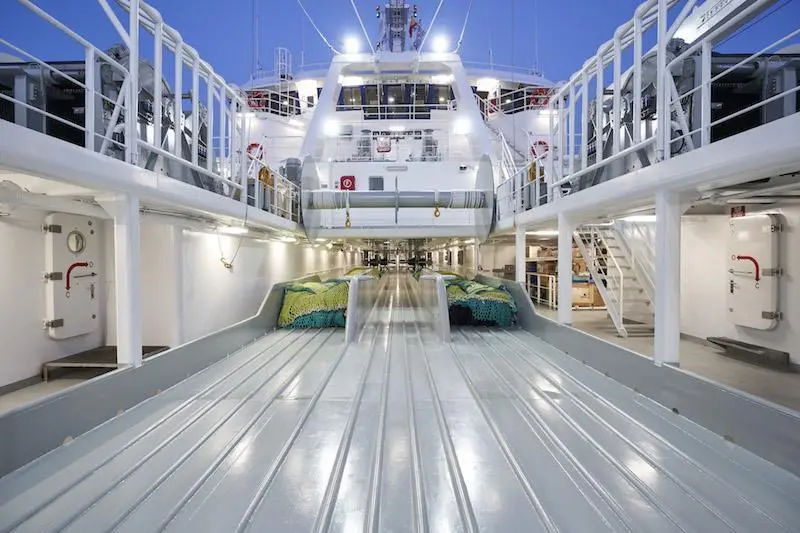
There is a bank of six 55kW, 15-tonne sweeplines at the head of the three full-length trawl lanes where three sets of gear can be ready for use, and there is a single 110kW, 29-tonne net drum over the deck.
Ibercisa also supplied the 24kW, 24-tonne gilsons and 13-tonne outhaul winches, which are partnered by 0.60-tonne backhaulers. There are 55kW, 13-tonne codend winches each side of the aft deck, plus there are 4-tonne auxiliary winches, 0.60-tonnes backstrop lifts, gear handling winches for the trawl deck and an anchor winch from Ibercisa. The Ferri deck cranes are 60t/m and 20t/m units.
Baldvin Njálsson is fishing with a single Hátoppur and a pair of Bacalao trawls for twin-rigging, supplied by Netagerð Suðurnesja, and the gear is spread with a 10.50 square metre pair of Injector Shark trawl doors supplied by Mørenot, along with an 8500kg centre weight.
The factory deck has been fitted out with an Optimar system for producing whitefish fillets, and processing lines for H&G redfish and Greenland halibut, with heading and gutting systems, and electronic grading according to grade and weight. Kapp supplied an Optim-ICE BP 120 slurry ice system for cooling catches prior to processing.
Production is routed to a highly automated freezing and packing arrangement, with the packed cartons delivered to the vertical and horizontal freezers, which have an 80 tonne/day throughput capacity.
Frozen products are automatically discharged from the freezers and pass to a freezing hotel where these are held until the right number of boxes of a each type have been produced, when these are automatically palletised, wrapped and transferred by elevator to the 1720 cubic metre fishroom. The refrigerated fishroom has its own forklift for stacking the full pallets. Palletised operation results in savings when landing catches, as pallets are already sorted and can go direct to cold storage ashore without needed to be sorted.
Related Articles
 PROCESSING & REFRIGERATION
 VESSELS & SHIPYARDS
 VESSELS & SHIPYARDS