


Parkol Marine wins UK survey-patrol newbuild contract
UK’s North Eastern Inshore Fisheries and Conservation Authority (NEIFCA) has teamed up with boat builder Parkol Marine to build a new, first-of-its kind survey and patrol vessel.
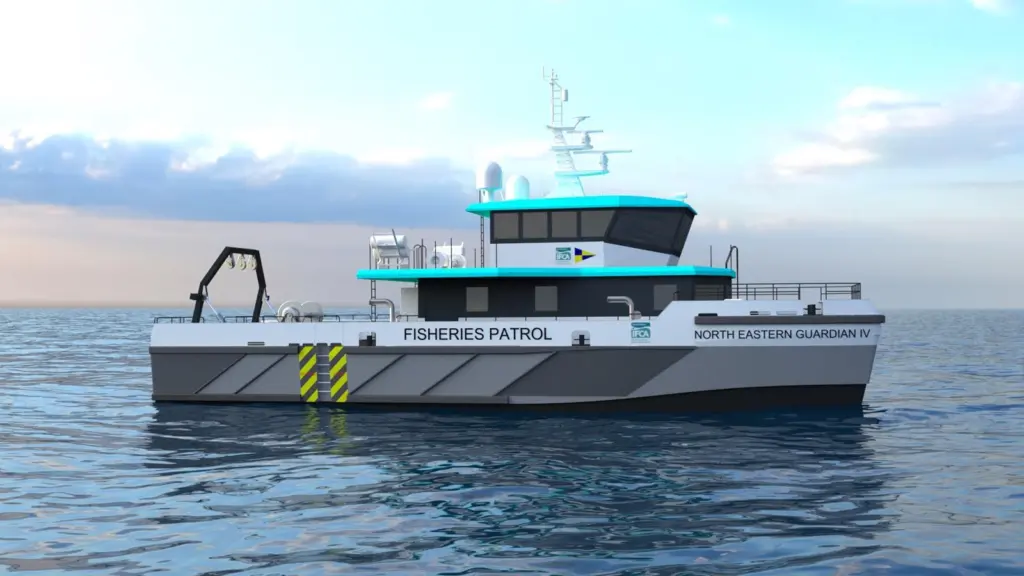
Developed in partnership with UK naval architects Chartwell Marine, the newbuild will dramatically boost the organisation’s capabilities at a crucial time for the region’s fisheries. It’s hoped the vessel, which is yet to be named and is due to be commissioned in the Spring of 2025, will become a blueprint for inshore fisheries and conservation authorities around the UK.
Nine years in the planning, this will be the fourth generation of inshore fisheries patrol vessel, with a heritage going back to 1890 when the then Sea Fisheries Committee was established. The first inshore patrol boat, powered by steam, set sail in 1905.
Replacing North Eastern Guardian III (NEG III), it will be faster, more environmentally-friendly and better capable of providing detailed data on the area’s marine life. This will enable the organisation to better plot trends in marine life and strategise to protect and diversify it in the future.
It will feature an aluminium hull, making it more fuel-efficient and capable of carrying heavier cargo loads, and will have a top speed of 20+ knots. A dedicated onboard wet lab will enable NEIFCA personnel, scientists and environmentalists to analyse samples in the field, forming faster, more accurate conclusions, while high-tech acoustic equipment including multi-beam echo sensors, will provide ultra-accurate 3D images of the seabed and under-water activities.
Nationally, IFCA is responsible for policing UK inshore fisheries, carrying out inspections at sea and ensuring fishermen and others adhere to the latest regulations. The authority’s duties shifted significantly in 2010, with around 80% of NEIFCA’s activity now focused on marine protection as well as fish and shellfish management.
NEIFCA’s region includes 900 square kilometres of protected marine areas.
Eighty-five percent of regional fishing vessels operate within this area, with the industry worth GBP 33 million annually.
Capable of travelling up to 60 nautical miles offshore, the new vessel will also play a key role in supporting the work of partner organisations where there is an urgent need, such as policing illegal incursions of fisheries limits and responding to extreme marine environmental events.
IFCA Chief Officer David McCandless said the organisation’s evolution also coincides with a hugely important evolutionary period for the UK fisheries generally.
“Post-Brexit, the political agenda has shifted and the government is reviewing previous regulations such as quotas as a matter of urgency, to support our homegrown fishing industry. Therefore, new data which helps us to build a clear picture of what needs to be done to build and manage our marine livestock, has never been as important as it is now.
“Stringent European quotas significantly restricted the amount of white fish our regional fisherman were allowed to catch over recent decades and many fell back on crab and lobster fishing, which now represents 90 per cent of local activity, an over-reliance which could threaten our regional industry if, for example, stocks became dangerously depleted or were hit by a catastrophic environmental event.”
McCandless added: “Data generated by the new boat will help us assess changes to marine habitats, formulate plans to manage them better and assess the effectiveness of those activities. It will also help us identify where there is an abundance of alternative fish, such as whelks, prawns, scallops and squid, which we can help our local fishermen to capitalise on, informing future UK fisheries policy.
“Unfortunately, events in the River Tees in 2020 demonstrated just how precarious over-reliance can be, with a high proportion of their crab, lobster and other marine life wiped out overnight for still-unexplained reasons. Therefore, through careful investigation we want to be able to give our fishermen access to a wider range of species again as a protective step. We are hopeful that the new Fisheries Act 2020 will result in more scope for our local fisherman, and hopefully we can positively impact how that evolves.
“It’s a huge feather in the cap for our region’s fisheries that, following a hugely competitive international tender process, this vessel is going to be built in our home port, by a local company with such a long and respected shipbuilding heritage as Parkol. When completed, it will be a frontrunner for the whole country, demonstrating what can be achieved in the battle to preserve our precious sea environments. We’re hugely excited about watching the boat take shape over the next year-and-a-half, and then seeing the difference it can make.”
The vessel will be built at Parkol’s yard in Whitby.
“We’re absolutely delighted to have been granted this opportunity, which represents a number of firsts for Parkol Marine – it is the first catamaran, first government tender that the company has won and is the first workboat of this type. It is also the first time we have worked with Chartwell Marine and their innovative style of ship design. The contract provides us with an opportunity to nurture homegrown skills with our existing aluminium welders/fabricators, and also to recruit dedicated aluminium specialists and an apprentice utilising our established apprenticeship programme,” Parkol Marine’s Commercial Director Sally Atkinson said.
“It’s also the first competitive public tender we’ve bid for and to have won it is a fantastic achievement. There is an increasing amount of optimism in the UK fishing and shipbuilding industries and we’re delighted to be part of that, working with new suppliers to increase our already-significant knowledge and experience and hopefully creating more job opportunities and further expanding our skill base.”
NEIFCA is largely funded by local authorities and a proportion of the finance for the vessel is being provided by a combination of 11 of these, including East Riding of Yorkshire Council as the lead authority and North Yorkshire Council. It will also be sourcing a proportion of the money itself – from savings and the sale of its existing vessel, as well as grant funding from the Department of the Environment and Rural Affairs (Defra).