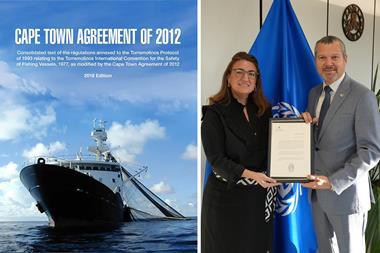





Efforts to combat illegal, unreported and unregulated (IUU) fishing have received a boost from the People’s Republic of China, the world’s largest capture fisheries producer, which has become the 108th State to join the FAO Agreement on Port State Measures to Prevent, Deter and Eliminate Illegal, Unreported and Unregulated Fishing (PSMA).

The PSMA supports sustainable fisheries by ensuring that only legal, regulated and reported fish catches are landed in ports and eventually traded. It does this by enabling Parties to deny port entry or use of port to foreign vessels suspected of engaging in IUU fishing, thereby preventing catches from such illicit practices from reaching markets and consumers.
“China’s accession to the PSMA is a milestone in the global effort towards responsible governance and sustainable development of fisheries,” said QU Dongyu, the Director-General of the Food and Agriculture Organization of the United Nations (FAO). “This step reflects the growing strong commitment of all the States that preceded and those who will follow China in joining hands to combat IUU fishing through the PSMA framework.”
China’s decision to become a Party to the PSMA is seen as a significant development in the implementation of the agreement as it represents one of the most important fishing nations.
According to the FAO, China is the world’s top producer of aquatic animals in marine capture fisheries accounting for around 15% of the global total in 2023. China’s fishing fleet is estimated to number more than 500,000 fishing vessels, 342,000 of which are motorised, placing it among the top three countries in terms of fishing capacity.
Prior to China, Ukraine and Saudi Arabia in March 2025 were the latest states to become a Party to the PSMA. Other states are at an advanced stage in acceding to the agreement.
The number of Parties to the PSMA now stands at 82, including the European Union which is a Party on behalf of its member states, bringing the total number of states that are now bound by the agreement to 108. The PSMA has the highest rate of adherence of all international fisheries and ocean-related instruments.
The PSMA’s implementation is backed by complementary instruments, such as the Global Record of Fishing Vessels and the PSMA Global Information Exchange System (GIES), which help port state authorities verify vessel identities and share compliance information with port, flag and coastal states and other concerned entities. These technologies enable real-time, cross-border collaboration, ensuring that vessels engaging in IUU fishing can be tracked, enhancing global enforcement efforts to conserve marine ecosystems and ensure sustainable fisheries.
The PSMA entered into force in 2016. Parties meet every two years to discuss and take decisions on its implementation and identify ways to increase its effectiveness in combatting IUU fishing.
A fifth meeting of the parties is scheduled to take place on 21-25 April 2025, in Manta, Ecuador.