




COFI focuses on food insecurity, malnutrition and poverty
The 36th Session of the Committee on Fisheries (COFI36), 8-12 July 2024, held at the headquarters of the Food and Agriculture Organisation of the United Nations (FAO) in Rome, focused on the vital role of fisheries and aquaculture in tackling food insecurity, malnutrition and poverty, stressing their ability to alleviate hunger, drive sustainable growth and reverse environmental degradation.
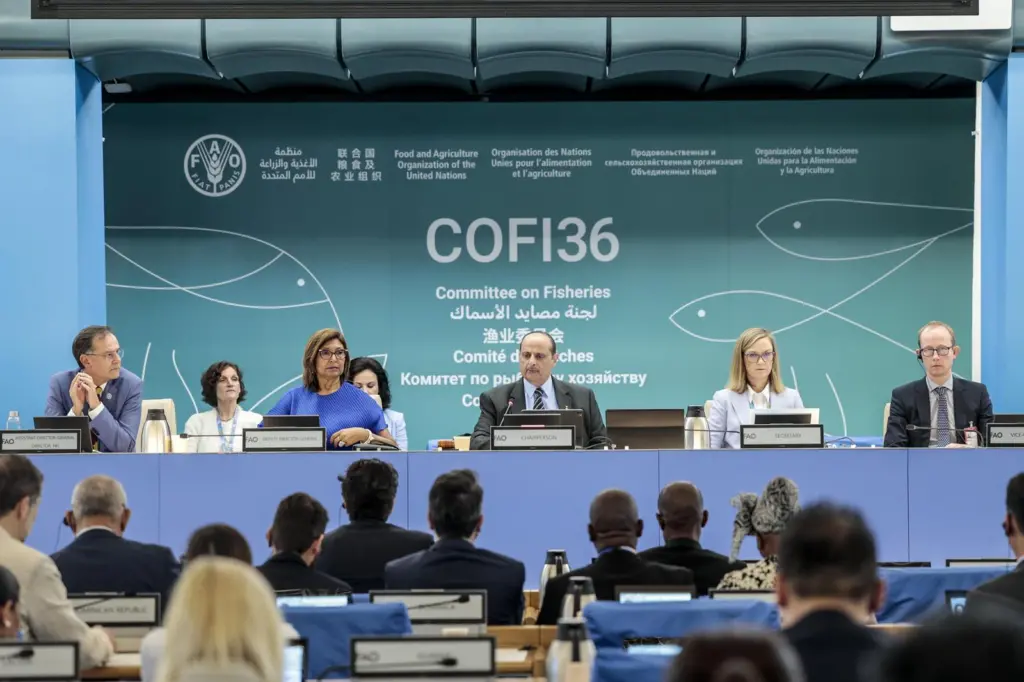
COFI is the largest global gathering of policymakers, experts and partners in the fisheries and aquaculture sector.
“An increasingly expanding global aquaculture sector is driving the supply of fish and fishery products to new records. In 2022, aquaculture overtook capture fisheries as the main supplier of aquatic animals. Ensuring the expansion of sustainable aquaculture is of fundamental importance for consumers,” Qu Dongyu, the Director-General of FAO, said in a video message at the opening of the session.
Last month, FAO issued the latest edition of its The State of World Fisheries and Aquaculture (SOFIA) report which showed that world fisheries and aquaculture production hit a new high of 223.2 million tonnes in 2022 and in his message, Qu pointed out that aquatic foods must contribute further to the fight against hunger and malnutrition for a growing population. But, for this to be the case, the sector needs to ensure aquaculture continues to grow sustainably, particularly in food deficit regions, and that successes in setting effective fisheries management systems are extended to fisheries whose sustainability is challenging.
Furthermore, the FAO Director-General said developing the value chains of aquatic foods, including by reducing loss and waste and facilitating product access to markets, is also urgent.
Topics discussed included the role of aquatic foods in global food security and nutrition, their potential as a solution to climate change, and the contribution of effective management to long-term biodiversity goals. Additionally, solutions and actions to address pressing challenges confronting aquatic food systems, such as climate change and plastic pollution are being explored.
Central to discussions are efforts to enhance data collection and stock assessment systems to inform fisheries management, urging countries to strengthen evidence-based policymaking. At the session, the first results of FishMIP 2.0, a global initiative forecasting the impact of climate change on marine ecosystems and fisheries under different future climate scenarios were presented.
Biodiversity conservation featured prominently, with a call to delegates to discuss the implications of the Kunming-Montreal global biodiversity framework on fisheries and aquaculture in both large marine ecosystems and in areas beyond national jurisdiction.
Also held was a high-level event marking the tenth anniversary of the endorsement of the Voluntary Guidelines for Securing Sustainable Small-Scale Fisheries in the Context of Food Security and Poverty Eradication (SSF Guidelines), which highlighted the critical contributions of small-scale fishers and fish workers to food security, nutrition and livelihoods, particularly in low-income and lower-middle-income countries. Small-scale fisheries account for at least 40 percent of the global capture fisheries catch and about 90% of the total number employed in fisheries globally. The estimated landed economic value of small-scale fisheries is $77.2 billion.
In a video message to the event, the FAO Director-General said: “The SSF Guidelines are the world’s first and only global normative instrument entirely dedicated to small-scale fisheries. The needs and aspirations of more than 500 million people around the world are reflected in those guidelines,” referring to the number of people who rely on small-scale fisheries at least partially for their livelihoods.
The event also featured speeches by representatives of the European Commission, Peru, the Philippines, the United Republic of Tanzania and the United States of America, as well as small-scale fisheries.
COFI, a subsidiary body of the FAO Council, was established by the FAO Conference in 1965. It is the only global inter-governmental forum where FAO members meet to consider the issues related to fisheries and aquaculture.
It provides periodic global recommendations and policy advice to governments, regional fishery bodies, civil society organisations and actors from the private sector and international community. Plenary sessions of COFI take place every two years. Typically, they discuss and address current issues related to fisheries and aquaculture, review progress, and set priorities for future work.
Related Articles
 SEAFOOD
 SEAFOOD
 FISHERIES