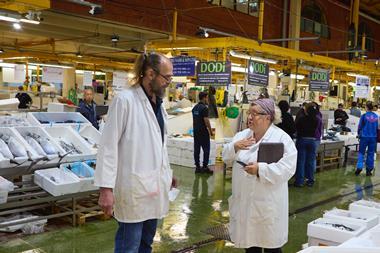




Growing consumer awareness, the association believes, will reduce the market for illegally caught tuna which is supplied mostly by foreign vessels. Discouraging consumption of illegally landed tuna, in turn, will raise demand for legally caught fisheries products landed by Japan’s fishing fleet.
JFA’s initiative to target consumers to combat competition from low priced fishery imports is being stepped up following the recent introduction of new fisheries resource management regulations by central and regional government agencies. These are aimed at reviving fishery stocks in Japanese waters and ensuring sustainable fishing in the future.
Fish imports now account for 45% of all fishery products consumed in Japan and pose a growing problem for local fishermen who now have high fuel prices to contend with.
Fuel costs
“The biggest issue now is fuel prices which are very high now. It’s the biggest problem for offshore fishermen such as squid jiggers, long liners and purse seiners,” commented Isamu Abe, operations division director at Japan Fisheries Association, “Fuel prices are not going to decrease in future, so the problem is getting bigger every day. The whole fuel cost for fishing is increasing. Fish prices, on the other hand, have been decreasing every year since the 1990s.”
“Fishing companies are not earning good profits, so the age of their fishing vessels is getting older. The average age of our fishing boats is 18 years, while the oldest are about 22 to 25 years which for fishing is quite old. Among Japanese fishing companies only 30% are earning a profit while about 30% are almost bankrupt.”
“The biggest problem is that fish prices are not increasing and imports are growing. The ratio of fish consumed is almost equal between the local catch and imported fish. Imports are decreasing the price of fish.”
Japan’s total annual fishery production has halved since the mid-1980s while fishery imports have risen at the same time offsetting the shortfall in the domestic annual catch. A surge in fish imports and a decline in domestic production occurred from the mid-1980s to the mid-1990s.
The decline since then in domestic catch and the corresponding rise in fishery imports have been more gradual, with the annual import volume subject to fluctuation. Japan’s major fishery imports include tuna, shrimp, prawns, mackerel, sardines, saury, Pacific cod, trout, salmon, crab, cuttle fish and octopus.
Although Japan’s fishing industry faces tough competition, consumption of fishery products has risen with the availability of cheap imports. According to the United Nations Food and Agriculture Organisation, Japan has the world’s second largest per capita fishery production supply after Iceland at 67.4kg per year.
Japan is the world’s third largest fishery producer with a total catch of 6.08 million tons in 2003 accounting for about 4% of total world fishery production compared with first placed China which produces 35% of the world’s fishery production and second placed Peru with 8%.
Offshore fisheries production totalling 2.54 million tons annually accounts for 42% of Japan’s total fishing catch, followed by coastal fisheries production of 1.57 million tons which represents a further 24% of production. Marine aquaculture totalling 1.25 million tons and the 600,000 tons distant water fisheries catch make up most of the balance.
Major species caught include common mackerel with about 250,000 tons caught annually along with about 200,000 tons of saury, 215,000 tons of skipjack tuna, 230,000 tons of Japanese anchovy, 125,000 tons of jack mackerel and 145,000 tons of Alaska Pollack.
JFA
Japan Fisheries Association is an umbrella association for the entire fishery industry to promote sales and consumption of fishery products. Established in 1882, JFA today has 407 members including major fishing companies and other individual members along with associations for fish farmers, fishing boat builders, fishing equipment manufacturers, fishery importers, distributors and fish processors, along with other associations for trawlers, long liners, whalers, squid jiggers, purse seiners and many other fishermen’s groups.
“We represent the interests of fishermen. Big fishing companies like Maruha and Mitsui are direct members. The member fishing associations are separated by the fishing gear their members use,” Abe said.
Japan is one of several countries in the Asia-Pacific region opposed to various World Trade Organization (WTO) policies designed to promote trade but which local fishermen feel penalise them by encouraging imports. JFA opposes WTO efforts to reduce import taxes and moves to remove subsidies to the coastal fishing industry which the association believes are vital to sustain coastal fishing communities.
“We do not support the WTO aim to decrease import taxes on fishery products. The main reason is that imports decrease fish prices and cause or result in over fishing,” Abe said, “One other reason for the decrease in fish prices is other food choices like beef, pork and chicken. Fishing companies are not making profits. Their vessels are getting old. This is a big problem for fisheries in future if fishing companies cannot build new vessels.”
“For food supply safety we think fish should be a domestic product. The WTO is for decreasing agricultural grants and subsidies, but we think there must be a level for grants and we think this is needed for Japan. The biggest problems are the high cost of fuel, low fish prices and ageing fishing vessels.”
Lack of grants
Abe pointed out that Japanese government fishery grants are not used to increase fishing efforts or capacity, and that no fuel subsidies are provided. Most grants are used for fishing port infrastructure building. No grants are paid direct to fishermen.
Grants also are used to rationalise the fishing fleet. Grants were paid as compensation to fishermen when the government scrapped 132 long line tuna vessels in 2001.
“Taiwan and South Korea take the same position as the Japanese government, but countries supporting WTO take a different position,” Abe said, “We think fishery importing and exporting countries have a different view point so it is difficult to reach agreement between the countries. Some countries propose to reduce subsidies to zero but food security and world trade are different issues.”
“One of our members, the Zengyoren (Fishing Cooperative) Association, is trying to rebuild the Japanese fishing community, but if there is no fishing then there will be no community. Zengyoren has a hard time to solve the problem. We think the WTO cut off idea is not good for fish stocks and food security.
While JFA continues to press the Japanese fishing industry’s case with the WTO for retaining some form of subsidised support along with fishery import duties, the association is backing efforts by the Organisation for Promoting Responsible Tuna Fisheries (OPRT) to clamp down on illegal tuna fishing.
The Patagonian toothfish and tuna are the two most well known instances of where fishing by illegal, unprotected and unregulated (IUU) vessels have affected fishery stocks. Japan already has scrapped 132 long liner vessels as a contribution towards reducing the large global overcapacity in tuna catching.
Japanese fishermen, as noted earlier, catch about 210,000 tons of skipjack tuna a year. Tuna also is Japan’s largest fishery import with about 415,000 tons of tuna imported annually including 160,000 tons of big eye and 140,000 tons of yellow fin.
“OPRT is campaigning for consumers not to buy IUU fishery products and drawing up a list of regulated vessels called the ‘white list’ so that buyers should buy tuna products only from white list vessels,” Abe said, “The global fleet capacity is too big for tuna long line fishing and tuna are over fished. We scrapped 132 vessels and OPRT is moving on countries like Taiwan, South Korea, China, Indonesia and others to scrap their old long line vessels.”
“IUU vessels are mostly Taiwanese vessels flying flags of convenience. These are unregulated and fish everywhere. This is one area where we are taking action. The white list idea is a first. Several years ago flag of convenience vessels were registered in Panama, Belize and Honduras. We stopped those products from entering Japan under a tuna products law.”
Labelling standards
As part of Japanese government efforts to support the fisheries industry as well as the agricultural sector which faces competition from low cost fruit, vegetable and meat imports, the government tightened labelling standards for 20 processed food categories in September 2004 raising quality label standards to a level almost equivalent to fresh food labelling.
Six fishery product categories are now required to show the place of origin on their labelling – the categories being dried fish and seaweed; salted fish and seaweed; seasoned fish and seaweed; boiled or steamed fish and seaweed; roasted fish; and battered fish.
Many fishery cooperative associations are promoting brand development and other initiatives to add value to fishery products while other groups are developing traceability systems for fishery products to support local fishing communities.
“We are trying to stop IUU tuna imports under the tuna law but for other products there is no law. Now we are debating introducing an eco-labelling system. This is for sustainable fish stocks and not to over fish,” Abe said.
“JFA’s policy is to raise fish prices to support fishermen. But under the WTO there is no way to stop imports and with imported products we do not know if they are controlled by fisheries management in their country of origin. We think that the decision about what to eat must be made by the consumer finally. One of our big issues is to provide information to the consumer. We hope fish prices will increase. We think that fish stocks must be controlled by responsible fishing and by OPRT.”
Revitalisation
Meanwhile, efforts continue to revitalise Japan’s declining fishing industry and support traditional fishing communities. According to JFA, some 2,214 fishing ports used primarily for fishing are scattered along the Japanese coastline at a distance of about 12km apart. Some 238,000 people are employed in the fishing industry which consists of 132,000 fishing operations, many being individual operations run by an individual fisherman.
Current measures to support the fishing industry date back to 2001 when the Ministry of Agriculture and Fisheries introduced the Basic Fisheries Law aimed at boosting stocks of major fish species and conserving fishing grounds. Limits have been established on fishing boat access to fishing grounds and fishery resource restoration plans drawn up including the release of seedlings to increase and conserve fishery stocks.
In addition a total allowable catch system has been introduced to protect seven major species – saury, Alaska Pollack, sardine, jack mackerel, common mackerel, spotted mackerel, common squid and snow crab.
In 2005 further regulations were introduced to regulate red snow crab fishing in the Sea of Japan, anchovy trawling in Seto inland sea, pole fishing for snappers around the Nansei islands, Kuruma prawn fishing off Ooita, sea cucumber harvesting in Oomura Bay and shellfish gathering off Kumamoto.
“Our strategy will take a long time,” Abe admitted, “JFA thinks that responsible fishing is a big issue, while a bigger issue is responsible consuming. We think that fair trading is a good way to do this. We also think that food security and business do not agree. Responsible fishery buying is an issue as well. But WTO is not about responsible trading; they only look at free trade.”