





Rebuilding Abu Dhabi Fisheries
There is still hope – natural ecosystems are resilient and can bounce back if initiatives are taken at the right time, writes Dr Shaikha Salem Al Dhaheri, secretary general of the Environment Agency-Abu Dhabi (EAD), the largest environmental regulator in the Middle East.
Early one winter morning, I set out for the Mina Fish market in Abu Dhabi along with my team of fisheries enumerators. While the rest of the Abu Dhabi was fast asleep, the Mina fish market was full of life, but what we were witnessing in front of us, small catch sizes and even smaller fish, was indicative of something gone badly wrong.
This was five years back, when I headed the Biodiversity Sector at the Environment Agency. The fisheries sector was at tipping point and that day, we made a promise to turn it around.
Abu Dhabi’s marine area covers more than 48,000km2 and has around 1100 licensed commercial fishers. There are nearly 500 licensed commercial fishing vessels, operated by over 3000 crew and an equal number of recreational fishers. Both commercial and recreation fishing were putting enormous pressure on the already depleted fish stocks.
According to our studies, the three most landed demersal fish species, orange spotted grouper (hamour), spangled emperor (shaari) and painted sweetlips (farsh) were being exploited at a rate estimated at five times the sustainable limit.
This grim scenario triggered a range of research, policy, and regulatory responses in Abu Dhabi.
The launch of the UAE Sustainable Fisheries Programme in 2015 was set up to achieve a sustainable fishery by 2030. Under the programme, a comprehensive Fisheries Resources Assessment Survey (FRAS) was undertaken between 2016-2017 in the UAE waters. The results were startling. Our fish stocks had declined by around 90%. Further independent data further corroborated what fisheries inspectors had found at our landing sites. With less than 10% of stocks being sustainably exploited, our fisheries were severely overexploited and almost in a state of collapse.
These shocking results triggered urgent activities to revive the fishery sector. We consulted key stakeholders, talked to our community and held series of local community (majlis) sessions. In 2019, alongside the World Ocean Summit held in Abu Dhabi, we launched our recovery plan.
We banned the sea cage trap (locally known as gargoor), a non-selective method. We also banned the use of encircling gill nets. A series of intensive community engagement and a media campaign followed the regulatory reforms. In addition, we developed an IUCN Guideline on integrating fishers’ knowledge in fisheries policy. The guidelines, produced in consultation with 50 international experts from16 countries, provided global guidance on how to utilise traditional knowledge in resource management, using an ecosystem approach to fisheries management.
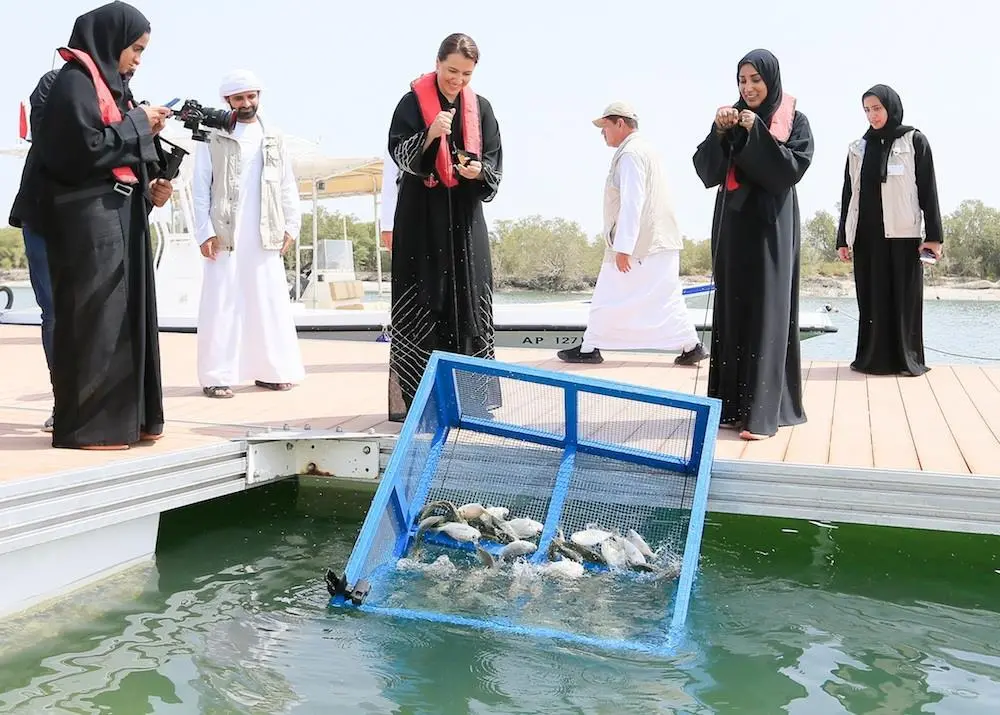
We also worked on the other key enablers for fisheries recovery. Expanding the network of marine protected areas, restoring mangroves through planting 10 million mangrove saplings, establishing coral nurseries to plant nearly one million coral fragments, and developing the nascent aquaculture sector further helped in this recovery story. Pilot studies, involving tagging and releasing fish species vulnerable to exploitations are also underway.
Regulatory interventions effectively halved the pressure on the fishery. The two regulations resulted in a dramatic decrease in the local fish catch by 47% in Abu Dhabi Emirate. The sustainable exploitation index increased to 57.1% and the Spawning Biomass per Recruit (SBR) index also increased from 7.6% in 2018 to 25.6% in 2020, an astronomical 236% within three years.
Two years on from launching our fisheries recovery plan, we have witnessed a remarkable improvement in the number of fish species sustainably caught. From, an abysmally low 5.7% exploited sustainably in 2018 to 57.1% in 2020. An indicator of a major recovery, which is on track to have 70% of our fish species exploited sustainably by 2030.
The combination of good science, harnessing traditional knowledge and the support of the fishing community were fundamental to understand the issue and develop appropriate policy and regulatory frameworks, but it was the unwavering support and commitment of the Abu Dhabi leadership which was the real gamechanger. To implement tough regulatory measures, especially for a sector which has socio-economic and socio-cultural sensitivities, was not at all easy and needed highest level of support.
The journey that we started in Abu Dhabi’s fishery seascape may be far from complete. However, I am confident that we are sailing in the right direction. From a tipping point to the turning point, the turnaround that we promised in the Mina Fish Market that morning seems to be complete. I am confident that as we recover our fishery and rebuild our ecosystems, we will also restore lives and livelihoods along the way.
Related Articles
 PROCESSING & REFRIGERATION
 PROCESSING & REFRIGERATION
 PROCESSING & REFRIGERATION