



Aquaculture needs to overcome the potential growth limiting issue of feed ingredient constraints if it’s to fulfil its long-term potential.
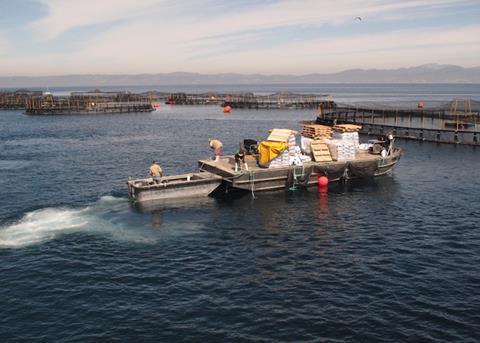
The farming of fish and seafood is widely touted as a prominent component of the global solution to food security. Already accounting for more than half of the world’s seafood consumption, aquaculture’s global output has grown faster than any other major food supply sector in recent times. That said, the backdrop of an ever-increasing population is exacerbating the need to dramatically dial up the industry’s total harvest, and in ways that do not add to current planetary burdens.
While the expectation that aquaculture will provide some 60% of the seafood that the human race consumes by 2030 may not sound like too much of a leap for such a dynamic food production sector, the fact that this stretch will require an additional 20 to 30 million tonnes of end products will surely pose some serious challenges. The industry itself acknowledges that its continued growth could be hindered by any number of potential barriers. These include climate change and environmental constraints, new regulatory boundaries, diseases and other biological challenges, but perhaps most crucial of all, the availability of raw material resources for aquafeeds.
Fishmeal and fish oil are among the most nutritious and digestible ingredients for aquaculture feeds and species, but in coming from wild-capture fisheries, they’re also a finite resource. Added to this, aquafeed producers are experiencing rising competition for supplies from other industries.
The recent Economist World Ocean Summit recognised that more than ever before, aquaculture needs to seek ways to reduce its dependence on these traditional raw materials through the application of new alternatives, as well as ensuring that what marine ingredients that it does have access to are put to the best possible use.
The role that these will play in the future of a global food system is one of the core challenges of the value chain, highlighted Petter Johannessen, director general at IFFO, the global trade organisation for marine ingredients.
“Since the beginning of industrialised aquaculture, marine ingredients have been the nutritional cornerstone of aquafeed ingredients. They still are. Marine ingredients will continue as a strategic ingredient – not only in volumes to provide food security, but also in nutrients to provide quality food through quality feed. We don’t just need more food; we need more quality food,” he said.
With the need for sustainable ingredients that have the right nutritional profile, IFFO would also like to see increased volumes from the processing of wild catches and farmed species diverted into feed formulation.
This could be easily achieved through greater supply chain collaboration, Johannessen explained.
“We are talking millions of tonnes here that’s going to waste that we could put into the food chain,” he said. “We need to have the supply chain engaged here because this is where we see a fantastic raw material that it [often] sees as waste. Today, 30% of fishmeal is based on by-products; you can image what it could be by working closer together.”
Novel approach
Alongside more efficient use of marine raw materials, there has been an increased global focus on the development of new or so-called “novel” ingredients, with the overriding aim to deliver new protein raw materials and alternative sources of essential omega-3 long chain fatty acids. To-date, this R&D has taken three distinct paths: Algae oils containing EPA and DHA; proteins based on different insect species using waste streams; and proteins created by multiplying bacteria.
Aquafeed producer BioMar believes that while marine ingredients and the nutrients they have are extremely important for fish and shrimp and aquaculture in general, there’s also a strong need to complement them with novel ingredients, and plant-based raw materials, said chief executive Carlos Diaz.
“At BioMar, we like to talk more about nutrients and not about specific raw materials. We are in the middle of the value chain, and we are essential to it. 80% of the impact that aquaculture has comes from feed, and 80% of that comes from raw materials or nutrients, so we need to find alternative sources to complement current ingredients.
“This is a never-ending game. We need to be agile; we need to be working with our recipes and especially doing a lot of R&D on new raw materials. Novel ingredients will play a role, plant-based will play a role, but we really need to be focused on developing this, working with suppliers, doing strategic partnerships, and being transparent because that’s what the consumer wants now. They want transparency in what they eat,” he said.
Achieving scale
The conference also heard from single cell protein producer Calysta, with Allan LeBlanc, the company’s vice-president and aquaculture lead, offering that while the “reality” is that there are insufficient alternatives to supplant the existing supply chain, it will be difficult to achieve much future growth from the traditional marine resources alone.
“One of the things that Calysta and all the alternative ingredients can do is provide a way to continue to grow this pie and grow the feed supply without negative impacts on the environment, whether that’s biodiversity, land use or greenhouse gases,” he said.
According to LeBlanc, Calysta’s first plant – a 100,000-tonne capacity facility being built in China is the equivalent of 400,000 tonnes of wild-caught forage fish ingredients or 500,000 square kilometres of soy plantations. Construction will be completed in Q2 2022, with production expected to get underway before the end of that year.
“The scale of that is significant and I think the scale of the alternatives being brought on across the [world] are meaningful,” he said.
“Alternative ingredients are being produced at scale now. We have spent the last 10 years – between single cell proteins and insect meal proteins – doing the R&D, and now you are seeing a lot of capital deployed and construction projects going on to really bring this scale to market.”
From a technology perspective, Diaz and BioMar believe that while there is “still some way to go”, single cell alternative proteins – specifically raw materials tailormade or designed for the aquafeed industry could be “a gamechanger” over the next 36 months or so, particularly offering value in terms of cost-efficiencies and sustainability.
“We definitely have a very positive view on single cell proteins,” he said. “In 2015, there were no novel oils in the aquaculture feed industry. Since then, we have produced more than 1 million tonnes of feed with a specific novel oil. That shows you how rapidly this can scale up when the research is very good.”
Consumer needs
LeBlanc also underlined aquaculture’s credentials as a sustainable solution to the widening protein gap.
“That protein gap – whether it’s the World Resource Institute or the World Wildlife Fund – is 50 to 100 million tonnes of additional protein for human consumption over the next few decades. This is a critical challenge for the world, and it’s something that is going to have to be addressed through all sources of aquaculture.
“What this really points to is that aquaculture might be the solution for feeding a growing world, but the second order problem is how do you feed all these fish? For us, it’s really a story of alternatives supplementing the traditional ingredients to allow us to provide this extra 30-50 million tonnes of feed ingredients that we expect to need in the next couple of decades,” he said.