Struggling to bolster food security, countries in this vast region have set their sights on aquaculture growth. But while ambitious plans are being laid out, fish farmers still find themselves undermined by weak infrastructure and low domestic demand.
Stretching from the Caspian Sea in the west to China and Mongolia in the east and from Afghanistan and Iran in the south to Russia in the north, for many years Central Asia was considered one of the world’s poorest regions, twinned with a turbulent political landscape. However, things are slowly changing – thanks to steady economic growth, underpinned by US$378.2 billion worth of direct foreign investment that was pumped into these countries between 2007 and 2019.
Kazakhstan has set the most ambitious goals among the Central Asian states in terms of fish farming development. A government programme originally rolled out in 2019 envisaged ramping up domestic fish production from 9,000 tonnes to 270,000 tonnes per year by 2030.
The country already has the first results to show, said Nariman Zhurusov, Chairman of the Fish Department at the Kazakh Ecology Ministry. In 2021, the country’s total fish export value was $7 million, with fishermen and fish farmers shipping around 30,000 tonnes of fish to overseas markets, he estimated.
There are 300 fish farms currently in operation in the country, he told World Fishing & Aquaculture.
Compared with 2019, the farmed production is expected to more than double this year – reaching 22,000 tonnes, forecasts the Ecology Ministry.
Meanwhile, the largest barramundi farm is under construction in the Kapshagai. With an investment cost of $157 million, this farm is expected to produce 1,000 tonnes of fish per year at its first stage. This volume is then expected to rise to 10,000 tonnes per year once the full designed production performance is reached, Zhunussov said.
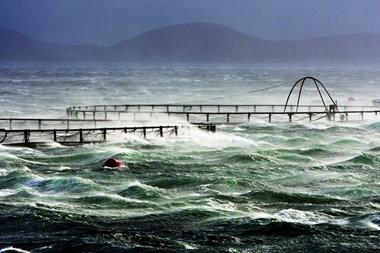
Kazakhstan also has access to the Caspian Sea, although local environmentalists have long complained that the territory along the coast is not a good fit for fish farming due to harsh weather conditions such as frequent storms and high waves.
It was not surprising therefore when Kazakh Ecology Minister Magzum Mirzagaliyev stressed at a press conference in August 2021 that the future development of Kazakhstan fish farming is tightly linked to the land-based recirculating aquaculture system (RAS) farms.
Family farm concepts
While Kazakhstan has primarily focused on industrial farming, Uzbekistan, Central Asia’s second-largest economy, has opted to make its own way, mainly relying on the family farm production.
The country’s population is 34 million, twice that of Kazakhstan’s. Of these, nearly 17.2 million people live in rural territories where they largely rely on backyard food production. In these circumstances, the family farm segment appears to have tremendous potential.
In 2021, Uzbek fish farms produced some 173,900 tonnes of fish – a figure that was near triple that of 2015, according to the Agricultural Ministry’s estimates. Last year, the country also managed to attract record-breaking investments in aquaculture totalling $340 million, of which $29 million came from overseas sources.
In total, 1,330 new projects in the industry were launched in 2021, the ministry said. Although, it highlighted that industrial projects accounted for less than 10%.
As of early April 2022, 4,000 fish farms were operating in Uzbekistan, more than in all other countries of Central Asia combined.
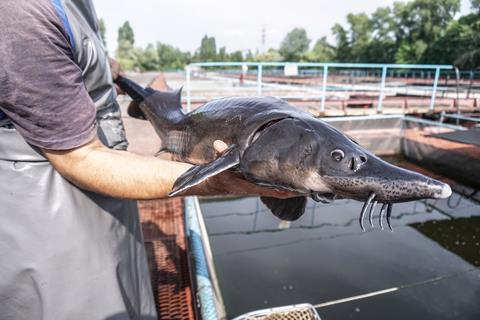
“In recent years, 10 fish species have been acclimatised and their commercial cultivation has been introduced, including Hungarian and Vietnamese carp, Japanese koya, trout, salmon, smelt, sturgeon, tilapia, pike perch and African catfish,” offered the Uzbek Agricultural Ministry.
Moreover, the number of fish farms in Uzbekistan is set to grow rapidly in accordance with the family farm programme that was personally greenlit last year by President Shavkat Mirziev. Under this programme, fish farming is expected to begin in 10,000 households, mainly in rural areas.
The Uzbek government has also been encouraging family farms to create production clusters in order to jointly solve supply issues, attract bank loans, and more besides.
Those producing more than 80 tonnes of fish per year will be eligible for major tax exemptions for three years, while those hiring foreign specialists can apply for partial reimbursement of production costs. At the same time, all family farms will see their land tax halved, and they will be allowed to get “soft loans” for up to $20 million. These measures are slated to come into force on 1 June 2022.
The programme is expected to contribute to an increase in Uzbek fish production from 400,000 tonnes in 2021 to 600,000 tonnes in 2022, according to Mirziev. The Ecology Ministry is further confident that the true potential of the country’s fish farming industry is above 1 million tonnes per year.
Small countries, high potential
Over the past few years, attempts to develop fish farming have also been made in Tajikistan, Turkmenistan and Kyrgyzstan. Of these, only Turkmenistan has access to the Caspian Sea, including the Gerabogazkoi basin, where the prospects of growing fish are believed to be among the best in the region. And yet it is strongly believed that all of these countries have a rather high potential in terms of fish farming industry growth.
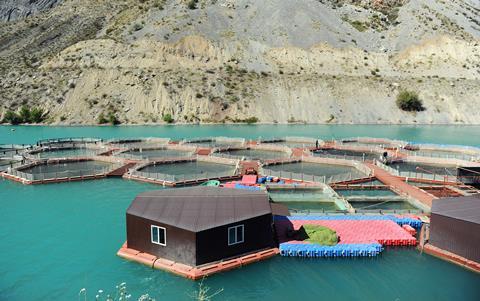
In 2021, Kyrgizstan produced 10,344 tonnes of fish, half of which was exported to Russia, Kazakhstan and other countries, said Edil Niyazov, chairman of the Kyrgyz fish industry department.
Vladimir Eliseev, Director of the Sumi Salmon Hatchery, said that Kyrgyzstan has every opportunity to bypass both the Russian leading redfish producing region, Leningrad Oblast, and the Karelia Republic in terms of trout production.
“It has excellent conditions for trout farming, which are not found either in the northwest or anywhere else in Russia from Kaliningrad to Kamchatka. [It’s] as if God and Allah came together and created such perfect conditions for aquaculture,” Eliseev said, explaining that the country has unique environmental conditions.
“In Kyrgyzstan, a lot of warm water comes out of the ground at temperatures of 14 to 16 to 18℃. This water contains a high amount of dissolved oxygen ranging between 12 and 14 mg, and for trout, this is a very important argument,” he added.
However, the small Soviet splinters continue to experience difficulties with increasing farmed fish production.
For instance, despite the availability of extensive water resources, fish production in Tajikistan dropped from 4,000 tonnes in 1991 to just 214 tonnes in 2006, according to FAO figures. As a consequence, the fish consumption per capita has decreased to a level of less than 0.5 kg, compared with 3 kg at the end of the 1980s.
Fish production and consumption are both yet to recover at least to the Soviet level.
Currently, fish production in Tajikistan is estimated at 2,300 tonnes per year.
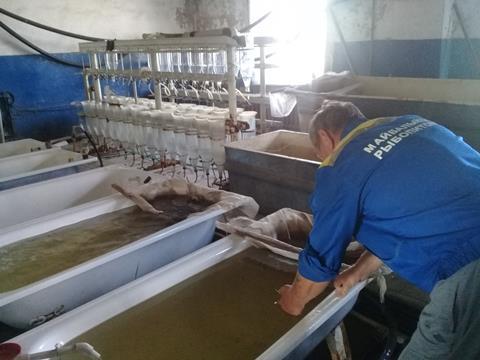
Meanwhile, Turkmenistan is trying to ramp-up its fish production in another way. Since 2019, the government has put some effort into increasing its broodstock production in order to rebuild fish populations in the Caspian Sea. To this end, several major fish hatcheries, including Daşoguzbalyk and Marybalyk, have been restored in the country over the past few years and have been releasing fish fry.
During Soviet times, the country’s fisheries used to catch at least 5,000 tonnes of fish per year in the Caspian Sea. Today, though, this figure ranges between just 100 and 150 tonnes per year – largely as fish reserves in the Caspian Sea have depleted due to environmental factors and poaching.
At the same time, only a few land-based fish farms currently operate in the country.
Disrupted supplies
Fish farms in Central Asia are currently enduring some quite turbulent times, associated with the Western sanctions against the Russian economy. One of the biggest challenges in this regard is that aquaculture companies across the region have historically imported aquafeeds from Russian distributors.
In this respect, Yerzhan Kazanbayev, spokesperson for the Kazakh Trade Ministry admitted that the country must brace for further supply disruptions, including in the feed segment.
“Perhaps there will be some difficulties with the imposed sanctions, but we are looking for new routes. It is clear that some supply chains are breaking,” Kazanbayev said during a press conference in April.
“Of course, it will be very difficult to find new ways and channels – some ports are closed, and the logistics is a little interrupted,” he explained.
In 2021, Kazakh company Virgil Soil Kz announced plans to launch a major feed mill in Central Europe with a designed production performance of 1,000 tonnes of feed for fish and livestock per year. It’s hoped the new plant will partly mitigate the problem of imported fish feed in Central Asia.
Still, there are fears that the Ukraine crisis will bring more than just supply disruptions to Central Asia. In 2020, money transfers from citizens working in Russia comprised 31.3% of Kyrgyz GDP and 26.7% of Tajik GDP. Western sanctions introduced against Russia are expected to present the biggest shock that Central Asian economies have seen since the fall of the Soviet Union, and fish farming is likely to suffer like all other industries.