


Today the seafood company, led by president and chief executive Yngve Myhre, is only part of Røkke’s industrial empire. Within that, Aker Seafoods remains one of Europe’s biggest fishing companies, with 1,350 employees and a capital base giving it the muscle to grow.
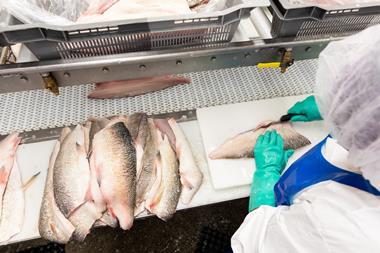
Almost a year after Aker Seafoods ASA was listed on the Oslo stock exchange the Norwegian whitefish giant now owns and controls 29 whitefish licenses, 14 trawlers and 11 processing plants. Its own quotas exceed 50,000 tonnes putting Aker Seafoods at the top of the whitefish harvest in Europe. This is almost doubled by external sourcing. The markets which Aker services with a variety of fresh and frozen products include Young’s, Seachill, Primex, Findus, Nestlé and Unilever But there is more growth to come. Yngve Myhre says Aker has more money to spend to consolidate its position in the industry.
This is a big fish and hungry for smaller in its plans for the seafood industry of tomorrow. Yet this is only one chapter in the story of one of Norway’s leading industrialists, Kjell Inge Røkke.
69 feet to 80,000
Kjell Inge Røkke hails from the town of Molde on the west Norwegian coast and he was only 17 and sick of school when he signed up on the Svalbard trawler to go fishing in the Barents Sea. This was the start of his career as a fisherman. His business career was launched in 1982, when he bought a 69-foot trawler in the United States. During his first few years he had little cash, but lots of will, energy and ideas. They were to put him at the forefront of the American pollock fisheries and surimi industry.
In 1994/95 Røkke started to invest in Norwegian fisheries. The first move was along the west coast, and he gradually moved his attention to the rich fishing grounds in the north and the fish industry of northern Norway. Røkke’s acquisitions were controversial, including his growing control over the leading industry group Aker. Røkke’s share of the Norwegian trawler fleet also grew, and the industrialist Røkke even gained control over Aker’s big rival, Kvaerner. The final result was a new Aker, with more than 40,000 employees and annual revenues exceeding NOK 50 billion (€6.2 billion). Today’s Aker Group is a major international player with divisions in engineering, construction, shipbuilding data storage and archiving -- and of course, fish.
Last month it was announced that Røkke’s controlled Aker Yards won a EUR 900 building contract for what will be the world’s largest passenger ship. At 222,000 gross register tons, measuring 360metres long, Project Genesis will have a capacity for 5,400 passengers ands it is 43 per cent langer than Freedom of the Seas, the biggest passenger vessel under construction at another Aker Yards in Finland.
“Aker Seafoods is present in the southernmost town of the world, Ushaia, in Argentine. And we’re established in Hammerfest, the northernmost town of the world.” Røkke has said, to give an idea of Aker’s reach. Such pronouncements have become rather rare lately. Big houses, even bigger boats and a rather fast way to achieve the skipper’s licenses have made him a favourite target for the Norwegian tabloids. These days he seems to spend more time talking to Bill Clinton and the German president than with the press.
Small fish – big expectations
On the other hand, the 47-year-old business magnate is still deeply involved in breaking new ground in the fishing industry. World Fishing was with Røkke at a ceremony for to launch the rebuilt surimi trawler and factory ship Atlantic Navigator in the Faroe Islands. Making surimi for crabsticks and similar out of the small northern blue whiting has been a completely new challenge – and an expensive one too.
“One hundred million NOK [has been] spent on this Norwegian-Faroese joint venture, but the costs must be measured against the value of the quota and the fact that we are creating a completely new seafood business,” Røkke said. He then went on to explain in detail about the technical challenges and how he aimed to double the Aker share of the international surimi market from five per cent to 10 per cent. One of the key elements in his strategy is to build a brand new plant designed to process the fish.
Myhre in charge
The company’s fishing activities in the Faroes, Argentine, the United States and Russia are owned by Aker Seafoods Corp., a sister company of Aker Seafoods. A special agreement places the management of the same activities in the hands of Aker Seafoods and the company’s president and CEO, Yngve Myhre. Myhre has held that position since 2001. One of the biggest challenges was last year. This was when he had to merge West Fish Aarsæther and Nordic Sea Holding into Aker, as well as run the roadshow for the listing of Aker Seafoods on the Oslo stock exchange. The way the share price has risen, from 29 NOK on 13 May 2005 to 44 NOK at the end of the year, shows his strategy worked.
“The Aker Seafoods share has had its ups and downs, but our main owners are very satisfied. 2005 was a year of restoring. In 2006 we will take out the effect of new structures,” Myhre said. The most important of these owners (66.7 per cent) is the Røkke-controlled Aker ASA, which also places Myhre and Aker in an extensive industrial family. Of course the Atlantic Navigator factory ship was rebuilt at one of Aker’s yards.
“Being a part of Aker means a lot. The industrial and financial resources are the best in Norway and can be of great help when we shall sort out ideas and develop technology. The direct participation of Kjell Inge Røkke also is of great value,” CEO Myhre says. After Norway’s decision to open up the Barents Sea for petroleum activities, the economic interests of the Aker family now cover resources both above and below the seabed. Myhre says there is no direct conflict. “Fisheries and oil activities can be combined if environmental protection is given first priority,” the 36-year-old CEO said.
Sourcing
Illegal fishing in the North East Atlantic is a bone of contention for Aker which regards it as an affront to themselves and all honest fishermen. They also represent a direct loss for the Norwegian giant.
“Today, 20 per cent of [all] catches in the North East Atlantic are outside regulations. This means that the basis for our quota
is reduced comparably. In addition, the presence of illegal fish on the European seafood market is driving prices down.”
Myhre is clear about their response: “We will work out ways to bring forth
the advantage of sourcing from a serious partner and an integrated value chain. Dialogue with the environmental organisations and traceability of each single delivery will be essential. I have recently had talks with the Norwegian Seafood Federation about brushing the dust off the former, EU-initiated traceability project Tracefish. Our customers shall not have to deal with this problem of origin and illegal catch. Actually I see the new awareness of origin as a great opportunity for Aker Seafoods.”
I put it to him that he would not be able to eliminate cheap products processed in China and other low-cost countries. Or did he have a solution?
“The possibility to deliver fresh and single-frozen seafood gives the processors in the Northern Atlantic region a great advantage compared with China. And the trend says that the market – especially in Europe - wants more fresh seafood. The export of fresh cod fillets from Norway to the EU [rose] by 57 per cent between 2003 and 2004. Growth in 2005 was an additional 30 per cent by the end of September. Yet, frozen seafood will still be our main arena. We will compete on quality and by giving our customers reliable documentation of origin,” Myhre said.
Consolidation
Stable, year round supply have been other key words for Aker Seafoods, and continual growth has been part of the struggle to achieve it. Last year’s acquisition of West Fish Aarsæther and Nordic Sea Holding raised the number of trawler licenses from 18.5 to 29. According to Myhre the whole European whitefish industry is in a state of consolidation, in part due to regulatory changes in many European countries.
“The consolidation takes part both within the industry and processing and in the markets. CapVest, the owner of Young’s Bluecrest, has bought Findus. Seabay takes over Quickfish. Royal Greenland buys 50 per cent of Poland’s Morpol. A lot more could be mentioned.”
So had Aker Seafoods made its final moves?
“We have a capital basis of 200 million NOK, and we are not at all planning to rest on our laurels. Aker Seafood will be an active co-player within the European seafood business. I think the future is in bringing fresh and single-frozen quality seafood to the market. The seafood industry of Norway should make use of the possibility to be a substantial supplier of fish from sustainable stocks and give our customers the ability to trace it,” Yngve Myhre said.