


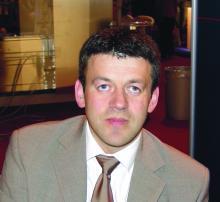
What is troubling the Faeroese is not the stock (Björn says it is mostly all right apart from cod which he says has declined a little over the past three years) but the issue of sharing them. There is no agreement on blue whiting and herring and also on the table are the mackerel agreement and negotiations with Iceland and Greenland over redfish.
"The main problem is how to share the stock. For example, on herring, since 1966 there had been an agreement between the parties (Faeroes, Norway, Iceland, Russia and EU). The Norwegians where not happy about it but the other parties were in agreement to continue with the share allocated in the 1966 agreement. This had allocated to Norway 56/57 per cent of the total quota. But Norway wants a bigger share of the quota (67 per cent) of the total because they argue that most stocks are in their area," he said.
In the past few years the Faeroes had increased its share and he said there had been enormous pressure from the industry to get a bigger share but the Faeroese government said that 'we wouldn't do that'. "But this year Norway got a higher quota for Norwegian vessels and that led to a situation where everyone also increased their share", he added.
On blue whiting he says there are "Always negotiations but never agreement. During the last few years every party has fished more and more but stocks seem to be ok. The catch is higher but everybody is afraid that the stock cannot tolerate such a high catch."
What about the Norwegians angrily giving up on conservation since others refused to help? (World Fishing Sept. 05, p. 4) "The Norwegian reaction was a bit tactical because blue whiting catch for the Norwegians is seasonal. For the Faroe Islands is a bit different because the blue whiting is in our waters all year round and, even though it is also seasonal, spring and autumn, you can catch blue whiting all year." Björn says now that the stock is in a good shape every party can get a higher share of the quota - maybe an agreement next year "but it is difficult to say," he added.
Shrimp and Canada
Like Rhodes, the Faeroes sits astride a global crossroads so it has to talk to everyone who passes through and that includes discussing Shrimp with Canada: "We are members of the North Atlantic Fisheries Organization (NAFO) which allocates quotas (3L on the Grand Banks) for each party. We don't agree [with the way] NAFO allocated them because we have been there fishing from the early 90s... and we can prove that we have fished a lot and we think it is not fair to [give] equal parts of the quota to each party. The TAC is set at about 30,000 tonnes. Canada gets the major share of that (83%) and the remaining 17% is split equally between all the member states of NAFO. We have always objected to that position saying that NAFO should use its normal allocation criteria which are historic rights, contribution to scientists' work in the region... If those criteria are applied, then the Faeroes are entitled to a much larger share.
"When we objected to the quota allocated to us (and we then set an autonomous quota according to the NAFO rules) Canada was very unhappy and they closed the harbours to our vessels. We don't think that was a 'proportionate' reaction by Canada. ...even though we have disagreements [with them] we had set the autonomous quota according to NAFO regulations -- we are entitled to do so and further more Canada not only closed its ports to the vessels involved in the fishing in the 3L area, they closed to all Faeroese vessels. So we have constantly objected to that measure." He said they were in touch with the Canadians and hopefully the TAC in 3L would go up for 2006 because there were signs that the scientists would recommend a higher quota. "When a quota is on the rise, perhaps it is easier to reach a political solution.
Around the bay
Around the bay
What was troubling them was how things had changed over the past few years. "If you look a few years back fish prices were high and oil prices low and there were more fish to catch. So it was a very good time for the fishing industry ....now prices are not so good, oil prices are very high and that makes it difficult, especially for trawlers, [however] the pelagic fleet is okay. The shrimp fleet had five vessels and now only two are left... there are pair trawlers fishing for saithe, and prices [are] stabilising [and even] a bit up at the moment so that seems okay and there are also the trawlers [working] cod.
"Since 1996, we have used the fishing-days system and we are very happy about it. They are allocated days at sea and the vessels can bring everything they catch to shore -- there are no discards. Everybody is happy about the system.
"Also, in these times of competition from countries with low labour costs, we are in the middle of Atlantic and we have fish of superb quality swimming around the islands and I think we are close to the market. This is the thing we ought to work with to get the prime quality fish onto the market in a short time. We can already feel competition from China but we can also work [our way] out of it," he added.
Common consumers
"I think the consumer is more aware of what he eats and he wants to know and make sure it is coming from a sustainable fishery. I think that is a job for [all countries together] to demonstrate to the consumer that our system and our fish is taken out of sustainable fisheries.
"We are convinced we are managing our stocks in a sustainable manner. Of course, we could, at some degree cut back the number of fishing days and I have recommended several times to do that in order to be more in line with what the scientists recommend. We are also setting up a national traceability system so people in Europe buying fish from the Faeroes are able to see the full traceability of the fish they are buying.
"We have supported Iceland's work in the FAO to get guidelines on eco-labelling and think we are pretty much on agreement with Iceland that the Marine Stewardship Council (MSC) [a promotional charity in London] is not a prototype for eco-labelling as they are the executive and judicial power in one body (they implement and supervise the system). We would like to have more transparency about this and to see the companies, performing the eco-labelling system, certified in a [different] way. You have your own quality system and maybe work with a consultant to set it up and you have an outsider to approve it but in this case it seems that MSC is doing everything."
Integration & IUU
As far as the future structure of the industry is concerned he thinks "There would be bigger units and maybe more integrated. You will see the companies own the vessels, factories and working with the markets". But what about the pirates illegal, unregulated and unreported (IUU) fishing? "This is not problem for us. All our vessels have satellite [monitoring] and the foreign vessels fishing in our waters do so by agreement. But illegal fishing in international waters and the North Atlantic is too common by far. This is a big problem sometimes when parties are negotiating quota for some stocks. It seems a little bit useless when you know there is so much illegal fishing going on. So that is a thing where all the countries who have responsibility in these quotas have to work together to find out some ways to stop illegal fishing." That could mean 'more control [together] in international waters... more checking on transhipments', control of flagging and buyers ensuring fish is from a legal fishery.
"We are happy about our own system,... but it is difficult to tell others what to do. We want to manage our own fishery policy within [our] national jurisdiction," not managed in Brussels. "When Denmark joined in the 1970s, the Faeroes opted to stay outside because we wanted to control our fisheries. Now it is not only important to manage your waters and access all markets... Maybe this [access all markets] is even more important now than back then and maybe they should discuss the membership but added "... the Faeroes are not ready yet to join the EU, although they were closely following Norway's and Iceland's positions on membership and if they joined that could change things, not forgetting the EU accounted for 70 per cent of Faeroese trade," he added.