



Brave New World – from occupation to liberalisation
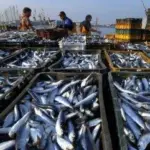
Peter O’Neill discussed the issues with Normunds Rieksti?š, Director of the National Board of Fisheries and finds that Latvia still leads with its most famous products, Riga sprats and herrings.
Normunds has been in fish all his professional life. A biologist by education he began working in the fisheries regulatory board in Soviet times in 1986 and was appointed as a national expert under the new regime after independence in 1990.
“I started to work as an ichthyologist.” We joked about Joukko Lepisto, the Lutheran ‘Black Priest’ of Lapland who serves the Lapps in the far north, and with whom I had long ago been fishing on Lake Inari where a rogue Soviet Cruise missile landed. My American researcher had mistakenly transcribed Joukko as having studied “ichthyology” at Helsinki University – instead of theology! Normunds pointed out that not only was the fish an important symbol in the development of early Christianity, a very early major international “branding” campaign and secret code for revolutionaries, but that “Christ had to feed a lot of people with a few fish!”
Of course in mediaeval times salted and pickled sprat and herring were the Euro-currency of barter trade. “We are living along the coast of the Baltic Sea and for sure we are a fishing nation and not only the Baltic Sea but also the inland waters which are quite utilised as a fishery resource. At the end of the 19th century it was our initiative to process and can such Baltic fish and export it to many European countries. We started to make canned fish at the end of the 19th century. In the Soviet era it incredibly increased and a lot of state companies were created.”
After Soviet occupation
“Then after that, when we became independent in 1990, a lot of structural changes were done in Latvia. Changes in the fleet, changes in how it all operated in the fisheries sector. Before, we had fishing, processing everything together — the vessels took the fish, landed it to the fish processing companies which were along the coast. Finally everything — the fishing and processing — were separated and that is almost how that is today. But there was a lot of discussion and in the mid-90s, somebody said it is not right to go this way and we need to put everything [back] in one place. There were lots of kolkhozis (the old state collectives) working in this [new, localised] way but it was not the way to make it all work in the EU in an open market.
“Before canning started in 1860 we were pickling and salting in barrels. The market depended on who ruled us as to where the fish went.” Some 200 years ago people working the land farms for landlords along the coast were complaining that they were sick and tired of only getting sturgeon or salmon to eat and that they wanted meat! “Now of course it seems very strange to hear about that and when, very occasionally, some sturgeon appear in the Baltic”
Under the 250-million strong Soviet market he says: “There was the fleet outside the Baltic, fishing in the Atlantic and the Arctic or whatever, coming from Riga and Leipaja port up the coast. This fleet was equipped from the centralised system, all the fuel and so on and the fish was not sold outside and it was incredibly cheap under a regulated market. There were around 100 ocean-going vessels from 55 metres up to 100m including the factory mother ships. Today we have only 12 such ocean-going vessels. All the mother ships were sold during the early 90s. Then we still have the Baltic fleet. There are some possibilities now, after our EU accession, for agreements between the EU and some African countries, for example with Mauritania for licenses to use these ocean-going ships to fish there. Of the other vessels, there were some 230 but now only about 160. There has been a very active scrapping programme, particularly in 2004. We spent all the money which was allocated for scrapping in very short time. Now we are going to reschedule these flows and provide additional monies for scrapping.”
“After independence [fish as part of national Gross Domestic Product] dropped quite dramatically, but other activities are increasing and the [fishery] resources are also more limited now. There is not such a big difference in the number of fishermen. There are about 86 companies now in Latvia for the 160 vessels.
“In the Gulf of Riga there is a special branch of the fleet, 15-20 metre vessels, fishing for herring which is in quite a good state, and also along the coastal line they are fishing with trap nets. I have not mentioned the other 700 small vessels along the coast, for local consumption and subsistence fishing which is largest along the coast – it is historically traditional and tourist-related. The increase in tourism is important because the land is not so good for farming. You will see very nice sand for beaches everywhere but the coast is not so good for agriculture.
The EU connection
Riga had long and protracted negotiations with Brussels over fish, prior to accession in May 2004. “We got fishing in the Gulf of Riga …and we are not going to share that with anybody – our historical rights. The Russians are not included – only Estonia and Latvia. It is about 24,000 to 25,000 tonnes of herring and then of course there are the other local fish which are available for coastal fishing – pike perch, perch (remember the Gulf is almost fresh water) bream, some eel roach and some other speciality such as eel pout – we smoke it.
“There are a lot of small villages on the Gulf of Riga and all the kholkhozi were located there — it was the border of the old Soviet Union. Of 11 Latvian kholkhozi, nine were along the coast. “It is a very small area, the Gulf and so you cannot have everyone coming or it would be a terrible situation, and I think the Commission and the other members states agreed on that position.
He said quotas under the Baltic Sea Fisheries Commission remained more or less the same after EU accession. There are some changes going on over Baltic cod and there is quite a hard struggle between the countries (Sweden, Denmark, Poland, Germany with some small fishing from Lithuania and Estonia) over management and the division of the quotas. There is the western and eastern cod in two total allowable catches (TACs). It is quite complicated and not what everybody would like. The Western cod is more than 20,000t, with some 50-80,000t of cod in the bigger eastern area. Only Denmark and Germany are on the western part.
“The stock is not good and there is a recommendation for a halt to fishing. Our scientists agree in general [with scientists advising Brussels]over the stock situation. The fishermen partly agree because the fish they are fishing is very small and becoming smaller and smaller every year. The fishermen would like to survive. They are also taking smaller than they are allowed. They feel the situation is not very good and there is no big cod in the Baltic which could reproduce.
“In the Baltic sea, it is a Commission idea that there is perhaps 40 per cent illegal catches going on. I am not sure personally of this figure. And when we are working on the allocations and setting the TAC and somebody says there is ’40 per cent in illegal catches’. Then I say: ‘Okay, we are not going to reduce the fishing opportunities for legal fishermen, but [we will need to be] struggling against the illegal catches and then the 40 per cent is added to what we are fishing for. But the Commission perspective is such that we should stop the fishing. And how to stop? Just reduce, reduce, reduce and almost going to zero.”
Discards – way forward?
And what about the bycatch and discards? “Of course there is a legal size for landing the fish and it depends whether the fisherman can land smaller fish or not and, if they could land it, they sell everything. This is the legal part coming in. But if they do not have the possibility because of the controls (and they are increasing) so there is less and less opportunity to sell blackfish or not report the fish and so on.”
It is worth noting that officials admit that Latvia has a two-tier economy with the black economy put at 14-19 per cent of the economy and most people talk about getting part of their wages under the counter.
I mentioned Estonia’s attack two years ago on the EU’s failure to involve European fishermen so they could keep discards, and make it legal, so they could get more money and not have to fiddle? Could the Baltic states take a lead on this?
“In our case it is not so easy because the regulated species are only four –cod herring sprat, salmon and there is some regulation on the flatfish such as turbot and flounder. Let’s say for herring and sprat there is no need for discard because all fish landed could be used for human consumption or meal. We are strongly re-stocking on salmon and we produce smolts and release about one million into the sea. We are also getting [farmed] salmon, e.g. Norwegian, coming in which disturbs the market quite a lot, because buyers say ‘okay we have enough salmon and if you would like to supply your [wild] salmon then your price has to be [competitive]’. Our fishermen catch them with drift nets and this will be banned by the EU from 2008. We are going ahead with a step by step reduction with compensation for the fishermen. Our fishermen are skeptical at the moment that hook fishing is economically viable.”
That Baltic dioxin
“In Latvia at the moment it is not allowed to sell [wild Baltic] salmon because of the dioxin. So there are a lot of problems in [wild]salmon at the moment.”
I asked how far could captains use the Swedish Baltic dioxin surveys which show where and when to fish to avoid dioxin problems?
“At the moment we only have a few [Latvian] samples and analyses done and they were done in the UK and when we got the results [more than year ago] six or seven from 12 [tested samples] were okay, but part were higher dioxin and part were lower dioxin but very close[to the allowed level]. And our food and veterinary service said it was not allowed to sell the salmon in the local market and herring and sprat were also affected. But the sprat showed there was no increase in dioxin. For the canning industry we are using younger fish than Sweden and Finland where they are using bigger herring so [for them] the dioxin content is higher. Dioxin is also quite a controversial issue and there is quite a discussion on how you test the samples and you can get quite a different result [depending] on the season, the size of the fish and so on. We were waiting for the analysis [from the UK] for half a year or so.”
He said the Danes had decided to ban the sale of salmon from the Baltic and then there was quite a reaction from their fishermen and the Danes then changed their minds and decided it was allowed to sell salmon which were under a certain size. “I suppose our fishermen are now probably selling their salmon in Denmark on these grounds, but they are not allowed to sell in Latvia. There are a lot of contradictory things in this matter.”
We started to talk about the how they were pushing ahead with diversification and to tap the potential of sport fishing and tourism and linking that to the extensive aquaculture sector. But it was time to go – Latvian TV was waiting outside to interview him about the salmon situation….
(Peter O’Neill was part of a team of specialist European journalists on a visit to Riga, organised by the Centre Européen de Journalisme, to investigate the future of Latvian industry and the EU market).
Related Articles
 INTERVIEWS
 PROCESSING & REFRIGERATION
 PROCESSING & REFRIGERATION