




Northern Norway fish farms thrive
A new Norwegian study has revealed a surprising north–south divide in the environmental impact of fish farming, showing that seabed conditions around aquaculture sites generally improve the farther north operations are located.
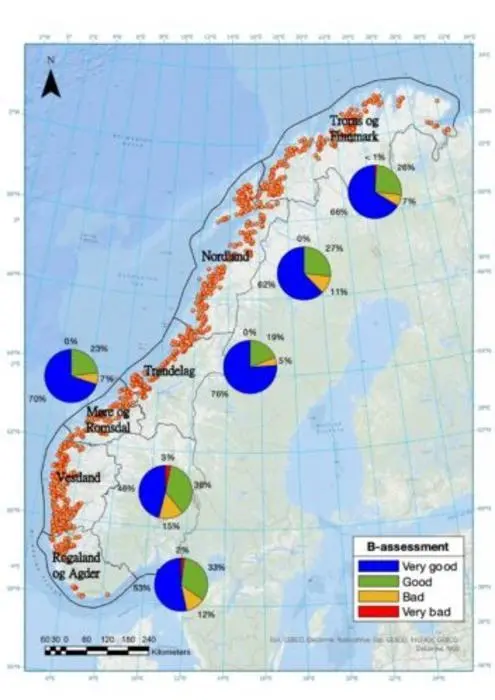
The research, conducted by Chun-Deng Wang from the Norwegian University of Science and Technology, analysed how efficiently fish farms use feed, how much nutrient waste they release and how marine life on the seabed responds. Using official environmental monitoring data, the study compared fish farming sites along the Norwegian coast.
“Our results show a significant geographical variation in both feed utilisation and nutrient emissions,” Wang said. “Efficiency increases steadily from south to north in Norway.”
The findings suggest that environmental costs associated with aquaculture decrease in northern regions, a trend that could influence the future location of fish farming. “These differences in efficiency and environmental costs may lead to a gradual shift of aquaculture operations toward the north,” Wang added.
Norway requires fish farms to carry out two types of seabed monitoring. The simpler B assessment measures basic biological and chemical indicators within 30 metres of fish pens, while the more detailed C assessment examines conditions up to 500 metres away. Wang’s analysis shows that the C assessment is particularly effective at detecting subtle environmental changes.
According to the study, colder water temperatures, greater depths and other physical conditions in northern waters help reduce environmental stress. “Benthic conditions are strongly influenced by feed utilisation, water depth, biomass density and the length of the production cycle,” Wang explained. Seasonal factors also matter, with higher summer and autumn feeding having a stronger environmental impact.
Despite ongoing concerns about pollution and sustainability in aquaculture, the study offers encouraging news. It shows that seabed ecosystems can recover quickly when problems are identified early. “Overall, the research suggests that both the B and C assessments collectively provide a cost-effective and reliable two-step method for detecting early signs of environmental damage,” Wang said.
Related Articles
 SEAFOOD
 AQUACULTURE
 SEAFOOD