




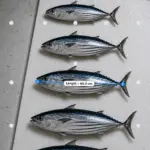

Bluefin farming progress
The production of juvenile Atlantic bluefin tuna is moving forward with a new cooperation agreement between tuna farming start-up Next Tuna and Skretting.

Through the agreement, both parties will jointly-develop dry feed for Atlantic bluefin from first feeding to transfer at 10kg, paving the way for large scale commercially viable closed aquaculture farms.
“This partnership with Skretting takes the Next Tuna project on to the next exciting level. Skretting’s world-class aquaculture and feed R&D will ensure we have the ideal feed solution to lead the way and put sustainable farmed Atlantic bluefin on the map – truly meeting the needs of the market,” said Andrew Eckhardt, co-founder of Next Tuna.
Commercially viable
The collaboration will also have the support of Skretting’s global network of scientific experts and its overarching global research units, with Skretting Italy formulating, manufacturing and supplying the Next Tuna feeds.
This new feed will utilise the knowledge and technologies that went into the development of MaGro, Skretting’s soft-extruded pellet feed dedicated for tuna that offers a superior performance during grow out rearing.
Launched in 2019, MaGro is a patented breakthrough solution through which tuna farmers no longer need to follow baitfish feeding protocols during grow out feeding. This leads to reduced biosecurity risks, increased food-safety and simplified operations; while keeping sustainability in focus.
“The cooperation with Next Tuna and our focus on early life stage requirements further underlines our commitment to supplying optimal solutions for the whole life cycle of species such as tuna. We want farmers to be in a position to produce healthy fish that perform to their fullest potential within the most cost-effective, profitable and environmentally responsible production systems,” said Lenaïg Richard Breivik, business development manager at Skretting.
Next Tuna’s ambition is to be the first company in the world to complete the reproductive cycle of the iconic Atlantic bluefin in a closed aquaculture system at a large enough scale to be commercially viable.
To achieve this, the company is constructing a land-based farm at a location north of Valencia in Spain, where Next Tuna is currently in the permitting process. This state-of-the-art facility will draw on all of the latest scientific developments in Atlantic bluefin tuna breeding and apply them on-the-ground in a fully controlled, floating RAS production system.
Commercial production is expected to begin in 2024, gradually increasing to full capacity by 2028.
Related Articles
 AQUACULTURE
 SEAFOOD
 SEAFOOD