



The European Commission has published the 2025 edition of the EU Fish Market report, produced by the European Market Observatory for Fisheries and Aquaculture Products (EUMOFA), revealing a sector navigating inflationary pressure, subdued consumption and evolving global supply dynamics.
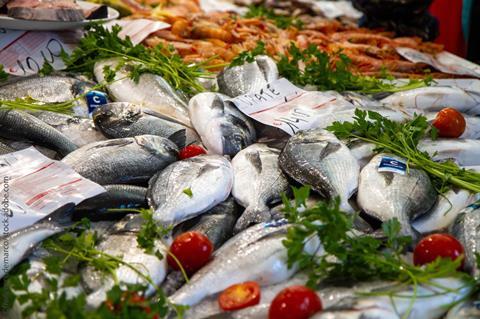
Drawing on data up to early 2025, the report shows that EU consumer spending on seafood rose 4% in 2024 to €62.8 billion — driven largely by higher prices as volumes continued to fall. Household consumption of fresh fish dropped by 5% last year, extending the downward trend seen since 2021 in the EU’s top-consuming countries: Spain, Italy, France, Portugal and Germany.
Between 2020 and 2024, consumer purchasing power eroded significantly. Prices for fishery and aquaculture products climbed more than 25% over that period — still rising more slowly than other animal proteins, but enough to restrain overall seafood demand.
EU seafood imports totalled 5.9 million tonnes worth €29.9 billion in 2024 — a 1% decline in real-term value and a slight 0.3% increase in volume. Exports grew 1% to €8.25 billion, although export volumes fell to their lowest level since 2019 at 2.2 million tonnes.
For the first time since 2018, the EU’s seafood trade deficit narrowed, falling 2% to €21.61 billion. In comparison, the United States saw its deficit widen by 5% in 2024, while Japan recorded a 3% decline.
Intra-EU seafood trade slowed, with both value and volume falling 1% to €31.7 billion and 5.8 million tonnes respectively. Salmon and cod together accounted for almost 40% of total intra-EU trade value. The Netherlands remained the EU’s main internal trading hub.
The EU’s self-sufficiency rate — its ability to meet seafood demand through domestic production — increased for the first time since 2018, reaching 38.1%.
Apparent consumption fell to 22.89 kg per capita in 2023, the lowest level in a decade and 3% below 2022. Consumption of wild-caught seafood dropped to 16.35 kg per capita — also a ten-year low — while farmed seafood consumption stood at 6.53 kg per capita. Portugal continued to lead Europe with 53.61 kg per capita.
The EU Fish Market report has been published annually since 2014 and remains one of the most comprehensive data sets tracking seafood supply, demand and market trends across the bloc.