



Recognising that almost one-third of the global fish catch is lost or wasted during post-harvest processing, India’s seafood industry will shift from a volume to a value focus by strengthening sustainability-driven reforms in the marine sector, according to Union Fisheries Joint Secretary Sagar Mehra.
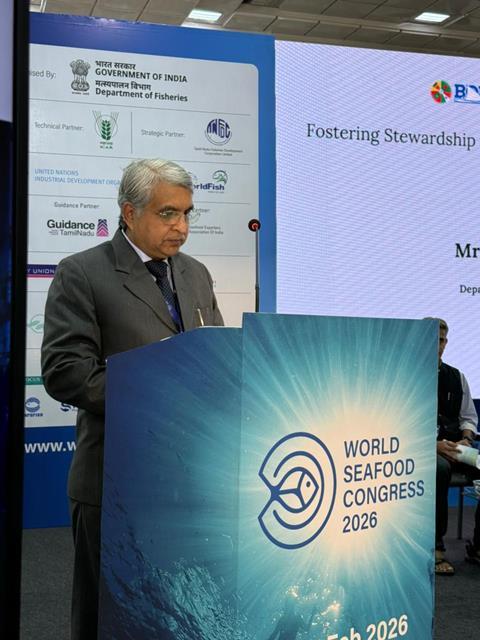
Addressing a global workshop at the World Seafood Congress in Chennai, Mehra explained that reducing post-harvest losses and strengthening value addition will become central to India’s marine ingredients strategy.
The sector must now move beyond volume-centric growth towards responsible, sustainable integration across the value chain, he said.
“India currently produces around 20 million tonnes of fish, reflecting significant growth in recent years. Now, it is the need of the hour to shift from linear production models to circular value chains, particularly through scientific utilisation of by-products and waste reduction.
“Increasingly, global buyers demand responsibly sourced and fully traceable supply chains aligned with Sustainable Development Goals (SDGs). It signals the need for collective action for stronger stakeholder participation to enhance governance, he said.
Mehra further stressed that sourcing must be ecologically sustainable and economically viable, ensuring inclusion and long-term stability of small-scale fisheries and coastal communities.
Organised by the Bay of Bengal Programme Inter-Governmental Organisation (BOBP-IGO) in association with United Nations-Food and Agriculture Organisation (FAO), the workshop deliberated on strategies to reduce post-harvest losses, strengthen regulatory frameworks, promote value addition from fish by-products, capable of competing in sustainability-conscious global markets.
Highlighting potential of fisheries value addition, Senior Executive Director of the National Fisheries Development Board Dr Kannappan pointed to products such as chitin and chitosan derived from crustacean waste, noting their growing biomedical and industrial applications.
Emphasising the principles of circular economy, he called for optimal utilisation of by-products to reduce waste and improve resource efficiency.
Also at the workshop, Indian Marine Ingredients Sector Association President Davood Sait said traceability is a major gap in the sector, particularly in meeting the evolving demands of international markets.
“Strengthening traceability systems will be critical to ensuring transparency and maintaining export competitiveness,” he said.
BOBP-IGO Director Dr P Krishnan said that sustainable growth in fisheries will depend on innovation, institutional coordination, and responsible trade practices aligned with global benchmarks.
A need to focus on credible global certification systems and stronger collaboration among industry, academia and government agencies were also discussed at the meeting.