



Fishing nets sunk at the bottom of harbour in the Danish port of Hirtshals are part of a long-term evaluation of biodegradable static nets, monitored at regular intervals to check condition and decomposition rates.
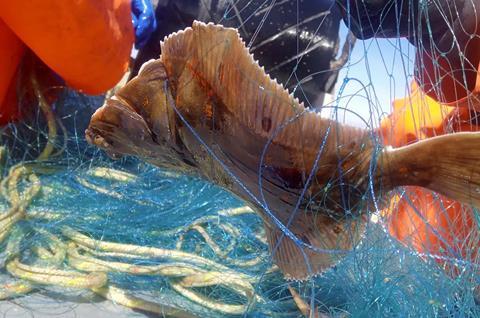
In a project funded by the European Maritime and Fisheries Fund and the Danish Fisheries Agency, researchers from DTU Aqua have spent time at sea with local fishermen to test nets made of PBSAT polymer, a thermoplastic biodegradable plastic type, for cod and plaice fisheries, while the Norwegian-funded Dsolve project, led by UiT Norway’s Arctic University, is monitoring the decomposition time of fishing nets placed on the bottom of Hirtshals harbour.
“The biodegradable fishing net is produced in Asia and is therefore primarily adapted to the Asian climate, which differs a great deal from European and especially Scandinavian conditions. It is therefore important to test which biodegradable materials are suitable for these waters. Fortunately, the fishermen in Hirtshals have been very interested in letting us know what they need,” reported DTU Aqua researcher Esther Savina.
“There’s a big difference in both temperatures and bacteria in European waters, so it is important to learn more about how biodegradable nets perform in different places and how quickly the nets are degraded,” commented Rikke Petri Frandsen, Associate Professor at DTU Aqua in Hirtshals.
“We are also testing in Germany, Croatia and Norway, as well as in Denmark and specifically Hirtshals. So far, the nets are not breaking down as quickly as expected, but we are gaining valuable insights into what characterises a good fishing net, which in the long term can contribute to the development of less environmentally harmful and highly functional nets.”
Industry input
For the fishermen, it’s essential that biodegradable nets are as robust as the standard nylon gear they use.
“The nets we have tested so far are not as durable as traditional nylon nets, but we are happy to contribute our knowledge and experience to what biodegradable fishing nets should be able to do,” said Niels Kristian Nielsen, chairman of Hirtshals Fishermen’s Association.
“We can only solve the problem with the nets if it makes practical and economic sense in everyday life.”
For the Port of Hirtshals, which is hosting the trials to monitor the state of the nets and how fast they degrade, it makes sense to be involved in the work to reduce plastic waste in the form of fishing nets in the oceans.
“Marine litter from fishing is an enormous challenge, which of course cannot be solved overnight,” said Port of Hirtshals CEO Per Holm Nørgaard.
“But if we can in some way contribute to people becoming more aware of what is needed to reduce the plastic pollution of our oceans, for example by testing different types of fishing nets on the bottom of the harbour or with the fishermen, we would of course be more than happy to do so.”