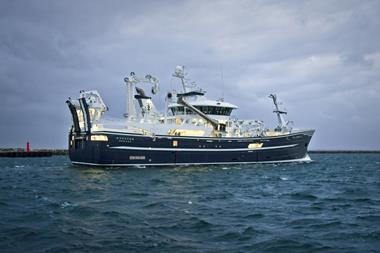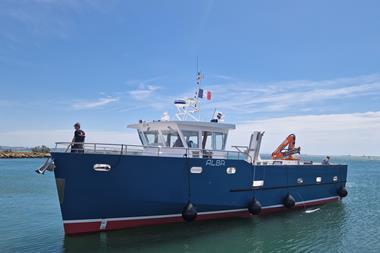



Salmon producer Scottish Sea Farms has taken delivery of a new semi-hybrid powered workboat specially designed to service larger pens and nets at its west coast of Scotland marine farms.
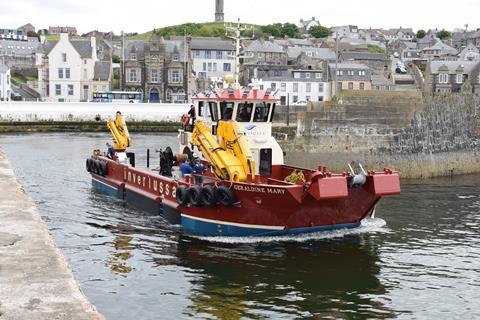
Geraldine Mary is on long-term contract from Mull-based Inverlussa Marine Services. It was designed and built in Scotland by Macduff Shipyards and will have a full-time crew of two with accommodation for two more if needed.
Equipped with a battery pack, the vessel will be able to use its harbour generators more efficiently, shutting them down overnight or between operations during the day to save on fuel and CO2 emissions, as well as reducing noise.
At 21 metres long, Geraldine Mary has the capacity for a heavy duty 72-tonne metre crane to better handle the company’s new 120-metre and 160-metre marine pens.
Scottish Sea Farms’ Regional Production Manager for mainland, Innes Weir, said the company’s move to fewer but bigger nets and pens was part of the ongoing drive to further enhance fish health and welfare.
“Increasing the size of pens allows for greater separation between fish stocks and predators, while reducing the number of pens enables even more focused husbandry and fish health monitoring.
“However, the new infrastructure also demands more of our farm teams – requiring different ways of working – and of our service vessels.”
Geraldine Mary is a sister ship to the Macduff-designed Helen Rice, which Scottish Sea Farms has operated under contract from Inverlussa for the past two years
Its first fully hybrid workboat, Laurence Knight, is also commissioned by Inverlussa.
Inverlussa Managing Director Ben Wilson said the decision to introduce a semi-hybrid power system aboard Geraldine Mary was a cost-effective, time-efficient amendment of an existing design compared with going fully hybrid with a complete redesign.
“It’s a vessel design we’ve had a lot of good experience with, and the semi-hybrid system is a big improvement on having generators running overnight.
“With a much larger forward crane and bigger deck winch than the Helen Rice, plus an extra cabin in the accommodation, it’s also a very versatile workboat.”
Weir pointed out that it is not just the new boat, but the crew and the administrative support from Inverlussa that help the smooth operation of the farm estate.
“One of the critical aspects of any marine farm is ensuring your moorings and containment infrastructure is secure, and this vessel’s main task will be inspections, as well as setting up and stripping down farms,” he said.
“We have a lot of farms and we need to inspect them all every year, sometimes twice a year, and it’s something we take very seriously, working closely and communicating often with Inverlussa on the logistics and operational aspects of these vessels.”