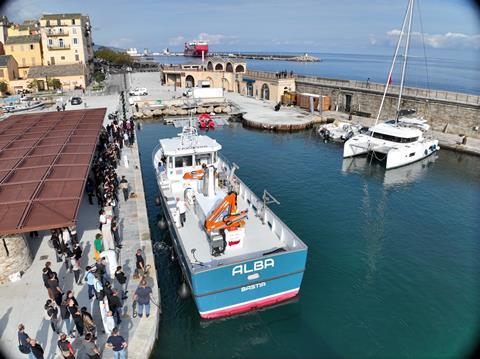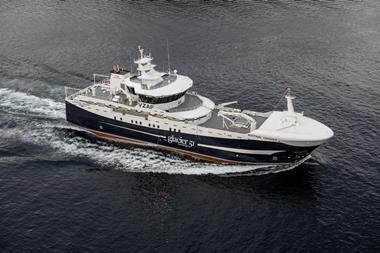
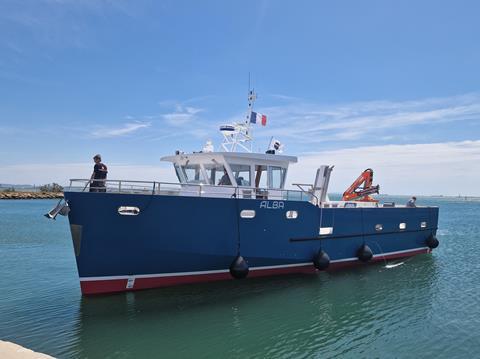
The Maritime and Aquaculture Professional Academy of Bastia (LPMA) in Corsica has taken delivery of Alba. Designed by Mauric, this innovative vessel is the first in France to have hydrogen-electric propulsion.
LPMA was awarded a €4 million grant to support the development and construction of a zero-emission vessel through the France 2030 Recovery Plan, and Mauric, with its extensive experience in designing fishing vessels for the Mediterranean, brought together key players in the hydrogen sector and ecological transition, such as Alternative Energies, CN GATTO Shipyard and EODev, supplier of hydrogen fuel cell-based REXH2 Range Extenders
The outcome was that their proposals for a composite vessel under 20 metres equipped with two 70kW REXH2 Range Extenders was selected by LPMA. For Mauric and the associated companies, this called for new thinking as the design of a hydrogen power-propulsion system vessel requires the use of the alternative design methodologies, incorporating multiple risk analyses (HAZID) to define the hydrogen system architecture, its integration into the vessel and consequently, particularly for a vessel under 20 metres, the general vessel architecture.
This led for the Mauric team to go beyond its usual design role, organising HAZID sessions with SEIYA Consulting specialists. From the general design phase, the consortium engaged Mediterranean DIRM and Bureau Veritas classification societies to involve them in the project and critical design choices.
Developing a zero-emission vessel meant first designing an energy-efficient vessel, using CFD calculation to enable the development of a highly efficient hull plan. Mauric also worked on optimising the composite structure, significantly reducing the vessel’s weight. The result is a maximum speed of 13 knots instead of the required 12 knots and an 11-hour autonomy at 10 knots, nearly 10% better than the LPMA’s required performance.
Tailored to teaching
Alba has been specifically designed to include fishing training capabilities such as longline and seine techniques, and is able to accommodate up to 12 students and two instructors/crew.
With an overall length of 19.95 metres, the maximum length allowed by the LPMA specifications, and a beam of 5.6 metres, Alba features a large deck area with layout arranged in close consultation with the LPMA teaching staff. The vessel is fitted with removable winches and deck machinery for longline or seine fishing, with configuration changes possible within just a few hours. Space is reserved aft for a boat or fishing winch. The deck is also outfitted with two hydraulic cranes.
The design ensures all areas of the vessel are accessible to multiple persons simultaneously, enabling fluid teaching, particularly in the wheelhouse for navigation and manoeuvring instruction, as well as in the Fuel Cell room where students and teachers can stand upright, which is unusual in vessels of this size.
Mauric completed all the detailed engineering studies, particularly the interface studies between the H2 system (FCs, storage system and H2 network) and the vessel, specifically addressing safety aspects, fire prevention and fighting, ATEX zoning, in close collaboration with BV and consortium members.
Propulsion gamechanger
Two 70kW EODEV REXH2 Range Extenders were integrated into the vessel, along with two 178kWh battery packs. It features fully redundant power-propulsion architecture with two propulsion lines, two 200kW electric propulsion motors, two independent battery packs and two independent REXH2s powered by nine hydrogen cylinders compressed at 350 bars, totalling over 75kg of hydrogen.
The newbuild’s outfitting was completed at the CN Gatto shipyard in Martigues. Dockside and sea trials were conducted under Mauric’s supervision for performance validation and regulatory compliance of the vessel and its equipment. Particularly, the H2 system commissioning and first dockside hydrogen bunkering for trials were significant project milestones that mobilised the entire consortium.
“This project represents a crucial milestone for Mauric and our partners, but also for the entire French hydrogen sector, as Alba is not merely H2-ready,” said Fabrice Ghozlan, Mauric’s Sales and Business Development Director.
“In fact, this is the first French professional vessel operating exclusively on hydrogen and batteries. With this project, we demonstrate that hydrogen can be a viable technical solution for certain vessel profiles, that the technology is ready, and that France possesses the expertise to design and build commercial H2 vessels.”