



Farming seafood on land making a lot more sense
Net pens, recirculating aquaculture systems (RAS), flow-through – which blue food farming system is best? According to Ohad Maiman, Managing Partner of land-based focused fund Aquafounders Capital, this is a complicated question that he’s been asked many times, particularly in the seven years he spent as CEO (and founder) of land-based yellowtail kingfish producer The Kingfish Company (2015-2022). Indeed, Maiman likens the question to asking which car is best – a Porsche or a Land Rover.
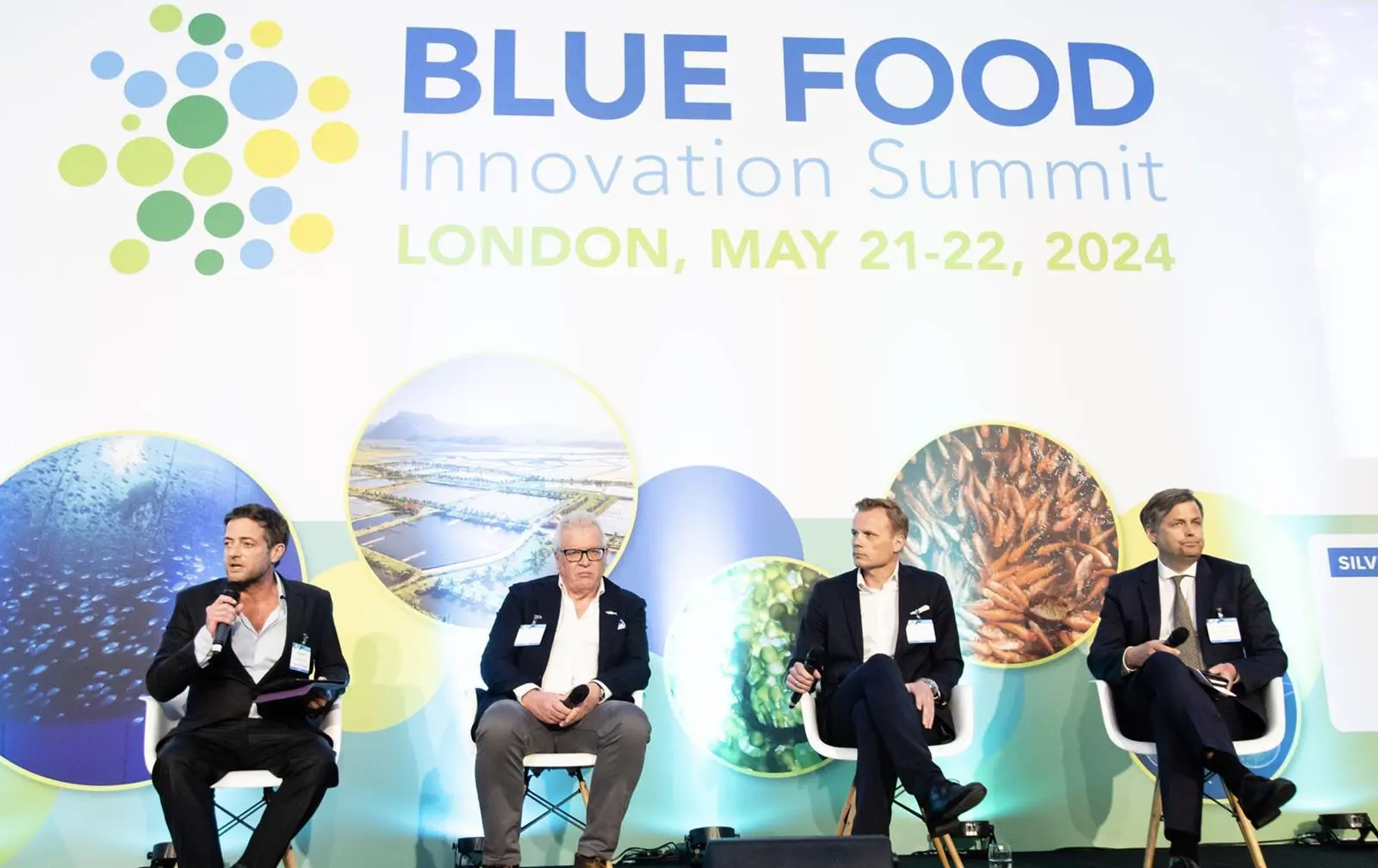
“It depends on what you are trying to do,” he told the recent Blue Food Innovation Summit in London. “There’s also the additional layer of technology combinations, with net-pen farmers using RAS for post-smolt, for example. It’s not ‘either/or’, with the technologies involved it’s about ‘also’. And when you think of the global seafood demand and an expected 30 to 50 million tonnes needed in the next 20 to 30 years, there’s room for all of them.”
Vincent Erenst, CEO The Kingfish Company, joined the RAS venture from the cage and pond farming sectors. He told the summit the main difference is that in the traditional production methods, there’s not much control over the environment that the fish are being farmed in.
“That counts for the water you pump into your system, and also for the water that comes out of the system,” he said. “You cannot really clean it because of the large volumes. And as you cannot really control what comes into the farm, you may get disease. And disease is one of the Achilles heels of traditional aquaculture. These are difficult problems to resolve.”
Erenst acknowledged that over the years, several technologies have been developed to try to resolve these issues, including pumping water from very low depths and cages that can be submerged into deep water, thereby reducing the impact on surface water.
At the same time, there are pump-ashore farms, with partial recirculation, and then there’s full recirculation systems such as that used by The Kingfish Company. This sees just 1% water replacement for every round that the water takes; the remaining 99% is cleaned by the filtration system.
“I think control helps make your fish perform a lot better. It’s surprising how well these fish do in these systems – if we compare our performance with net cage farming yellowtail in Japan, our fish do a lot better. It shows that if you provide the ideal conditions for the fish, their potential really comes to the fore. That’s a huge advantage,” Erenst said.
“The disadvantage, of course, is the more complex you make it, also the more it’s going to cost you. Capex – capital expenditure – per kilo is an issue for land-based farming, and the more control you get and the more sophisticated you make the system, obviously, the more you are going to spend. On the Opex (operating expenses) side, it’s not so bad – it’s not cheap to run a farm, but as your fish grow fast with good feed conversions, these costs become pretty similar to traditional farms, and without the disease risk.
“Complexity and Capex – those are things that are more difficult in land-based farming, but they’re really developing. A lot of work has been done in the last five to 10 years, and you see how this industry is now developing. I think that in the coming years, it will develop a lot further and also make the investments much more affordable.”
Ideal location
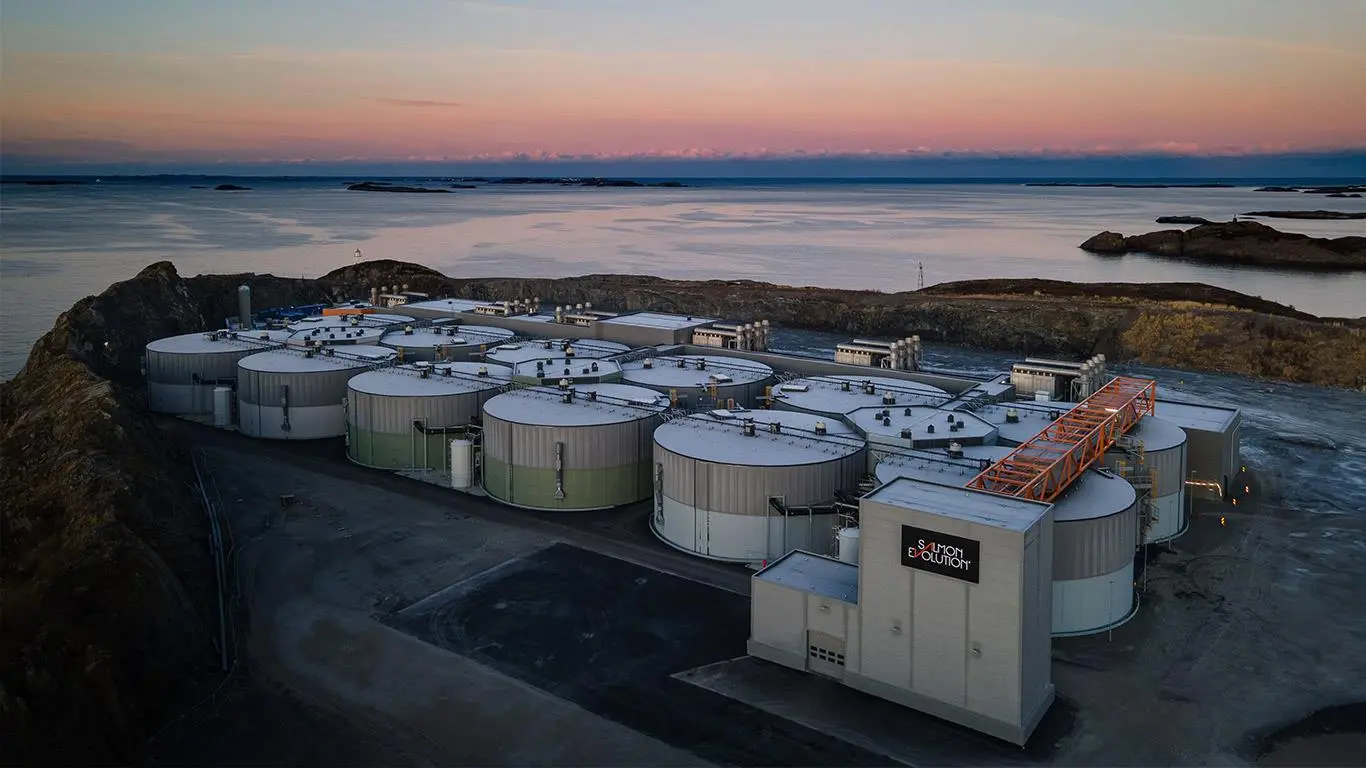
Norway’s Salmon Evolution is using a hybrid flow-through system to produce its fish. CEO Trond Håkon Schaug-Pettersen told the summit location is a key element in establishing a land-based farm. He said the company’s location on the west coast of Norway, next to the Atlantic Ocean, gives it unlimited access to clean, high-quality water of the ideal temperature.
“Providing a lot of new water at all times makes it easier to maintain good water quality. Secondly, it’s also a sort of risk mitigating thing with having access to water – you don’t have the same complexity or limited margin of error that you have in a RAS facility, where if things go wrong, they happen very [quickly].”
On the downside, Schaug-Pettersen acknowledged that such flow-through systems “can be heavy” on the Capex side. “But compared to the conventional industry, if you include the licence costing in Norway and also the taxes you are, you are at the stage now where this is more or less on parity on Capex, and now we are seeing Opex levels that that are also fairly competitive. This was not the case if you go back only three four years ago – the relative competitiveness of land-based has significantly improved. And I think if you look at all the opportunities you have to control the environment, this should also increase going forward.”
Horses for courses (mostly)
Giving a technology-provider perspective, AKVA Group’s Communications & Sustainability Director Ståle Økland said there are many ways to reach a goal. This, he said, is evidenced by all the innovations coming into the aquaculture space.
Agreeing that water quality is essential, Økland said there have beene a lot of different types of technologies being introduced, not just in the RAS area, which has been AKVA’s main focus thus far, with the delivery of facilities producing close to consumer markets.
But he added that land-based aquaculture isn’t just about full grow-out, with a growing trend towards post-smolt facilities, with young salmon grown to sizes of 500 to 700 grams before at-sea transferal.
“We think that will get more important,” he said. “It’s a great way to grow in many places.”
What’s key is utilising the right technology in the right way, added Maiman.
“I remember in the early days of RAS, early advocates used to love saying with the technology, you can grow salmon in the Sahara Desert, but from a business-case standpoint, that doesn’t necessarily mean you should,” he said. “If you have optimal conditions and an abundant water supply then there are benefits in going more towards flow-through. The less you have [of these], the more sense that RAS makes. But even that isn’t a black and white separation – there are RAS systems with zero discharge goals and there are RAS systems with 40% replacement per day.”
Public responsibility
Factoring current sustainability and traceability pressures, the summit heard it’s also very important to make the operations more appealing from a customer and consumer perspective.
“First of all, we’re farmers, and we like what do, and we want to be proud of it. Animal welfare, sustainability, traceability – those things that are our duty, and I think people at our company consider that duty above everything else. But especially in the market segment that we have chosen so far, which is high-end restaurants, we have a lot of responsibility – there’s a lot of chefs that really want to know what they are serving in their restaurants; they’re very proud of what they do too,” Erenst said.
“There’s a lot of attention on those aspects – for the consumers that we serve, and we believe that will trickle down further. We also see it at some purchasing sites of some retailers, consumers in Northern Europe, much more so than in Southern Europe, but it’s definitely increasing, and I think America will also follow. So, these trends – the things we try to do to grow fish in a sustainable and more animal-friendly way, I think they ring a bell with consumers. And I think that will spread.”
An important aspect of the seafood or aquaculture industry is that it’s highly regulated, added Schaug-Pettersen. He highlighted that in the salmon farming sector, there’s been no growth in global production over the last two or three years.
“The prospect of growth is very limited in the short-term,” he said. “This is due to the need for sustainable growth; it’s also due to the challenges facing the industry. It’s extremely important to have sustainability, to have fish welfare and health very high on the agenda because it’s becoming more and more a licence to operate and to produce. I also think that increasingly you will see customers migrate to solutions that can prove, for example, very good fish welfare.”
Related Articles
 PROCESSING & REFRIGERATION
 SEAFOOD
 SEAFOOD