Norway is a country that’s small in population but mighty in fish exports.
When it comes to fish, there are few countries that have such a wealth of resources as Norway. In value terms, the Scandinavian country is the second largest exporter of seafood products in the world, behind China.
Last year, Norway exported seafood products to 130 countries with a total value of €8 billion ($10.3 billion). Of this, aquaculture products generated 58.5% of the total with a value of €4 billion ($5.1 billion), while fishing accounted for 41.5%, bringing in €2.9 billion ($3.7 billion). WF&A readers should note that this was the highest value ever generated by the fishing sector.
In terms of markets, Russia was Norway’s biggest export market in 2011 with a value of €660.2 million ($848 million), followed in descending order by France, Denmark, Poland, Japan and China.
Terje Martinussen, managing director of the Norwegian Seafood Council (NSC), said that overall, there has been a steady growth in value, particularly over the last seven years.
“This dropped slightly in 2011, but the export figures for last year were still the second largest we have seen since 1991,” he said, attributing much of the international success to the active ‘country of origin’ marketing that takes place in about 20 countries.
“We believe that every day 38 million meals are eaten around the world that comprise Norwegian fish.”
2011 was a record year for exports of Norwegian groundfish, including clipfish, salted fish and stockfish, with a total value of NOK 11.2 billion (€1.5 billion/$1.9 billion), an increase of NOK 739 million (€96.9 million/$127.2 million) or 7% compared with 2010.
The NSC said the biggest increase was in exports of frozen whole fish (cod, saithe and haddock) to China for further processing. These exports were valued at NOK 1.2 billion (€157.4 million/$206.6 million), a 21% increase from 2010.
Norwegian exports of fresh groundfish, including farmed cod and halibut, increased in value by 3% year-on-year to NOK 2 billion (€262.3 million/$344.4 million).
Less landings
The high values are, however, in line with a declining catch. According to figures published by Statistics Norway (based on data from the Directorate of Fisheries), Norwegian fishing vessels landed 2.3 million tonnes of fish, crustaceans and molluscs last year, down 15% compared with 2010. The catch has been valued at around €2.1 billion ($2.8 billion), a 19% increase on 2010.
Some 79% of the 2011 catch was used for consumption, while the remaining 21% went into the production of meal, oil and animal feeds.
There were notable declines in the catch volumes of herring (down 31%) and blue whiting (down 89%).
In Norway, however, cod is king and last year’s catch amounted to 341,000 tonnes with a value of €507.9 million ($666.2 million). These figures represent 15% of the total catch quantity and 24% of the total catch value.
The cod quota rise in the highly important Barents Sea for 2012 points to continued success. Norway and Russia co-manage the largest and most sustainable cod stock in the world in these waters and in line with the healthy stocks their shared quota increased 8% this year to 751,000 tonnes, of which 339,857 tonnes is the Norwegian share.
The two countries will also share a haddock quota of 318,000 tonnes, an increase of 5%. Norway’s share of this quota is 153,235 tonnes.
It’s in the Barents Sea that Norway captures about 93% of all its cod. And the fish here, along with the haddock, were recently certified as being sustainable under the Marine Stewardship Council (MSC) eco-label.
According to Atle Vartdal, operations manager at the Aalesund, Norway, -based fishing company Vartdal Seafood AS, the Barents Sea stocks are at an all time high for a number of reasons, including good management of the resource, but the biggest reason for the abundance of cod and haddock is that increasing sea temperatures have brought a lot more food fish – namely herring and capelin – to these waters in recent years.
“We’re delighted,” said Mr Vartdal. “There is a huge amount of North Atlantic cod up in the Barents Sea, and haddock has the largest spawning stock on record. The stocks are in a very healthy shape and they’re certified as being sustainably managed.”
Cod was in fact the first product ever exported from Norway. Historians say the trade of dried cod goes back as least as far as the Viking age.
Bullish approach
Norwegian state secretary Kristine Gramstad said the Nordic sea area, which is larger than the continent of Europe, has some of the most productive waters in the world.
“If managed well, they will remain sustainable for generations to come,” she said. “But the economic viability of fisheries depend upon how we cope with overfishing, fluctuations in the market-prices for fish, global competition, and structural changes in the fishing fleet and processing industry.
“Our fishing and aquaculture industries operate in highly competitive international markets so the management system has a central role to play in securing optimal production of the marine ecosystems.”
Meanwhile, the country’s fisheries minister Lisbeth Berg-Hansen has pledged to help the European Commission with its reform of the EU Common Fisheries Policy (CFP), and in particular she wants to assist fisheries commissioner Maria Damanaki in fulfilling her objective of putting an end to the practice of discarding fish at sea; fish which either have no market value or for which there is no quota.
Last month, Minister Berg-Hansen told Norwegian fishing leaders in Oslo that Norway has proved it’s possible to have a fishing industry without large scale subsidies.
“We have for many years worked hard to prevent dumping in the Norwegian fisheries, many times with and sometimes against the industry. This is an important issue that concerns many people within the Norwegian fishing industry,” she said.
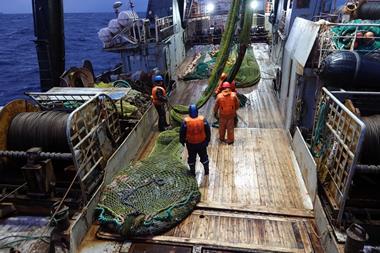
To provide some context, Norway introduced a ban on discards in 1987. There had been seven consecutive weak year classes of Arctic cod stocks and then in 1983, a strong year class occurred. But the Norwegians felt a strong year class could be grossly reduced through excessive discarding and so the authorities decided to implement a programme of temporary closures of fishing grounds.
Another problem was high grading, whereby in situations of large catches, the trawlers were
inclined to keep only the biggest cod, and were discarding the smaller, but still legal-sized fish.
This was a legal practice under the regulations in place at that time. But it was still widely regarded a tragic waste of valuable resources and received considerable media attention in Norway. This encouraged the then minister of fisheries to ban discarding on ethical grounds.
According to the Norwegian Ministry of Fisheries and Coastal Affairs, Norway’s focus on the discard conundrum over the years, and the regulations introduced to deal with the problem, have had a beneficial influence on the research and development of more selective gear. And it claims the temporary closure of fishing grounds driving the introduction of grid technology both in shrimp and cod trawls is a very good example of this spin-off effect.
Salmon overproduction
While Norwegian wild capture fisheries performed well from a revenue point of view in 2011, particularly in the whitefish sector,and will most probably continue along this course throughout this year, the country’s salmon farming industry has had something of a rollercoaster ride over the last 12 months.
Certainly 2011 started very well with some of the main players like Marine Harvest and Leroy posting record Q1 results, but by the start of the summer, things had turned sour. The problem, which many stakeholdersbelievewill continue throughout this year,is that supplies have grown so substantially in such a short space of time that prices have nosedived.
While at the start of 2011, the farm gate price was touching NOK 50 (€6.44/$8.39) per kg, at the end of the year it was less than half that price. The average price for the year was NOK 31.93 (€4.19/$5.50), down from NOK 37.47 (€4.92/$6.45) in 2010.
Not surprisingly, this led to a decline in the value of Norwegian salmon exports last year. They fell NOK 2 billion to NOK 29.2 billion (€3.8 billion/$5 billion) in 2011. This was despite the exported volumes exceeding 840,000 tonnes in product weight, a 7% increase. In round weight (whole fish equivalent), this is equal to an export volume of 979,000 tonnes and is the biggest annual export volume ever registered.
Putting a positive spin on the situation, Bjorn-Erik Stabell, marketing manager for Norwegian salmon and trout with the NSC, said the fall in salmon prices has made the product much more competitively priced on the global food market.
“This, combined with a continued strong focus on marketing and product development, ought to result in increased demand for Norwegian salmon in years to come,” he said.
The NSC said Norwegian salmon was exported to 98 countries last year. France was the single biggest market, importing 143,000 tonnes (round weight), followed by Russia, Poland and Denmark.
Among the single markets, Russia showed the biggest increase in export volume last year with growth of 20,699 tonnes. The biggest fall in export volume was to the United States, where the majority of exports comprise fresh and frozen salmon fillets. Less than 20,000 tonnes was imported by the US – a drop of almost 25,000 tonnes from the previous year.
Silver lining
The immediate problem for Norwegian producers is Chile and the South American country’s progress since overcoming the infectious salmon anemia (ISA) outbreak in 2007 that virtually wiped out all its salmon output for three years. With the subsequent drop in global supply, prices soared and Norway – as the biggest producer in the world – profited from record prices.
Chile’s production is expected to grow 40% this year to 360,000 tonnes and Scotland, the number three producer, is also expected to produce at least 160,000 tonnes in 2012. This will undoubtedly exert further downward pressure on prices and farm gate prices in the low NOK 20s have been predicted.
In announcing its 2011 fourth-quarter results in February 2012, the Marine Harvest Group – the largest producer of farmed salmon in the world with a presence in 22 countries – said it is expecting a challenging supply situation this year with continued price pressure and added that the group will take steps to preserve its financial strength.
The Bergen-based aquaculture giant reported revenues of NOK 4.3 billion (€562.9 million/$746.9 million) in Q4, down from NOK 4.6 billion (€602.2 million/$799 million) in Q4 2010. Its harvest volumes for the quarter increased by 16% to 104,589 tonnes compared with 90,485 tonnes in Q4 2010.
Alf-Helge Aarskog, CEO of Marine Harvest ASA, commented that spot prices continued to fall in Q4 as markets absorbed an increase in industry supply of a massive 20.5%.
Marine Harvest expects to harvest a volume of 360,000 tonnes in 2012, of which 89,000 tonnes is expected to be harvested in the first-quarter.
“We expect a challenging supply situation in 2012 with continued pressure on prices. Our sales and marketing unit will continue to exploit the strong demand stimulus from reduced prices to expand the market for Atlantic salmon,” said Mr Aarskog.
Norwegian salmon producers have, however, recently receieved a welcome shot in the arm, through the announcement that they can now send their fish to the United States without incurring the penalty tariff that obstructed Norway’s salmon imports since 1991.
The tariff, which had only applied to whole fresh salmon rather than to filleted or smoked varieties, was imposed after US officials determined that Norway had dumped underpriced (subsidised) fresh salmon in US markets.
The US International Trade Commission (USITC) announced the decision to rescind the 24% penalty duty in January this year, presenting a new opportunity for Norwegian producers.
Minister Berg-Hansen, who is also a salmon farmer, welcomed the Commission’s move. “This case has fundamentally relevant business and trade policy aspects that have been important for us to clear up”, she said. “The salmon industry is highly export-oriented and dependent on good, predictable trade conditions.”
However, WF&A readers should note that the cost of air transport across the Atlantic will keep Norway-based salmon farmers at a disadvantage to their competitors in Canada and Chile.