





iFarm 3 salmon stocking
Norwegian salmon producer Cermaq has stocked the third version of its iFarm, a project that’s aiming to improve the health and welfare of the fish in the net pens with the help of artificial intelligence.
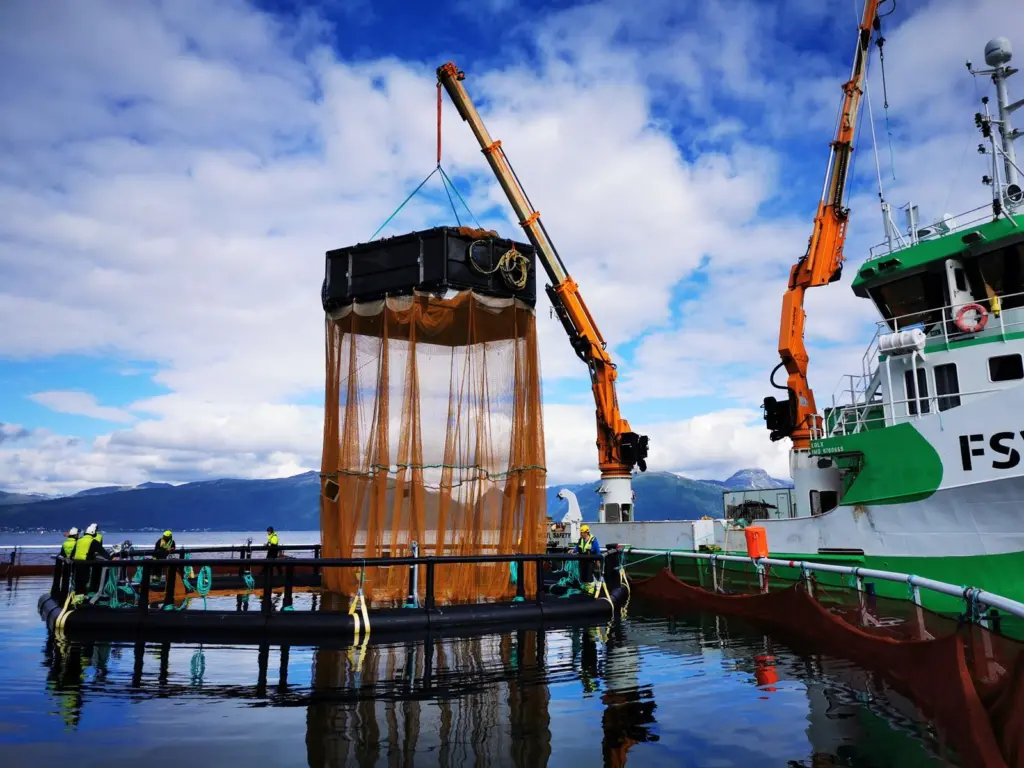
For iFarm version 3, it’s the sea site Hellarvika in Steigen that’s being equipped with the setup, using the same crew that was responsible for the first iFarm fish that was stocked in Martnesvika in 2020.
“With the first version of iFarm, everything was new, and we had an incredibly steep learning curve, but as we got started with operations, we think it worked out quite well,” Hellarvika site manager Tor Hansen said. “Now a number of adjustments have been made both to the set-up and to operations based on experiences gained in Øksnes, where we now have version two of iFarm, so it will be exciting to get started with operations, and to follow how the fish thrive in the third version of iFarm.”
While in the testing of version 1 the main focus was on establishing an understanding of how iFarm affects fish behaviour and gaining basic learning about the iFarm construction, in the testing of version 2 there has been a lot of work with alternative versions of the sensor housing and operational adaptations, such as feeding the fish under a net roof, and to achieve efficient handling operations in a sea site with a lot of extra equipment in the net pens.
For version 3, the focus will be mostly on the sensors, on data collection and machine learning, and on further development of the mechanism that sorts fish.
“At Hellarvika, we will concentrate on the sensor arrangement to retrieve images with good quality and follow up the annotation of key parameters such as fish ID, lice, growth and fish welfare in the net pen, and on further developing sorters,” BioSort Managing Director Geir Stang Hauge said. “After a successful test of the first-generation sorter in net pens where we saw that the mechanical sorting mechanism worked with fish swimming through the system, we are now testing the second generation, and we will try to lead the fish from the sorter into another volume through a pipe. The aim is to validate that it is possible to take out individual fish according to specific sorting criteria.”
The sorter will eventually become autonomous, so that together with the sensor system in iFarm it can make its own decisions based on defined criteria, such as the discovery of lice or wounds.
“It’s complicated work, and it’s work that hasn’t been done before, so it’s demanding, but also very exciting,” Hauge said.
The iFarm project is planned to last five years and is a collaboration between Cermaq and BioSort. Cermaq has been awarded four development concessions for it.
Related Articles
 AQUACULTURE
 AQUACULTURE
 AQUACULTURE