






Global tuna health decline
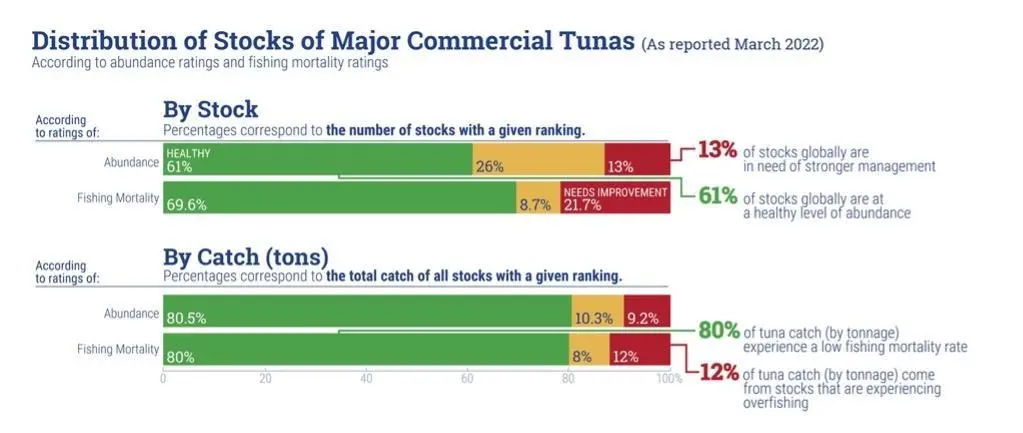
Of the total commercial tuna catch worldwide, 80.5% is sourced from stocks deemed to be at “healthy” levels of abundance, according to the latest edition of the International Seafood Sustainability Foundation (ISSF) ‘Status of the Stocks’ report.
ISSF’s March 2022 report also finds that 9.2% of the total tuna catch came from overfished stocks, and 10.3% came from stocks at an intermediate level of abundance.
Six months previously, the “healthy” level was at a much higher 87.7%, with the decline mainly attributed to a change in the rating of the Eastern Pacific skipjack stock, which represents about 6% of the global tuna catch. The report downgrades that stock from a green to a yellow colour rating.
The report explains that the Inter-American Tropical Tuna Commission (IATTC) has not conducted a conventional assessment of skipjack tuna since 2012. As such, its status is uncertain.
In addition, fishery indicators show an increase in fishing mortality in the floating-object (or FAD) fishery and a historical low level in skipjack average size.
This, ISSF said, adds to the uncertainty of the actual stock status. It is therefore urging the IATTC to conduct a conventional stock assessment as soon as possible.
Other changes in tuna stock status since ISSF’s September 2021 report include:
- Atlantic Ocean bigeye stock improved its spawning biomass status from orange to yellow and its fishing mortality status from orange to green
- Mediterranean albacore stock’s spawning biomass status was downgraded from yellow to orange, and its fishing mortality rating was demoted from green to orange
ISSF’s latest report also determines that the Indian Ocean yellowfin, Pacific bluefin tuna and Mediterranean albacore stocks are overfished and subject to overfishing, while the Indian Ocean albacore and bigeye stocks are subject to overfishing.
In 2020, the total global tuna catch was 4.9 million tonnes, which was about 10% lower than in 2019. Some 57% of this was skipjack tuna, followed by yellowfin (30%), bigeye (8%) and albacore (4%). Bluefin tuna accounted for 1% of the global catch.
Some 66% of the catch is from purse seining (approximately 36% associated or FAD sets, 27% unassociated or free school sets, and 3% dolphin sets), followed by longline (10%), pole-and-line (7%), gillnets (4%), and miscellaneous gears (13%).
Related Articles
 PROCESSING & REFRIGERATION
 FISHERIES
 FISHERIES