


Mowi debuts Chilean solar fish farm
Mowi has commissioned Chile’s first low-emission fish farming installation, introducing a floating solar-powered pen system at its Huar Norte site in a major step towards reducing emissions from sea-based aquaculture.
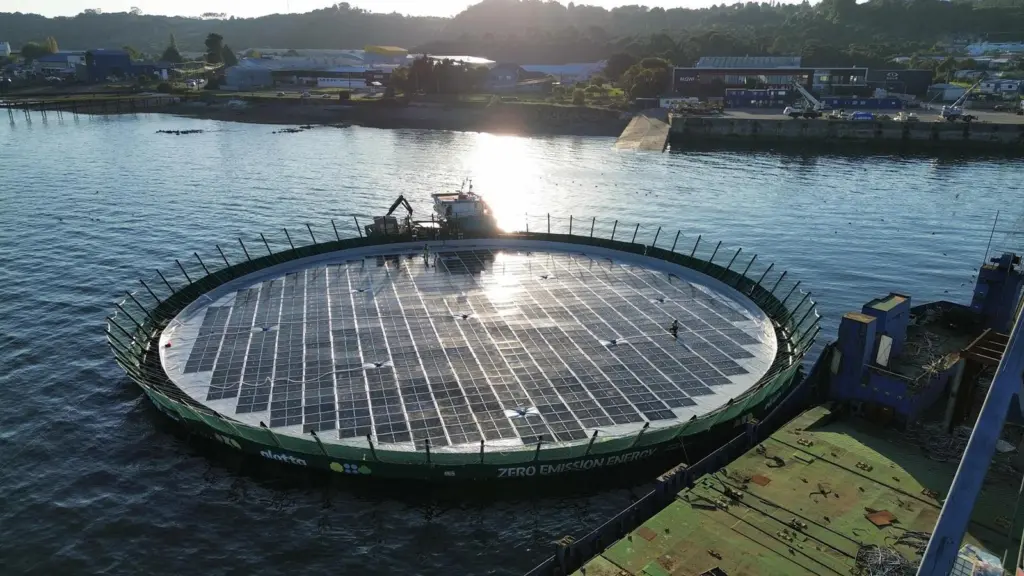
The project has been developed in partnership with AKVA group, Alotta Energy and Fjord Maritime, combining floating solar technology, energy storage and power management to significantly reduce the site’s reliance on diesel generators.
The hybrid energy system is expected to cut annual diesel consumption by approximately 139,200 litres, reducing CO2 emissions by around 350 tonnes each year. Renewable energy is forecast to supply approximately 57% of the site’s electricity demand, while also reducing fuel delivery traffic and improving working conditions through lower generator noise.
“This is an important delivery for us, but even more significant is that Mowi has shown leadership and courage by being the first to act,” said Christian Schäfer, general manager of AKVA group Chile.
AKVA group supplied the complete pen infrastructure, integrated the floating solar installation and will continue to provide maintenance and service support. Norwegian renewable energy specialist Alotta Energy delivered the floating solar power plant, while Fjord Maritime supplied the energy management and battery storage systems.
“We founded Alotta to create renewable energy solutions that work where it matters most,” said Kari-Elin Hildre, chief executive of Alotta Energy Chile.
“Our Alotta Solar Hybrid technology has been proven along the Norwegian coast, and now it’s helping Mowi cut emissions in Chile. That’s a milestone we are truly proud of.”
Steve Burns, managing director of Fjord Maritime Chile, added: “By combining our energy management and storage capacity with efficient solar power, we are directly contributing to more climate-friendly food production.”
The Huar Norte installation is expected to serve as a model for future low-emission aquaculture developments as producers seek practical ways to reduce fossil fuel consumption while improving operational efficiency.
Related Articles
 AQUACULTURE
 AQUACULTURE
 AQUACULTURE