



Trials prove successful ROV tracking
Joint trials by Norwegian research institute, SINTEF Ocean, and marine resource technology company, Sonardyne International, have proven the ability for an acoustic positioning system to track underwater robots as they move through industrial-scale fish pens.
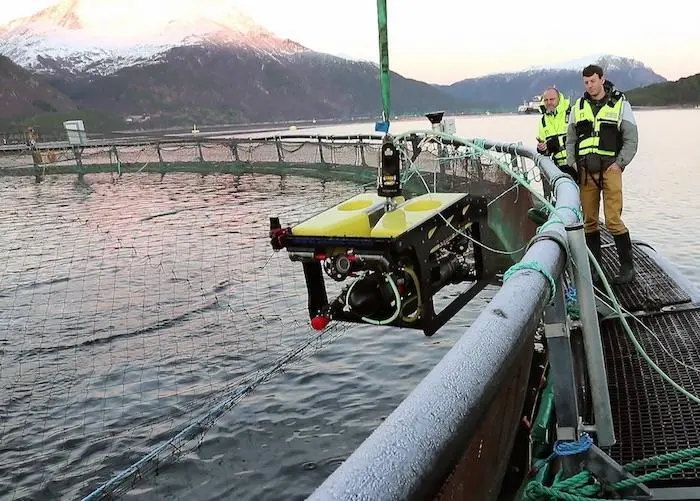
Being able to accurately track remotely operated vehicles (ROVs) in aquaculture operations will help operators increase productivity and reduce the need for divers.
Elizabeth Paull, business development manager at Sonardyne, said that “the demonstration showed that our systems function to their usual high standards in low to medium fish densities, both inside and outside of the cage, with the ROV being tracked consistently and accurately.”
There has been a misperception that acoustic tracking systems do not work in fish farm applications, due to the volume and density of fish within the pens or cages. Fish have an air-filled swim bladder that helps them regulate their buoyancy and this organ can interfere with the transmission and reception of acoustic signals from the surface to an ROV.
In the trials, at the Korsneset SINTEF ACE site near Trondheim, Norway, a Micro-Ranger 2 Ultra-Short BaseLine (USBL) positioning system was used to track an Argus Mini ROV through a pen containing an estimated 150,000-200,000 salmon.
Micro-Ranger 2 is Sonardyne’s latest USBL positioning system, designed for users with no previous experience of USBL equipment. It features a small acoustic transceiver deployed from a vessel or pontoon and an acoustic transponder attached to the ROV.
Related Articles
 AQUACULTURE
 SEAFOOD
 SEAFOOD