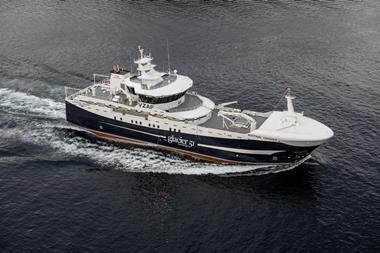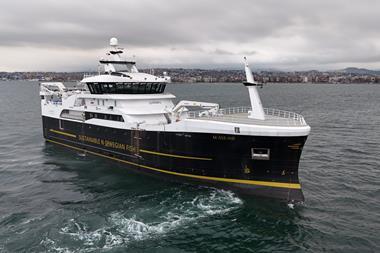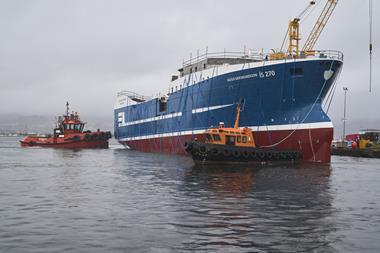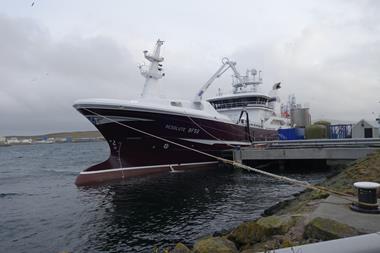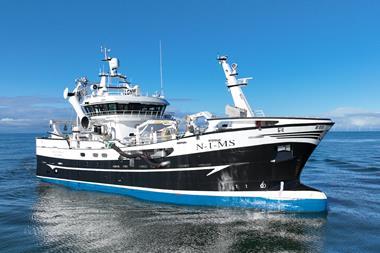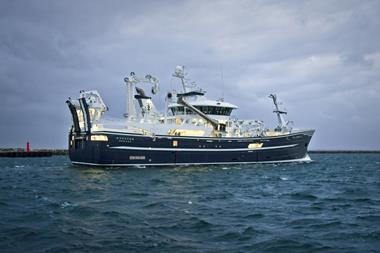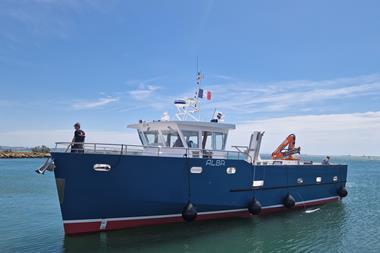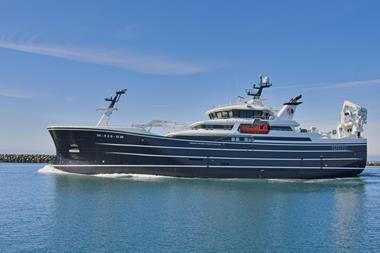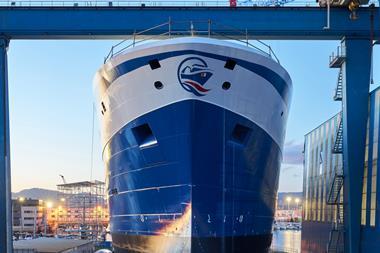




This latest newbuild designed to fish Scottish waters replaces the Fruitful Vine the same yard delivered in 2010, and it also closely follows the design and propulsion patterns of recent new trawlers for owners in Scotland. Fruitful Vine BF-240 is designed to trawl with twin-rig gear on traditional fishing grounds, as well as having the option with a specially adapted winch to work as a pair – opposite the company’s other trawler, Steadfast Hope BF-340.
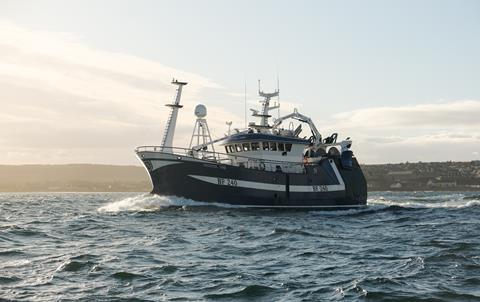
The original intention had been to work Macduff’s previous 24.5-metre design, but early in the design process the decision was taken to remodel the bow section of these vessels, based on the preliminary results of a tank testing programme which the yard and Macduff Ship Design were running for another project.
The outcome of a quick study conducted by the Wolfson Unit in Southampton using CFD technology to compare the proposed new bow against the previous model confirmed an expected net decrease in hull resistance at steaming speeds.
As a result, the hull form was faired and finalised by Macduff Ship Design, which then produced a full set of steel construction plans along with conducting the incline experiment and producing the vessels stability booklet. The hull’s fabrication went ahead in Macduff with the construction reviewed and verified by SFIA and the MCA.
With an aluminium wheelhouse and masts, the 24.5-metre, 7.6-metre breadth, steel-hulled Fruitful Vine has a double chine hull form, transom stern and bow designed to cut cleanly through the water with less energy, resulting in reduced fuel consumption and emissions along, as well as making life more comfortable for the crew.
Tried and tested
The layout is on much the same lines as other recent newbuilds for Scottish owners, with cabins for up to eight crew, the engine room and 700-box capacity fishroom below deck level, plus a substantial fresh water tank placed forward of the collision bulkhead. The above deck layout puts a trawl handling area under the after shelter, the galley and mess area blow the superstructure and the catch handling area under the forward shelterdeck and the winch room forward.
Tank capacity is for 20,600 litres of fresh water and 26,000 litres of fuel.
Fruitful Vine’s owners opted for the same propulsion package as has proved to work effectively on previous newbuilds – and this is the eighth new trawler to date to feature this combination with a Caterpillar main engine. The 660hp at 1600-1800rpm C32 main engine drives a 2500mm diameter Wärtsilä propeller inside a high-lift nozzle via a Masson Marine W7400 reversible gearbox with a 9.077:1 reduction ratio.
According to the yard, this combination has proved to be a winner, showing itself to be both robust and adaptable, and with the wide operating speed range of the C32 main engine providing flexibility to achieve full power from a fixed-pitch propeller both when steaming and towing.
Fruitful Vine also has steering gear from Scan Steering APS for the triple rudder, and the Kort Propulsion bow thruster for manoeuvring at low speeds is supplied by the yard.
Power aplenty
Electrical power is provided by two Mitsubishi gensets supplied by Macduff Diesels Limited, each with a rating of 98kWe and generating enough energy that each one is capable of meeting Fruitful Vine’s power requirements. Electrical systems on board were designed and fitted by RD Downie who also fabricated the switchboard and control panels for all the pumps and motor starters, as well as providing fire, bilge and gas alarm systems, the navigation light panel, and assisting with the installation of the navigation equipment supplied and installed by McMinn Marine.
Cooling systems for all engines and hydraulics are served by box coolers supplied by Blokland Non-Ferro.
The deck is laid out with a pair of split net drums aft, lined up to the shooting hatches at the stern. The complete package of hydraulic deck equipment was supplied by Macduff Shipyards, and includes a triple barrel trawl winch located forward which has oversized drums providing the capacity needed for pair trawling gear. There are also two bagging winches, two small gear-handling winches, a codend lift and a dedicated anchor windlass.
Power for the hydraulics comes from a single Parker hydraulic pump driven from a dedicated 218kW Mitsubishi 6D24 auxiliary engine, while secondary hydraulic power is provided by a Parker hydraulic pump driven from a power take-off to the main propulsion gearbox.
The MFB8 landing crane forward and the MBK13 powerblock crane on the aft gantry are both mounted on slew ring bases, and were supplied by Thistle Marine.
The codends are taken forward to be emptied through the hatch on the starboard side into a hopper below on the catch handling deck to be passed through the sorting, gutting and washing setup fabricated by the yard. The catch handling areas has a DEGA resin floor system fitted by PBP services.
There are two separate compartments within the fish processing area, providing an enclosed storeroom and an ice plant room to feed the ice pound in the fishroom below. The icemaker and the chiller system for the 700-box fishroom were supplied and fitted by Premier Refrigeratio