

Inverlussa orders hybrids
Two hybrid aquaculture services vessels have been ordered by Inverlussa Marine Services that will see the Scottish company’s fleet reach 20 vessels later this year.
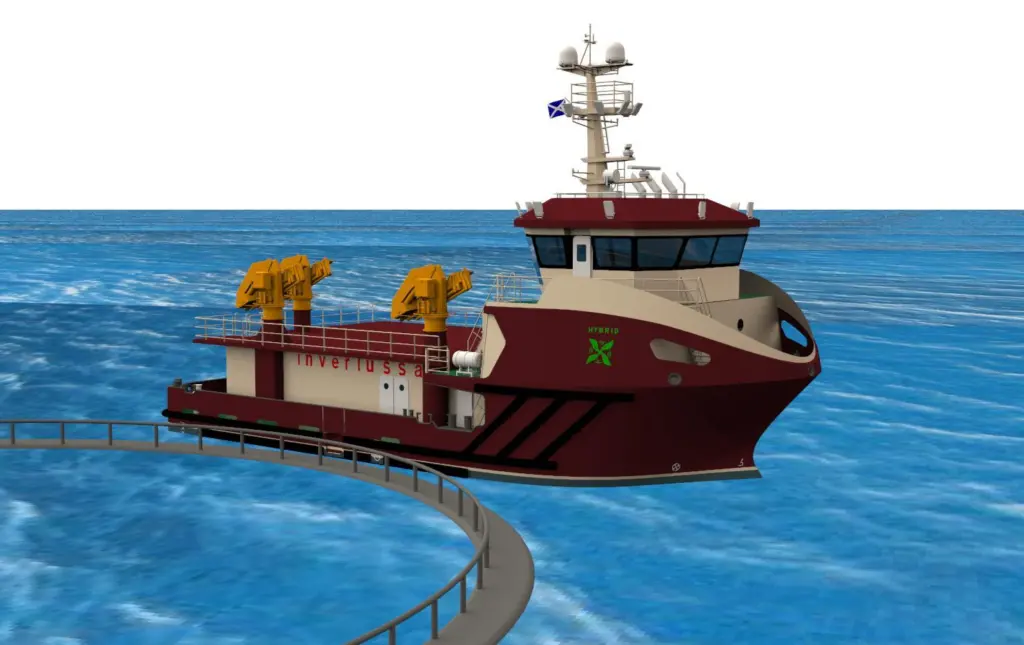
The first new vessel, Eloise Eslea, will be delivered late September, with the second (currently known as N023), to be delivered late December. The company also expects to recruit an additional 12 crew/staff, which will take the company’s headcount to 115 local employees.
The signing of these contracts marks the second and third vessels to be built for Inverlussa at the Netherlands-based Nauplius Workboats. The first being the recently delivered 34-metre delousing vessel Camilla Eslea, which is on a long-term charter to Mowi Scotland.
Inverlussa has invested heavily in newly-designed vessels in recent years. Since March 2020, the Mull-based company has taken delivery of six new vessels, designed and built specifically for Scottish aquaculture.
Managing Director, Ben Wilson, said Inverlussa was pleased to be working with Nauplius Workboats again following its positive experience with Camilla Eslea, with the vessel delivered on budget and on time.
“As a business we want to be an industry leader, building a reputation as a leading and forward-thinking partner in the Scottish aquaculture sector. We aim to achieve this through continually reinvesting, innovating, and a strong focus on working with the most talented crew in the industry.
“This order for two-newly designed hybrid vessels show Inverlussa’s commitment to delivering the best service to our customers,” Wilson said.
Inverlussa said the vessels have been designed with the latest technology, a high focus on crew safety and comfort as well as low emissions and incorporated with the latest fish welfare and high capacity de-licing systems. The vessels have a diesel-electric propulsion system to ensure the optimum availability of power in all working conditions, thereby increasing weather resilience.
The inclusion of hybrid technology and cutting-edge battery technology enable the vessels to either use energy from the batteries, or store energy in the batteries when surplus energy is produced from the ship’s generators. The reduced fuel consumption will in turn help drive down the operation costs for our customers.
These vessels along with Camilla Eslea will be the first fish farm vessels in Scotland to use azimuth propulsion which enables the vessel to use full power in any direction allowing the ability to move in wind speeds which would normally not be possible with conventional vessels.
Another major attribute is the dynamic positioning system allowing the vessels to remain stationary on any one position for long periods which is also a first within Scotland.
Inverlussa was the first service vessel company in Scotland to take delivery of a fully hybrid vessel last year when Laurence Knight was delivered from Moen Marin in Norway. In addition to this latest order, the company will also take delivery of Geraldine Mary, a 21 metre semi-hybrid vessel from Macduff Shipyards in May this year.
Salmon Scotland, the body that represents the farm-raised salmon industry, has welcomed Inverlussa’s latest order, with Chief Executive, Tavish Scott, saying that innovations such as hybrid aquaculture service vessels are a key part of the sector’s commitment to sustainability and responsible growth.
“Salmon farming already has the lowest carbon footprint of any comparable livestock, but farmers are constantly looking for even greener solutions like this,” he said.
Related Articles
 VESSELS & SHIPYARDS
 VESSELS & SHIPYARDS
 NEW VESSELS