



Why make things complex when they can be simple? That’s the question engineer Sébastien Termet asked himself when he was approached by a fish farmer to come up with a feeding system.
The result was the first Westair product – built in his garage – and the customer was delighted with the unique solution he came up. That was in 2017 and now Westair’s workshops in Brittany designs and builds systems for the delivery of a variety of substances via pipes, along with equipment for dosing, cleaning and pipe inspection, as well as providing after-sales service.
The Multizone automatic feeding system for aquaculture is a direct development of that very first system built in Sébastien’s garage, the key to which is the unique Multiway three-way valve that makes it possible to route a variety of powders and liquids through a network to deliver feed in precise quantities as required, based around the concept of real-time feeding.
Feed passes from storage silos to the DosAir dosing management system, which routes all feed along a single pipeway fitted with Multiway valves, leading to each cage or tank in the farm, with options for one or more feeders for each tank.
“To keep the system clean, we came up with the CleanPipe. This is a mechanical crawler that passes through the pipes in between feed deliveries, and it automatically removes condensation, or any sludge left in the pipes, making sure that they remain clean all the time,” said Westair’s Henri Herledan, who joined the company as its sales director, before taking over as CEO, allowing founder Sébastien Termet Sébastien to concentrate on his real passion, focusing on the technical side of the business and developing further innovation
The ideas that go into Westair’s systems don’t end there, as the package includes a control and management system based around a single PC coupled to a pocket controller that can be used to stop and start feeding processes.
“The touchscreen PC is loaded with all the software needed to manage the whole site, while the pocket controller is also ideal for remote locations,” Henri Herledan said.
“There are also remote control options and site managers can control, monitor and check systems and equipment status via remote PC, tablet or smartphone,” he said and explained that the Multizone system collates data from a variety of sensors throughout an aquaculture installation, measuring oxygen and NH4 levels, temperature and water turbidity, and it communicates constantly with the feeder software, interrupting the feed process and flagging up an alert if parameters are exceeded.
“The intention is to replicate natural feeding patterns as far as possible, and to minimise losses of both feed and fish, and we aim to minimise power consumption while also being able to offer consultation with our partners to provide options for utilising renewables, such as solar, wind and hydro-electric power sources,” he said.
A number of Multizone installations are currently underway or under consideration by fish farmers in several countries, each of which aims at building a new installation or extending an existing one, upgrading production facilities to improve hygiene, protecting both animal and human health, and raising the quality of each farm’s production.
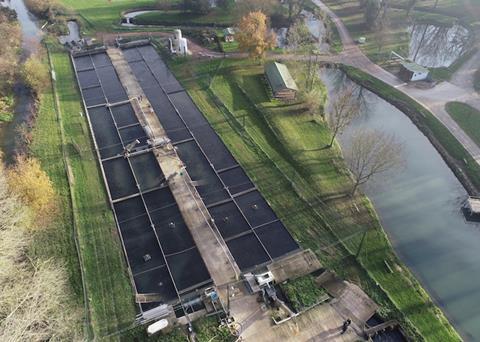
Alexis Cleret’s fish farm in Monchel-sur-Canche in northern France was the first to be fitted out with a Multizone system, and the results made an immediate impression.
“Sébastien Termet came to see me to show me diagrams of the Multiway valve. I was impressed with the 3D presentation. I thought the valve looked reliable, and as there is only one straight pipe the pellet will not degrade,” he said.
“I liked Sebastien’s approach. He clearly didn’t come to see me to sell his valve. He came to find out what he could do to adapt his ideas. He wanted to make a system for us fish farmers and was making a big effort to meet a real need. My feeling at the time was that this could turn out to be a good system, and Sébastien explained about a new generation system with a flow of information, with the sensors gathering data and feeding it to the software. Any fault is detected and can be managed, which makes this system unique.”
Sébastien had begun testing his prototype in a fish farm in Brittany but the trials were restricted by a water shortage, so Alexis Cleret offered to do the trials at his farm.
“It was very impressive that Sébastien was determined to come up with a machine that was as simple as possible and which required a minimum of maintenance. He was determined to make a market-friendly system that worked well. ‘Between us, we’ll find the right solution,’ was what Sébastien Termet told me,” Alexis Cleret said, adding that bringing the fish farmers and engineers together was the way to develop the new-generation automatic feeding system that had been envisaged right from the outset.
Alexis Cleret’s location is a busy one with numerous regular deliveries taking place and a constant flow of leisure fishermen making their way through the site, particularly during the summer months. Installing the Multizone system has simplified working practises significantly and prior to this, feeding had been highly time-consuming.
“It reduces our manual workload,” he explained. “We spent a lot of time handling and transporting food in small vehicles or in wheelbarrows, depending on the location on the farm, while the Multizone system transports the granulate very quickly and without degrading it. Generally, the fish farmer has the time to feed the fish only two to three times per day whereas the Multizone feeds three, four or five times per day if necessary, spread over time and in a precisely defined sequence. This means that the oxygen consumption in each basin is optimised,” he said.
“Previously, we did not feed on Sunday, which was to give ourselves a break, But this wasn’t ideal for the fish. Now the machine feeds automatically and we can also take it easy on Sundays.”
Philippe Jorgensen, one of the owners of Abbeville-based Jorgensen Piscicultures in northern France, one of the largest producers of its kind, has been taking a very close look at the Multizone system.
“The valve and the single pipe are what interest me,” he said. “This is a true three-way valve, and it’s a genuine technological innovation. It’s compact and easy to change if any problems occur. I can see that there are many advantages to this system. Feed distribution is simultaneous across the site and standardised. It provides the capability to feed more frequently, and the system as a whole is modest in size.”
Jorgensen’s interest is in optimising its conversion ratio, and in freeing up time that could instead be devoted to maintenance and management.
“I’m convinced that Multizone has the potential to help achieve these goals,” he said.
This automatic feeding system reduces the labour associated with manual infeed, according to Henri Herledan.
“We are currently working on a micro-dose feeding process for hatcheries, rearing, laboratories from 150µ à 1000µ pellets,” he added.
“We envisage that the Multiway system will be used in a variety of industry sectors, including food, alcohol, cosmetics, pharmaceutical industries, oil & gas, and others. It makes it possible to streamline industrial processes by reducing the amount of pipework needed. The system is also extremely easy to clean, and so it meets even the strictest hygiene requirements,” Henri Herledan said.
“Anywhere there’s a pipe, Multiway can be installed.”