


Scallop project launched
Low-impact precision seabed harvester Arctic Pearl is ready to set course for the Barents Sea and the reopening of the Arctic scallop fishery for the first time in 30 years.
As a result of the technology that Ava Ocean has developed in collaboration with independent research organisation SINTEF, Norwegian regulators granted the company a five-year research quota of the species of up to 15,000 tonnes per year.
“Harvesting with minimal impact on the seabed and ecosystems is an important step towards developing sustainable fisheries. Ava Ocean is contributing to revolutionising an entire industry through developing technology for harvesting climate-friendly foods, where research and sustainability has been central throughout,” said Alexandra Bech Gjørv, President and CEO of SINTEF.
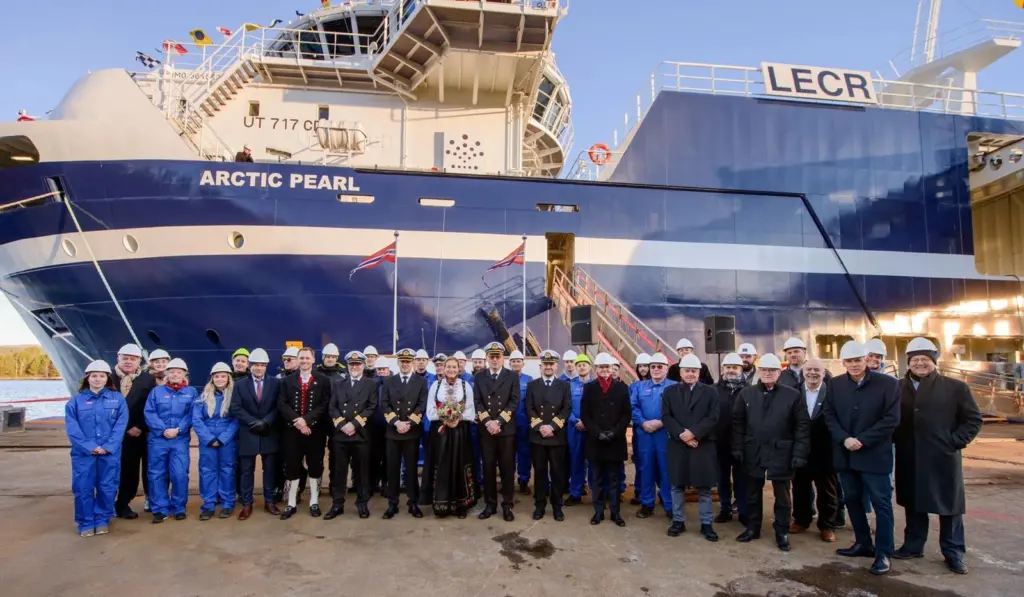
She christened the ship Arctic Pearl at Fiskerstrand wharf outside Aalesund, Norway. The ship is a former oil service vessel now reinvented as a fishing vessel.
“We are delighted so many of our most important partners and supporters could be her today and mark the occasion with us. This is the start of the next phase in this project, and a historic day for Norwegian fisheries,” said Øystein Tvedt, CEO of Ava Ocean.
Arctic Pearl will not only commence a fishery on a seafood delicacy that has been absent from the Norwegian seafood portfolio for decades, but also perform a thorough research project documenting development and impact on flora and fauna in collaboration with the Norwegian Institute of Marine Research.
“The goal is to prove not only that we have developed a gear able to efficiently pick shells from the seabed, but also that it is possible to harvest without harming the ecosystems on the seabed or the recruitment of new shells over time. It is the only way we will be able to establish a truly sustainable long-term fishery, both from an environmental and economic perspective,” Tvedt said.
During the five-year research quota, Ava Ocean wants to show the world that it is possible to enjoy more of the many food resources abundant on the seabed, without negatively impacting their fragile ecosystems.
It highlighted that there are few or no real alternatives to dredging, which is illegal in Norway, but still the most widely used method to fish bottom-dwelling seafoods internationally.
The international potential of Ava Ocean’s innovative ocean tech solutions was recently highlighted in Forbes Magazine, listing Ava Ocean as one of five green Norwegian companies to watch.
“We are experiencing a lot of interest for our project and what we are aiming to do also outside of Norway. We hope that we will be able to share good results from our activity in the Barents Sea which will give grounds for international expansion, both in other locations and for other species,” Tvedt said.
“We have great faith in this project and can’t wait to start fishing, but we are also prepared for it taking a little time before all cogs of the machinery functions optimally.”
Related Articles
 FISHERIES
 FISHERIES
 SEAFOOD